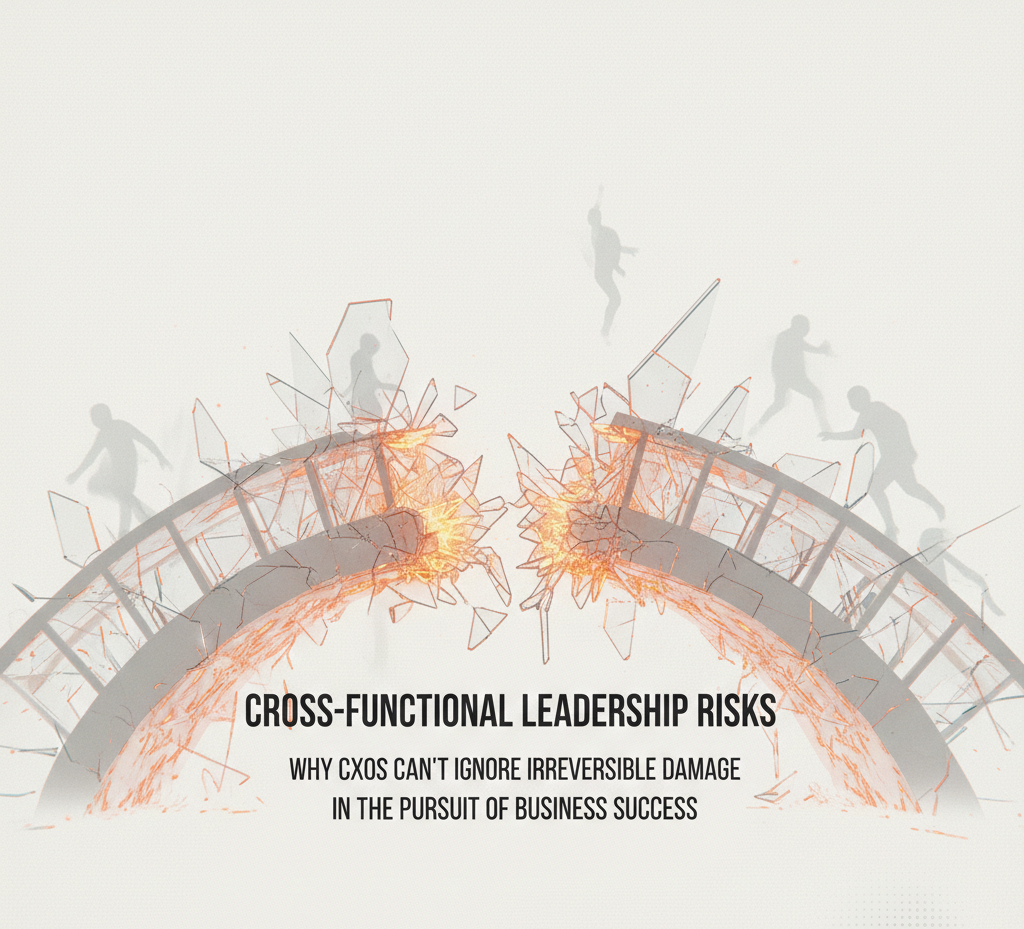
Cross-functional leadership risks have evolved into existential threats in an AI-accelerated world,where matrixed organizations and rapid transformation amplify both opportunities and vulnerabilities. As enterprises dismantle silos to harness generative AI and agentic workflows,CXOs face a stark reality: unmanaged cross-functional dynamics don’t merely erode efficiency—they trigger permanent fractures in culture, trust, and market position. In 2026, cross-functional leadership is non-negotiable for navigating complexity, yet treating it as an unqualified virtue is executive malpractice. The choice is binary: govern these risks with rigor or invite irreversible decline.
Executive Summary
Cross-functional leadership accelerates innovation and adaptability, with AI-augmented teams delivering breakthrough ideas at triple the rate of traditional setups. However, unmanaged cross-functional leadership risks cultural fragmentation, decision paralysis, ethical drift, incentive conflicts, and emerging AI-induced biases inflict lasting damage in global coporations. CXOs must deploy explicit governance, stress testing, and accountability mechanisms. In the age of cybernetic teammates, ignoring these risks isn’t optimism, it’s obsolescence.
Table of Contents
Why Cross-Functional Leadership Is Mandatory in 2026, Yet Perilously Fragile!
Enterprises today grapple with interconnected value chains, regulatory volatility, and AI-driven disruption. No function operates in isolation; outcomes demand integrated execution. Yet adoption remains superficial. While leading firms leverage cross-functional models for agility, Gallup’s 2025 State of the Global Workplace report reveals global employee engagement stagnated at 21%, with disengagement costing trillions in lost productivity annually as much is attributable to misaligned collaboration and managerial burnout.
CXOs who impose collaboration without resolving power imbalances, mismatched incentives, or unclear decision authority foster facade alignment. Beneath it lies accumulating risk with eroded trust, talent exodus, and regulatory exposure that no retrofit can undo.
Cross-Functional Leadership as a Multiplier When Governed Ruthlessly
Mastered properly, cross-functional leadership becomes a decisive edge.
A 2025 field experiment at Procter & Gamble demonstrated that AI-augmented cross-functional teams were three times more likely to generate top-decile breakthrough innovations compared to human-only teams or individuals with AI. This “cybernetic teammate” effect, where AI bridges expertise gaps it multiplies human diversity; yielding superior balance and creativity.
Amazon’s constrained, outcome focused teams and Apple’s structured conflict under centralized authority exemplify disciplined execution. Organizations prioritizing explicit governance in collaboration achieve materially higher innovation ROI and faster market delivery.
The caveat: these successes stem from rigorous design, not mere assembly. Replicating structures without the underlying accountability invites cross-functional leadership risks to dominate.
Core Cross-Functional Leadership Risks CXOs Routinely Underestimate
- Cultural Fragmentation and Accelerated Talent Flight
- Forcing divergent subcultures—engineering’s precision versus sales’ urgency—into proximity without integration breeds resentment. In 2026, AI tools exacerbate this by automating routine tasks, displacing roles unevenly across functions and intensifying territorial friction.
- Gallup’s 2025 data shows manager engagement declining faster than employee levels, driving cascading disengagement. Once top talent departs, institutional knowledge vanishes permanently.
- Decision Paralysis Masked as Inclusivity
- Consensus rituals in cross-functional settings often mask diluted accountability, stalling velocity. Boeing’s persistent safety lapses post 737 MAX stemming from commercial pressures overriding engineering scrutiny illustrate how ungoverned dynamics lead to catastrophic, reputation shattering outcomes.
- Ethical Erosion and AI-Amplified Incentive Conflicts
- Incompatible metrics across functions blur ethical lines. Add AI agents optimizing local objectives, and risks compound leading to biased algorithms that perpetuate misalignments, inviting regulatory backlash.
- Volkswagen’s emissions scandal arose from cross-functional target pressures without unified oversight. In today’s environment, similar lapses yield not just fines but existential threats.
- Capital Misallocation and Compounded Value Destruction
- Assumed synergies in cross-functional transformations often mask waste. GE’s overambitious integrations under Immelt created opacity and massive shareholder erosion. With AI investments surging, ungoverned cross-functional pursuits risk squandering billions on unproven scale.
A Practical Framework to Surface and Mitigate Cross-Functional Leadership Risks
Elite CXOs don’t wish away risk they expose it preemptively.
- Begin with structural hygiene: Deploy RACI matrices relentlessly to eliminate ambiguity.
- Assign singular accountability per initiative, irrespective of contributors.
- Conduct scenario-based stress testing: Model outcomes under talent disengagement, AI-induced biases, or regulatory shifts.
- Quantify intangibles attrition costs, decision latency, hand-off errors, trust metrics.
- Incorporate AI governance early: Define how agentic tools align with cross-functional goals, preventing sub-optimization.
Netflix’s radical candor and performance calibration prevent decline through early signals. Theranos’s suppression of dissent offers the counter-lesson: narrative over evaluation equals collapse.
The 2026 Fault Line: AI as Cybernetic Teammate Velocity Versus Control
AI redefines cross-functional tradeoffs. While it empowers individuals to mimic team diversity, combining it with human cross-functional teams yields exponential gains; yet introduces new risks like over-reliance on opaque models or amplified group thinkings.
Uber’s speed-first culture fueled growth but birthed governance voids. Balanced scorecards, external audits, and independent oversight aren’t bureaucratic, they’re survival tools.
Forrester and McKinsey analyses highlight persistent overconfidence in collaborative maturity. In 2026, this delusion ranks among the deadliest cross-functional leadership risks.
Cross-Functional Leadership as the Ultimate CXO Litmus Test
Cross-functional leadership isn’t elective; it’s the arena where executive judgment is tested daily. In an AI-augmented era, the question isn’t collaboration’s necessity, it’s your willingness to confront the irreversible damage unmanaged risks inflict.
Enduring organizations are forged by CXOs who evaluate trade-offs mercilessly, intervene preemptively, and architect systems prioritizing accountability over optics. Those who falter learn too late that certain fractures lost trust, departed talent, shattered reputations defy repair.
Your tenure will be defined not by the teams you assembled, but by the risks you governed or ignored.
Disclaimer – This article draws on publicly available research and analyses as of January 2026. It is for informational purposes only and does not constitute professional, financial, legal, or investment advice. Views expressed are independent and may evolve with new data & information.