
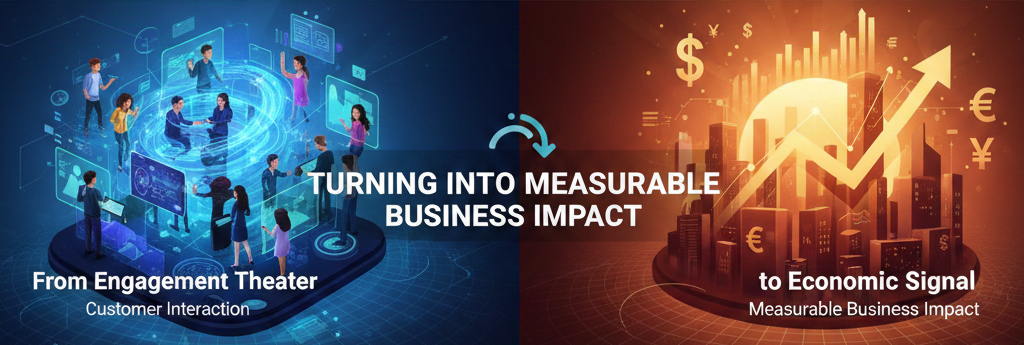
From engagement theatre to economic signal with customer is treated as article of faith in most boardrooms. Dashboards glow with NPS scores, app DAUs, click-through rates, and campaign attribution charts dense enough to intimidate a data scientist. The assumption is implicit and rarely challenged: more engagement equals more value.
After nearly two decades operating inside regulated, multi-country payments businesses across APAC, I no longer accept that assumption. I have seen organizations with world-class engagement metrics quietly destroy margin. I have also watched others with modest, almost non-glamorous customer interaction outperform peers on cash generation, renewal durability, and regulatory survivability. The difference was never how much customers engaged. It was whether engagement was engineered as an economic signal or left as theater.
This article examines the uncomfortable trade-offs leaders face when attempting to convert customer engagement into measurable business impact. Not marketing impact. Not sentiment. P&L impact. And why most engagement strategies fail precisely because they avoid those trade-offs.
Table of Contents
Engagement as Growth Narrative vs Engagement as Economic Instrument
Every executive deck eventually reaches the same slide: “Improving Customer Engagement to Drive Growth.” It sounds benign. Strategic. Unassailable.
The problem is that engagement, when framed as a growth narrative, becomes non-falsifiable. Any metric can be rationalized post-hoc. If revenue rises, engagement “worked.” If revenue falls, engagement was “long-term brand investment.” No one is accountable.
Contrast this with engagement as an economic instrument, a lever designed to move specific financial outcomes: margin expansion, cost-to-serve reduction, renewal predictability, or risk containment.
I learned this the hard way while leading a regional payments product that served SMEs across South Asia. Our engagement numbers were objectively strong: high portal logins, frequent feature usage, and positive CSAT. Yet contribution margin declined quarter after quarter. The root cause was not pricing or volume. It was who was engaging and why.
Our most “engaged” customers were operationally expensive: fragmented transaction profiles, high exception handling, frequent compliance queries, and custom workflow demands. Engagement was correlating with cost amplification, not value creation.
The trade-off became unavoidable:
- Optimize for engagement volume and look successful on dashboards.
- Or constrain engagement to economically aligned behaviors and accept lower headline metrics.
We chose the latter. Engagement dropped. Margin recovered. No one applauded, but the P&L stopped bleeding.
Lesson: Engagement without economic intent is a vanity asset. Leaders must decide whether they want affirmation or control.
Personalization Depth vs Operational Scalability
Personalization is the crown jewel of modern customer engagement. AI-driven recommendations, tailored journeys, bespoke reporting, each promises relevance at scale. In regulated financial infrastructure, this promise collides with reality. Every layer of personalization introduces operational surface area: exception paths, approval matrices, compliance interpretation, and reconciliation complexity. What looks like customer-centricity in isolation often manifests as organizational fragility.
I once approved a highly personalized onboarding flow for mid-market merchants expanding cross-border. Conversion improved by double digits. The sales team celebrated. Six months later, compliance costs had doubled. Manual reviews spiked. Audit exposure increased. Product releases slowed because edge cases multiplied faster than engineering could absorb.
The uncomfortable truth emerged: personalization had outpaced institutional maturity.
The trade-off leaders must confront is not personalization versus standardization. It is personalization velocity versus operational half-life.
You can personalize aggressively:
- If your compliance tooling is modular.
- If your data lineage is auditable.
- If your operating model can absorb entropy.
Most organizations cannot.
We eventually rolled back large portions of the experience, standardizing flows by risk tier rather than customer persona. Engagement dipped. But operational resilience improved, and regulatory conversations became boring again, a vastly underrated outcome.
Lesson: Engagement that cannot survive audit scrutiny is not innovation. It is deferred liability.
Behavioral Metrics vs Economic Accountability
Engagement teams love behavioral metrics: time-on-platform, feature adoption, session frequency. They are immediate, granular, and emotionally satisfying. Finance does not care. The CFO wants to know whether engagement changes:
- Net revenue retention
- Gross margin per account
- Cost-to-serve trajectory
- Working capital velocity
The gap between these worlds is where most engagement strategies die.
In one organization, we attempted to bridge this gap by tying engagement initiatives directly to economic hypotheses. For example:
If customers adopt automated reconciliation within 60 days, exception handling costs will fall by X%, improving gross margin by Y basis points.
This forced discipline. Some engagement programs were killed before launch because no credible economic linkage could be articulated. Others survived, but were tightly scoped. What surprised the team was how few engagement behaviors actually moved financial outcomes. Most were neutral. Some were negative.
The trade-off is cultural:
- Preserve engagement teams as creative, loosely governed engines.
- Or subject them to the same economic scrutiny as sales and operations.
Once we chose scrutiny, engagement became quieter. Smaller. More effective.
Lesson: If engagement cannot be translated into an economic hypothesis, it should not be funded at scale.
Relationship Capital vs Contractual Reality
Enterprise leaders often conflate engagement with relationship strength. Dinners, events, roadmap sessions, executive check-ins, these feel like investments in loyalty. Sometimes they are. Often they are avoidance mechanisms.
I have watched deeply “engaged” enterprise customers churn the moment commercial terms tightened or compliance obligations increased. Relationship capital evaporated on contact with contractual reality.
True economic engagement shows up differently:
- Will the customer absorb a price increase without re-bidding?
- Will they commit volume forecasts contractually?
- Will they co-invest in integration or regulatory change?
These are not sentimental gestures. They are economic commitments.
The trade-off leaders face is stark:
- Optimize engagement for goodwill and perceived partnership.
- Or anchor engagement to enforceable, reciprocal obligations.
In one painful negotiation, we declined a long-standing client’s request for bespoke features unless they committed to minimum volume thresholds. The relationship cooled. Escalations followed.
Six months later, the same client returned, having failed to extract similar concessions elsewhere. The relationship that survived was smaller, but economically honest.
Lesson: Engagement that avoids commercial friction is not trust. It is procrastination.
Short-Term Signal vs Long-Term Optionality
Engagement metrics are seductive because they move quickly. Revenue, especially in regulated markets, does not. This creates a bias toward optimizing what can be seen rather than what compounds.
Some of the most valuable engagement decisions I have made looked irrational in the short term:
- Removing features used heavily by low-margin customers.
- Slowing onboarding to improve risk stratification.
- Forcing self-serve paths that reduced “white-glove” satisfaction.
Each decision depressed engagement metrics initially. Each improved long-term optionality: cleaner customer mix, faster scalability, and regulatory credibility.
The trade-off is psychological as much as strategic. Leaders must tolerate periods where engagement appears worse while the business becomes structurally stronger. Few organizations have the governance patience to do this.
Lesson: Engagement that optimizes short-term signal often mortgages long-term freedom.
What Actually Works: Re-framing Engagement as an Economic System
Across multiple cycles, geographies, and regulatory regimes, a few principles consistently held:
- Start with P&L, not personas. Define the economic outcome first. Design engagement backward.
- Segment by cost-to-serve, not enthusiasm. Your most vocal users are rarely your most valuable.
- Attach kill criteria to engagement programs. If the economic signal does not materialize, shut it down.
- Instrument friction deliberately. Where engagement feels harder, ensure the business becomes stronger.
- Reward teams on financial delta, not activity. Otherwise, motion will masquerade as progress.
None of this is glamorous. None of it photographs well for investor decks. All of it compounds.
Outlook: Engagement Under Constraint
Looking ahead, three forces will reshape how serious organizations treat customer engagement:
- Regulatory tightening will penalize uncontrolled customization and undocumented workflows.
- Margin compression will expose engagement models that amplify cost faster than revenue.
- Capital discipline will force clearer ROI thresholds across all customer-facing initiatives.
In this environment, engagement theater will not survive budget reviews. Engagement engineered as an economic system will.
Leaders who adapt early will enjoy quieter dashboards and far stronger businesses.
Customer engagement is not a virtue. It is a tool. Used carelessly, it distracts, inflates cost, and obscures accountability. Used precisely, it becomes one of the few levers capable of reshaping unit economics without burning trust.
The difference is not technology or intent. It is executive judgment and the willingness to disappoint metrics in service of reality.
Disclaimer: This article reflects professional insights based on publicly available information and anonymized industry experience. The views expressed are personal and do not constitute financial, regulatory, or investment advice.