
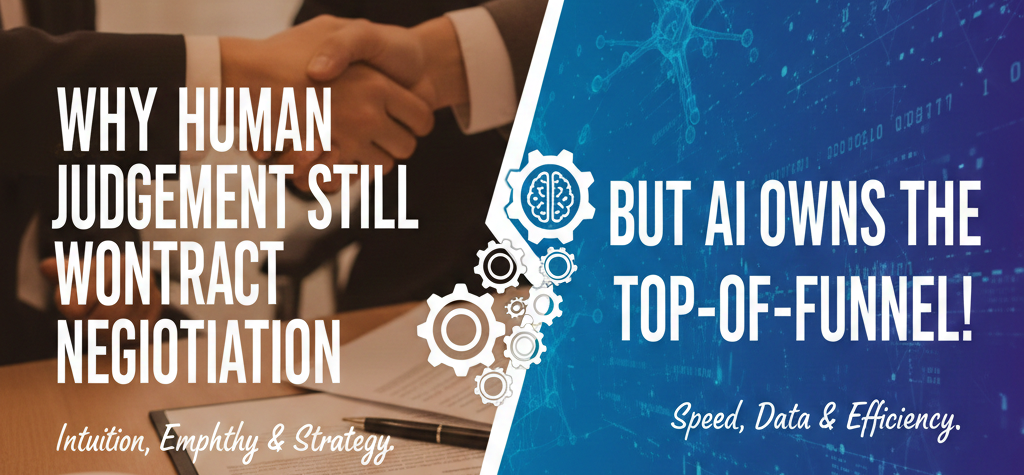
AI in Enterprise Contract Negotiation conversation has matured. The question is no longer whether AI can draft clauses or suggest redlines. It can.
The real question is governance: Where must optimization stop and executive accountability begin?
In enterprise payments and cross-border fintech, contracts do not simply close revenue. They allocate:
- Regulatory exposure
- Operational resilience obligations
- Revenue recognition timing
- Liquidity and settlement risk
- Data protection liability
In APAC markets, operational resilience guidance, safeguarding requirements, and cross-border supervisory expectations can shift interpretive weight months after a deal is signed. A clause considered commercially standard today may be scrutinized tomorrow under new regulatory circulars.
AI optimizes for pattern alignment. But Regulators assess individual responsibility.
That distinction defines the boundary.
Table of Contents
Executive Summary
AI now decisively dominates the top-of-funnel in enterprise sales and procurement. Agentic systems handle segmentation, scoring, outreach personalization, qualification, contract parsing, and deviation detection at scale. The result: compressed CAC, higher pipeline velocity, and reduced operational drag.
But contract negotiation in enterprise payments, fintech infrastructure, and regulated cross-border markets is not a workflow exercise. It is a capital allocation decision. Indemnity caps, SLA penalties, termination triggers, safeguarding clauses, FX exposure allocation, and regulatory fallback language determine margin durability and balance sheet risk. AI can benchmark clauses and simulate outcomes. It cannot reliably evaluate asymmetric exposure, political authority structures, or regulatory interpretation shifts.
Industry benchmarks show average post-signature value leakage of 8-9%, with financial services often at the higher end due to complex compliance obligations. AI-native contract lifecycle systems can materially reduce leakage, when deployed with disciplined governance and strong guard rails. Without boundaries, however, optimization logic migrates upstream into pricing and concession strategy, eroding margin under the banner of efficiency.
The mature approach is clear:
Let AI own volume and standardization.
Reserve discretionary risk decisions for accountable humans.
In regulated enterprise environments, velocity without governance becomes margin leakage at scale.
Velocity vs Margin Durability
AI-driven top-of-funnel systems deliver measurable gains:
- 30-40% pipeline growth in automated roll-outs
- Shortened qualification cycles
- Lower acquisition cost per qualified lead
- Standardized messaging across markets
On dashboards, this looks like operational excellence.
In one mid-market rollout I led, automation materially increased qualified deal volume. Sales teams could focus on closing. Forecast visibility improved. Revenue accelerated.
What changed quietly was negotiation posture. Uniform outreach logic created visible pricing bands. Prospects began negotiating inside our optimization model. Anchor flexibility narrowed. Concessions became data-guided rather than judgment-led.
Six months later, gross margin across that segment compressed 6-8%. Nothing dramatic. Nothing catastrophic. Just consistent micro-erosion across dozens of deals. Revenue growth masked it temporarily. EBITDA did not. That was not an AI failure. It was a governance failure.
We allowed throughput optimization to influence concession strategy without margin guardrails. Velocity improved. Margin discipline weakened. That trade-off is real.
Why Contract Negotiation Is Not a Pattern-Matching Exercise
AI performs exceptionally well in:
- Clause extraction and comparison
- Redlining detection
- Deviation from playbook flagging
- Obligation tracking post-signature
- Bench-marking indemnity caps against market norms
These capabilities reduce execution leakage and compliance gaps. They should be deployed aggressively. But enterprise negotiation breaks in edge cases.
In one cross-border licensing negotiation, a counter party insisted on expanding indemnity language under the justification of “regulatory alignment.” AI bench-marking suggested the clause remained within sector norms. The context was not. The jurisdiction in question had evolving supervisory interpretations around safeguarding and downstream liability. If accepted, the clause would have shifted exposure asymmetrically to us in the event of a partner compliance failure.
The model saw similarity. Experience saw tail risk.
Contracts fail in edge conditions:
- Liquidity stress
- Political regime shifts
- Regulatory reinterpretation
- Banking partner withdrawal
- Data breach escalation
Models optimize for median probability. Boards worry about extreme outcomes. “The system recommended it” is not a defensible position in a regulatory inquiry.
The Measurable Risk of Overreach
Allowing AI optimization logic to influence discretionary negotiation decisions introduces three structural risks.
1. Margin Erosion Through Incremental Concessions
Predictive close-rate optimization tends to nudge toward incremental flexibility. Across volume, these adjustments compound. Individually negligible. Collectively material. In high volume mid-market segments, this effect alone can compress blended margins several percentage points over time.
2. Risk Mispricing in Complex Jurisdictions
Bench-marking “market standard” indemnity caps ignores jurisdiction-specific enforcement environments. A 12-month liability cap in one market does not carry the same regulatory implication in another. AI flags deviation. It does not evaluate enforcement appetite.
3. Authority Signal Dilution
Enterprise negotiation is partially psychological. Counter parties assess authority structures quickly. If concession logic appears automated, escalation behavior increases. In multimillion-dollar cross-border contracts, perceived authority often determines final economics more than data modeling. Automation can reduce perceived firmness.
Where AI Should Dominate Without Hesitation
There is no strategic advantage in resisting AI at the top-of-funnel.
AI should own:
- Ideal customer profiling
- Segmentation clustering
- Outreach optimization
- KYC triage
- Template generation
- Standard deviation detection
- Post-signature obligation monitoring
These functions reduce operational waste and free experienced negotiators to focus on asymmetric risk.
The mistake is not adoption. The mistake is boundary ambiguity.
Segmented Governance: The Only Scalable Model
Organizations that scale safely implement explicit tiering:
Segmented Governance: Tiered AI–Human Authority Model
| Tier | Deal Type | AI Authority | Human Authority | Guardrails |
|---|---|---|---|---|
| Volume / Standard | Low-risk, mid-market | Drafting, bench-marking, deviation flagging | Final sign-off | Hard margin floors, strict clause libraries |
| Strategic / High-Value | Cross-border, regulated, multi-million, novel structures | Analysis, scenario modeling, risk alerts | Lead negotiation, concession sequencing, exposure ownership | Risk committee review, regulatory impact assessment |
Without segmentation, two failures occur:
- Over-humanization wastes efficiency.
- Over-automation institutionalizes risk.
Here Governance maturity, not AI capability becomes the differentiator.
Expansion Without Abdication
Agentic AI will expand into:
- Real-time negotiation assistance
- Sentiment modeling
- Dynamic clause risk scoring
- Automated fallback drafting
These tools will increase speed. They will not absorb accountability. Regulators will continue to assess named executives. Boards will continue to scrutinize margin durability. Shareholders will not accept “model drift” as a justification for EBITDA compression.
The competitive advantage will not be who adopts AI fastest. It will be who defines its decision boundaries most clearly.
Conclusion
AI Accelerates Revenue. Humans Defend Enterprise Value. AI owns the top-of-funnel because scale, repetition, and pattern recognition are computational strengths. Enterprise contract negotiation allocates capital, defines exposure, and shapes long-term profitability. That responsibility cannot be delegated to systems optimized for historical probability.
AI should inform. Humans must decide.
In regulated enterprise payments and fintech infrastructure, the boundary between suggestion and accountability is not philosophical. It is financial. Velocity without governance does not create advantage. It creates scalable leakage.
Disclaimer:
This article reflects professional insights based on publicly available information and anonymized industry experience. The views expressed are personal and do not constitute financial, regulatory, or investment advice.