
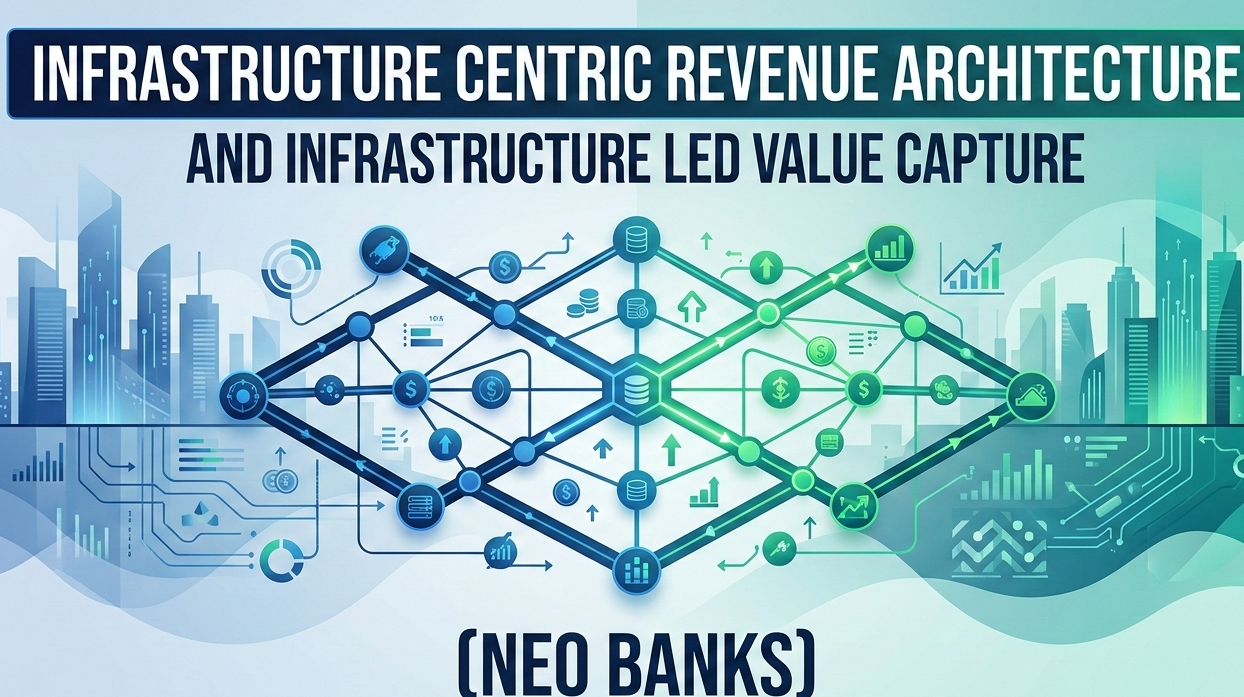
Infrastructure-Centric Revenue Architecture and Infrastructure-Led Value Capture Beyond Digital-First Banks mark the transition from fintech as a user-experience insurgency to fintech as a systems-level capital control strategy. Over the past decade, digital-first banks demonstrated that branchless onboarding, fee transparency, and mobile-native design could scale into the tens of millions of users. Several achieved multi-billion-dollar revenue run rates and, in leading cases, sustained profitability.
But distribution was only phase one. Phase two asks a harder question: Once digital access is normalized, where does structural financial power accumulate?
The answer increasingly lies beneath the interface layer, within payment processors, orchestration platforms, compliance engines, identity stacks, and programmable settlement frameworks that monetize flows rather than brands. We are witnessing the migration of margin from visibility to infrastructure.
Table of Contents
Executive Summary
Infrastructure centric Revenue Architecture and Infrastructure led Value Capture Beyond Digital-First Banks (NEO Banks) define the structural migration of enterprise value from consumer facing fintech interfaces to the control layers that move, verify, settle, and regulate capital. The digital-bank cycle proved distribution could be digitized and scaled. It did not prove that interface ownership alone delivers durable margin control. As public and private markets increasingly reward revenue quality, regulatory insulation, and recurring throughput-based economics, valuation gravity is consolidating around infrastructure operators. The defining competitive question of the next decade is not who owns the customer, it is who owns the rails, compliance abstraction, data gravity, and settlement orchestration that monetize every transaction regardless of brand.
The Capital Market Signal: Revenue Quality Over Revenue Volume
Capital markets have quietly repriced fintech models over the past several years. Infrastructure oriented platforms have generally commanded:
- Higher gross margins, Recurring transaction based revenue, Multi-product attach rates, Lower churn, and Embedded switching costs.
Consumer heavy models, by contrast, often exhibit:
- High customer acquisition costs, Margin compression from interchange dependency, Regulatory exposure tied to lending cycles, and Preference driven churn.
Even when revenue growth rates appear similar, the composition of revenue now determines valuation premium. Revenue volume attracts attention. Revenue architecture commands multiple expansion. This is not sentiment. It is structural repricing.
The Structural Constraints of Digital-First Banks
The digital-bank thesis rested on three economic levers:
- Low-cost acquisition via digital channels
- Interchange and net interest income expansion
- Cross-sell into lending, insurance, and wealth
However, structural friction emerged:
- Interchange economics are thin and regulatory-sensitive.
- Net interest margins compress in tightening liquidity cycles.
- Marketing arbitrage becomes competitive and expensive.
- Credit exposure introduces cyclicality.
- Profitability timelines extend beyond venture patience and public-market tolerance.
Leading players have adapted and strengthened their models. But the broader category illustrates a reality: distribution alone does not secure durable economic control. Experience is now commoditized. Infrastructure is scarce.
What Infrastructure Centric Revenue Architecture Actually Means?
Infrastructure-centric revenue architecture is not a feature expansion. It is an economic positioning decision. It means controlling:
- Transaction routing and orchestration
- Multi-rail settlement logic
- Compliance and licensing abstraction
- Identity verification frameworks
- Risk scoring engines
- Ledgering systems
- Treasury automation layers
Rather than charging end users, infrastructure operators monetize:
- Every transaction processed
- Every compliance check executed
- Every cross-border settlement
- Every API call
- Every embedded financial product launched
This is monetization of flow, not monetization of preference.
Why Value Migrates Downward in the Stack?
- Embedded Finance Expands Throughput
- As marketplaces, SaaS platforms, logistics firms, and vertical software companies integrate financial capabilities, transaction volume multiplies. The brand at the surface owns the user. The infrastructure layer monetizes the economic activity. Over time, embedded finance ecosystems can generate transaction throughput exceeding standalone neobank flows without bearing consumer acquisition cost.
- Regulatory Complexity Centralizes Power
- AML, KYC, sanctions screening, data localization, and cross-border licensing requirements increase annually. Infrastructure providers that abstract regulatory complexity create durable switching costs. Owning regulatory abstraction is equivalent to owning enterprise dependency.
- Data Gravity Resides at Processing Layers
- The interface sees identity. The infrastructure layer sees behavior.
- Processing layers accumulate: Fraud signatures, Cross-border risk patterns, Merchant performance signals, and Liquidity timing data.
- This data becomes underwriting advantage, pricing precision, and embedded credit expansion opportunity. Infrastructure converts operational exhaust into economic leverage.
- The interface sees identity. The infrastructure layer sees behavior.
- B2B Revenue Outperforms Consumer Volatility
- Enterprise contracts tied to throughput scale with economic activity. Consumer accounts tied to preference fluctuate with sentiment.
- B2B infrastructure revenue often exhibits:
- Higher net retention
- Multi-year contractual depth
- Embedded operational integration
- Lower marketing dependency
- In uncertain macro cycles, revenue durability commands premium valuation.
Revenue Architecture Beyond Digital-First Banks: The Five-Layer Model
Financial ecosystems can be simplified into five layers:
- Interface: Apps, wallets, digital banks
- Product: Lending, cards, deposits
- Orchestration: APIs, banking-as-a-service
- Settlement: Payment rails, clearing networks
- Infrastructure Core: Identity, compliance, risk, ledgering
The first fintech cycle innovated at Layer 1. The second is consolidating at Layers 3-5. The closer you are to settlement and compliance control, the closer you are to economic gravity.
The Infrastructure Monetization Layer
The Infrastructure Monetization Layer represents the compounding effect of programmable financial plumbing. It includes: Usage-based billing models, Revenue share on throughput, Cross-border FX spreads, Compliance-as-a-service modules, Risk scoring subscriptions and Embedded treasury products.
Each module individually generates revenue. Collectively, they create a flywheel. Interface monetization is episodic. Infrastructure monetization is cumulative.
Implications for SVP Sales and CRO Leadership?
Enterprise Motion Becomes Dominant. Winning in infrastructure revenue requires:
- CTO-level selling
- CFO aligned ROI modeling
- Regulatory confidence
- Integration depth
- Platform reliability guarantees
Sales cycles extend, Deal sizes expand and Integration creates lock-in. But Revenue predictability improves.
Board Metrics Shift
Boards now ask:
- What percentage of revenue is recurring?
- What is net revenue retention?
- How much revenue scales automatically with throughput?
- Where does regulatory risk concentrate?
- How embedded are we in customer workflows?
These are architecture questions, not marketing questions.
Three Predictions for the Next Decade
- A meaningful percentage of digital-first banks will evolve into distribution layers atop infrastructure providers rather than independent economic engines.
- Infrastructure providers will vertically integrate risk and treasury layers to capture margin previously reserved for banks.
- The highest multiple fintech companies will increasingly resemble regulated financial operating systems rather than consumer brands.
The first fintech wave democratized access. The second will centralize economic control.
The Realignment of Financial Gravity
The migration of financial power rarely announces itself. It reveals itself in margin composition. Digital-first banks proved that friction could be removed from onboarding. Infrastructure operators are proving that friction can be monetized when abstracted and scaled.
If you do not control routing, compliance abstraction, settlement logic, or data gravity, you are not designing revenue architecture and you are participating in someone else’s.
The future of fintech is not about who owns the interface. It is about who controls the invisible systems that make every interface possible. In a fully embedded financial world, visibility may drive attention. Infrastructure will drive enterprise value.
Disclaimer: This article presents strategic analysis for executive discussion purposes only and does not constitute financial, investment, or legal advice. Market observations and valuation patterns are derived from publicly available information; interpretations and outcomes may vary materially by jurisdiction, regulatory environment, and company-specific execution and independent due diligence is strongly recommended prior to any capital allocation or strategic decisions.