
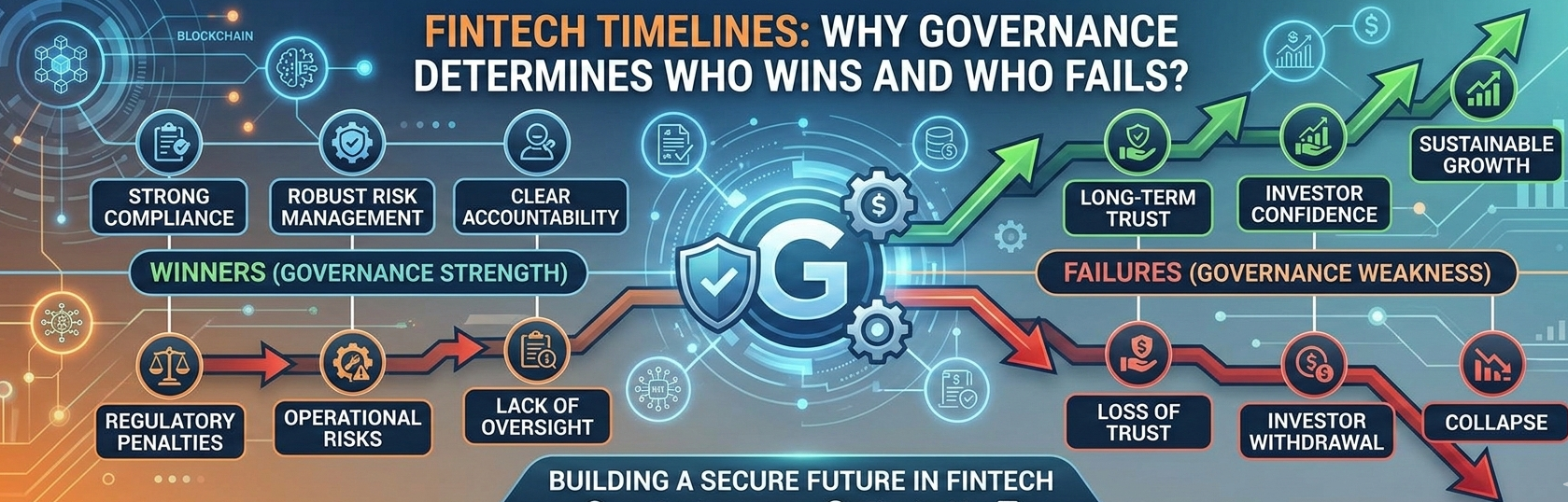
Fintech Timelines are not project management artifacts they are governance declarations about how an institution understands risk, authority, and capital discipline. In global payments, embedded finance, cross-border infrastructure, and regulated digital assets, timelines are rarely neutral. They signal whether leadership respects operational reality or prefers narrative convenience. They reveal whether accountability matches decision rights. And they expose whether a board governs execution or simply celebrates ambition.
Over the past decade, fintech scaled under abundant capital and aggressive growth mandates. Speed was rewarded. Market entry trumped structural readiness. Investor updates often dictated launch calendars. But as capital has tightened and regulatory posture has hardened particularly across Asia Pacific, the EU, and major scheme ecosystems, timeline failure has shifted from cosmetic embarrassment to enterprise risk.
This article examines why fintech timelines fail, how competition both sharpens and distorts execution, and why governance not urgency, ultimately determines who wins.
Table of Contents
Executive Summary
Fintech Timelines fail when governance is subordinated to narrative, and they succeed when authority, accountability, and capital discipline are structurally aligned. Missed delivery dates are rarely caused by incompetence. They are typically the product of fictional deadlines, misaligned decision rights, hidden dependency stacks, and competitive panic layered onto fragile governance. In regulated financial markets, these failures compound into EBITDA erosion, regulatory remediation costs, reputational drag, and long-term valuation compression.
Competition is not inherently destructive. Properly understood, it is a forcing mechanism that compresses indecision and surfaces structural weaknesses. But speed without governance alignment produces second-order damage that often outweighs first-mover advantage. The institutions that consistently win are not the fastest. They are the fastest within their risk envelope.
The Structural Misconception: Timelines as Aspirations
Most timeline failures do not begin with operational weakness. They begin with institutional optimism detached from constraint reality. A fictional deadline typically emerges from one of three drivers: 1. Investor narrative pressure. 2. Board calendar alignment and 3. Competitive signaling.
Once established, the deadline becomes politically anchored. Challenging it is interpreted as resistance rather than risk management. At that moment, the timeline ceases to be an operational contract and becomes a symbolic commitment. The consequences follow predictably:
- Risk migrates downstream to teams without authority
- Dependencies are minimized in board reporting
- Exceptions begin replacing controls
- Delivery definitions are retroactively softened
In consumer applications, this may result in feature delays. In payments infrastructure, acquiring, issuing, or cross-border settlement corridors, the implications are materially different. Regulatory sequencing, scheme approvals, correspondent banking onboarding, and AML architecture cannot be negotiated by optimism. Reality eventually reasserts itself usually expensively.
The Fintech Timeline Failure Equation
Through repeated observation across infrastructure roll-outs and regional expansions, the pattern is consistent: Fintech Timeline Failure = Fictional Deadline, Authority Misalignment, Hidden Dependency Stack, Competitive Compression, and Governance Friction. Let us unpack this structurally.
- Fictional Deadlines: Dates approved without validated dependency mapping or regulatory clearance sequencing.
- Authority Misalignment: Decision rights remain distributed across committees while accountability for delivery is centralized.
- Hidden Dependency Stack: Third-party integrations, scheme certification windows, regulator response cycles, and vendor remediation are underweighted.
- Competitive Compression: A credible rival announcement triggers deadline acceleration without governance recalibration.
- Governance Friction Removal: Controls are quietly reframed as “process overhead.”
This combination does not create agility. It creates fragility.
Competition as a Governance Stress Test
Competition is frequently mischaracterized as motivational fuel. In reality, it functions as a stress test. When a credible competitor enters a corridor or launches a parallel capability, three structural weaknesses are exposed: Decision latency, Ownership ambiguity, and Process debt.
Healthy organizations respond by clarifying authority, narrowing scope, and reprioritizing capital. Fragile organizations respond by demanding speed without structural reform. The difference is not cultural energy. It is governance maturity. Competition should compress indecision, not bypass risk discipline.
Speed Within the Risk Envelope
In one APAC expansion scenario, a fintech attempted to match a competitor’s corridor launch timeline by overlapping compliance validation with product release. The initial revenue spike validated the decision superficially. Six months later, remediation costs, regulatory scrutiny, and partner friction erased 18 months of contribution margin. The competitor did not win because they were faster. They won because they were faster within their validated risk envelope.
This distinction is foundational. Speed outside the risk envelope generates negative convexity: downside accelerates faster than upside compounds.
The Capital Allocation Consequence
Timeline failure is often mis-categorized as operational inefficiency. It is fundamentally a capital allocation distortion. Consider the cascading financial impact:
- Delayed revenue recognition shifts NPV assumptions
- Remediation expenses compress EBITDA margins
- Partner friction increases integration cycle time
- Reputational drag raises enterprise sales CAC
- Board credibility erosion increases future cost of capital
In private markets, repeated timeline misses depress valuation multiples. In public markets, they amplify volatility and erode investor trust. Capital markets reward predictability more than optimism. A deliverable that lands on time within declared risk parameters enhances institutional credibility. A heroic acceleration followed by remediation erodes it.
Board-Level Governance: The Wrong Question
Boards frequently ask: “Are we moving fast enough?” The superior question is: “Is this timeline governable within our current authority structure?”
Governing timelines requires interrogation of: Explicit decision rights, Named risk owners, External dependency mapping, Regulatory sequencing validation, and Capital reserve buffers.
When boards reward aggressive commitments without validating execution mechanics, they unintentionally incentivize narrative inflation. Governance is not about slowing management. It is about protecting capital from structural overreach.
Incentive Distortion and Executive Behavior
Compensation architecture frequently exacerbates timeline risk. If revenue leaders are compensated primarily on launch velocity or short-term GMV targets, while compliance and risk teams are measured on incident avoidance, organizational friction becomes inevitable.
Absent structural alignment, speed becomes adversarial. Mature institutions align incentives such that:
- Delivery is rewarded only when risk thresholds are satisfied
- Revenue recognition requires compliance validation
- Regional expansion targets incorporate regulatory lead time
This is not bureaucratic caution. It is capital discipline.
The Slow Decay of Uncontested Environments
A more subtle risk emerges in the absence of competition. Uncontested environments breed timeline elasticity, Delivery windows expand, Dependency mapping grows casual, Escalation pathways soften, and Cultural tolerance for delay increases.
When competition eventually materializes, these organizations experience shock not because competitors are extraordinary, but because internal governance has atrophied. Complacency is rarely visible until compressed by external pressure. The cost of inaction is not neutral. It is cumulative.
Process Debt: The Silent Multiplier
Process debt accumulates when organizations repeatedly defer structural improvements in favor of tactical acceleration. Examples include:
- Manual reconciliation in scaling corridors
- Informal regulator communication pathways
- Vendor dependency without contractual performance alignment
- Integration without standardized API governance
Under timeline pressure, these shortcuts compound. When governance debt intersects with competitive compression, failure probability rises nonlinearly. Strong institutions treat process debt like financial leverage, useful in moderation, dangerous when unmonitored.
The Governance Operating System
The strongest fintech institutions share a common structural characteristic: they treat governance as an operating system, not a compliance overlay.
This operating system includes: Explicit authority maps tied to delivery milestones, Dependency registries reviewed at board level, Risk envelope definitions for each expansion corridor, Incentive structures aligned to validated delivery, and Escalation channels that reward early transparency.
In such environments, competition sharpens execution rather than destabilizing it.
Institutional Honesty as Competitive Advantage
At its core, timeline discipline is about institutional honesty.
- Honest dependency disclosure
- Honest regulatory sequencing
- Honest risk quantification
- Honest capital buffer planning
Organizations fail when they confuse confidence with control. Markets do not punish ambition. They punish misrepresentation of constraint. The ability to say, “This cannot be delivered within the current authority structure,” is not weakness. It is governance strength.
Conclusion
Fintech timelines matter because they reveal how seriously an institution respects constraint reality. Competition matters because it eliminates the illusion that time is abundant. But neither speed nor rivalry is inherently virtuous. What determines who wins is whether governance architecture can support decisive movement without distorting risk, authority, or capital discipline.
The strongest institutions do not fear compressed timelines. They interrogate them, they validate them, and they move only when governance and execution are aligned. In the long arc of enterprise value creation, credibility compounds faster than velocity.
Disclaimer: This article reflects professional insights based on publicly available information and anonymized industry experience. The views expressed are personal and do not constitute financial, regulatory, or investment advice.