
Executive Summary
Leadership Arbitrage the strategic exploitation of geographic misalignments in leadership capabilities, regulatory acumen, and executive compensation is fundamentally altering how global financial technology, cross-border remittance, and fintech companies scale. While cost-centric talent relocation offers immediate balance-sheet relief, it frequently introduces systemic organizational risks. In high-stakes sectors like cross-border payments, geographic fragmentation between executive decision-making and localized operational realities directly degrades organizational culture and fragments the corporate sustainability roadmap. To maintain long-term equity value, institutional investors, board members, and CXOs must pivot from purely transactional talent arbitrage toward a model of decentralized capability equity. This ensures that governance, compliance velocity, and cultural cohesion evolve in tandem with geographic expansion.
Table of Contents
Introduction
Leadership Arbitrage has quietly emerged as both an operational lever and a governance challenge within the global financial technology, cross-border remittance, and fintech sectors. Traditionally, financial technology companies viewed arbitrage through a purely operational lens thus offshoring engineering talent to South Asia or migrating customer success units to lower-cost hubs. However, intense margin compression in cross-border payments, combined with shifting macroeconomic realities, has pushed this practice straight into the executive suite.
Today, international payments networks and cross-border remittance firms frequently distribute their leadership footprints across distinct jurisdictions. They might place commercial strategy in financial capitals like Singapore, London, or New York, while anchoring regulatory engineering, treasury operations, and risk management in emerging delivery hubs. When executed purely as a cost-containment measure, this executive misalignment creates structural gaps. For CXOs, board members, and institutional investors, understanding how leadership arbitrage shapes corporate velocity, cultural integrity, and long-term viability is no longer just an operational detail it is a core fiduciary duty.
Defining Leadership Arbitrage in Financial Technology
In the context of global payments infrastructure, leadership arbitrage is defined as the deliberate distribution or relocation of executive management, strategic oversight, and specialized governance roles across varying geographies to capitalize on differentials in:
- Compensation and Total Cost of Ownership (TCO): Optimizing executive spend by placing senior leadership roles in markets with favorable tax regimes or lower baseline executive compensation.
- Regulatory Familiarity: Positioning compliance and legal leadership in specific jurisdictions to maintain proximity to key oversight bodies (e.g., MAS, FCA, FinCEN).
- Talent Density: Leveraging localized pools of deep domain expertise in niche verticals, such as real-time payments routing, foreign exchange (FX) liquidity management, and high-throughput transactional ledger architecture.
Unlike traditional talent sourcing, this approach partitions the executive stack itself. In cross-border remittance firms, it is common to see the Chief Commercial Officer based in a high-margin distribution market, the Chief Risk Officer situated in a strict regulatory sandbox, and the Chief Technology Officer managing execution from an engineering hub thousands of miles away.
The Cultural Impact: Fragmented Identity and Execution Drag
The primary casualty of unmitigated leadership arbitrage is an organization’s internal culture. In fast-moving sectors where clearing and settlement structures require instant cross-functional alignment, separating leadership roles geographically can easily fracture corporate identity.
- The “HQ vs. Satellite” Operational Friction: When strategic authority stays concentrated in primary financial hubs while operational execution is delegated to regional hubs, a subtle but damaging corporate caste system often develops. Regional leadership teams, who frequently handle the day-to-day realities of local payment rails and partner banks, can find themselves excluded from core strategic decisions. This isolation dampens entrepreneurial initiative, stalls local market responsiveness, and creates an environment of cautious execution rather than proactive innovation.
- Disconnect in Compliance Culture: In cross-border payments, compliance cannot operate as an isolated back-office function; it must be deeply embedded in product design. When senior risk and compliance leaders are geographically detached from the core product and commercial decision-makers, a dangerous cultural gap opens up. Commercial leaders may chase volume and rapid market acquisition, while risk teams look on with growing apprehension. This friction is not the healthy tension every business needs—it is a structural disconnect that can lead to systemic oversights in Anti-Money Laundering (AML) and Know Your Customer (KYC) frameworks.
- Dilution of Shared Mission: Fintech scale-ups thrive on shared intensity and clear, immediate feedback loops. Fragmenting leadership across time zones and cultural contexts often dilutes this shared focus. Corporate values can become abstract statements on an intranet page rather than principles lived out in day-to-day operations, making it significantly harder to retain top-tier local talent.
Impact on the Sustainability Roadmap and Long-Term Viability
For global payments providers, sustainability extends far beyond environmental metrics. A true fintech sustainability roadmap centers on systemic stability, financial inclusion, data security, and maintaining long-term institutional trust across borders. Transactional leadership arbitrage introduces distinct risks to these critical areas.
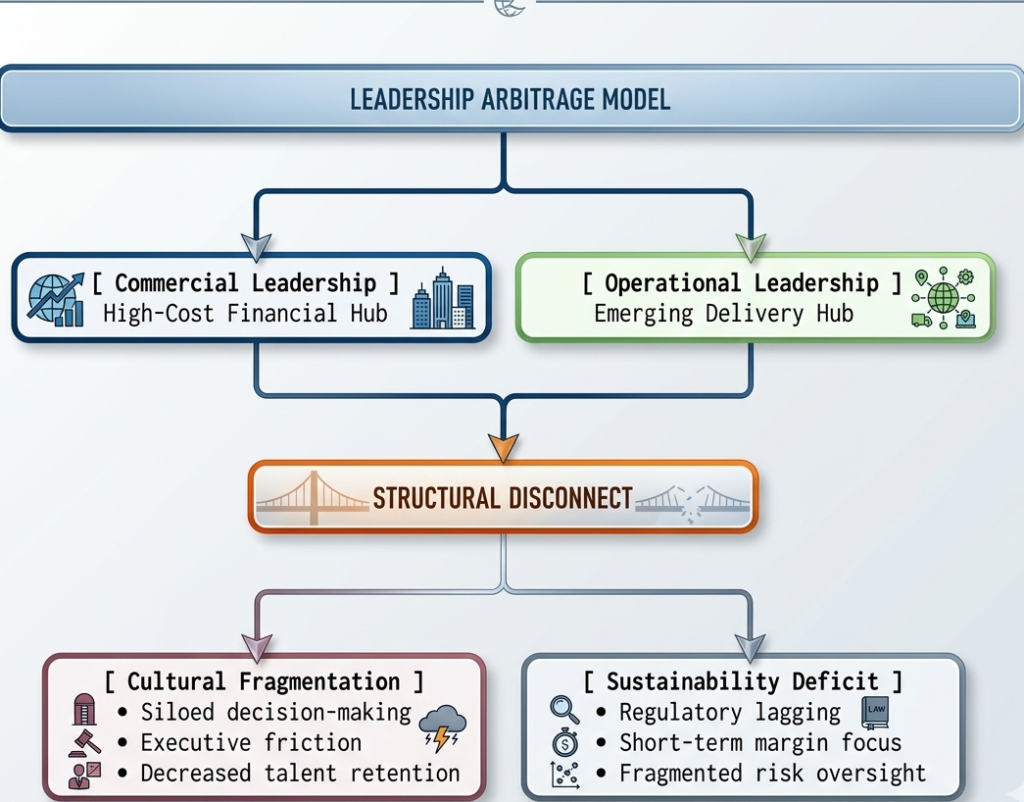
- Regulatory Resilience and Governance Gaps: Cross-border remittance relies heavily on a complex web of local licenses, correspondent banking relationships, and regional clearing systems. If executive leadership is too far removed from local regulatory realities, the organization tends to become reactive. Decisions are made based on high-level legal briefings rather than a nuanced, hands-on understanding of local enforcement trends. This lag leaves the firm vulnerable to sudden policy shifts, license suspensions, and unexpected compliance costs.
- Financial Inclusion vs. Short-Term Margin Pressures: A sustainable payments network balances profitable corridors with the development of lower-margin rails that drive broader financial inclusion. When commercial leadership is separated from the emerging markets they serve, strategy often skews heavily toward short-term margin optimization. This narrow focus can lead firms to under-invest in the localized alternative payment methods (APMs) and real-time payment networks that are essential for long-term growth and market relevance.
- Technical Debt and Systemic Security Risks: Core ledger systems, settlement engines, and cybersecurity infrastructure require sustained, visionary investment. When technical and operational leadership is managed through a cost-arbitrage lens, engineering teams are often treated as resource units rather than strategic partners. The result is a steady accumulation of technical debt, fragmented system architecture, and heightened operational risks directly undermining the reliability that global payments infrastructure demands.
Strategic Blueprint for Board Members, Investors, and CXOs
To prevent leadership arbitrage from turning into an operational liability, boards and executive teams must transition from basic cost optimization to a strategy centered on capability equity.
| Strategic Pillar | Transactional Arbitrage (High Risk) | Capability Equity (Sustainable) |
| Executive Placement | Based entirely on minimizing compensation and operational costs. | Based on proximity to key markets, major regulatory bodies, and core engineering infrastructure. |
| Governance Structure | Centralized authority at HQ; regional offices operate under strict, top-down directives. | Decentralized accountability with clear, localized autonomy for regional executive leaders. |
| Risk & Product Alignment | Compliance and product teams operate in separate geographic silos. | Co-located or tightly integrated cross-functional teams linking risk directly with product design. |
| Sustainability Metrics | Limited to high-level corporate governance policies managed from the center. | Embedded directly into regional operational KPIs and local product design choices. |
Recommendations for the Board and C-Suite:
Redefine Executive Proximity: Avoid placing the entire C-suite in a single financial hub if your primary volume and growth are driven by emerging corridors. Ensure that senior leaders with direct P&L accountability are regularly on the ground in core operating markets.
Elevate Regional Governance: Transform regional managing director roles from simple execution functions into true executive positions with clear strategic authority and seats on global management committees.
Integrate Risk and Innovation: Ensure that compliance and engineering leadership share equal organizational weight and work within unified reporting lines, preventing geographical separation from turning into structural blind spots.
Conclusion
Leadership Arbitrage remains a powerful tool for optimizing organizational footprint and managing structural costs in the global payments landscape. However, its success depends entirely on moving past a simple, spreadsheet-driven approach to talent. When financial technology companies distribute executive authority across borders purely to trim expenses, they risk fracturing their internal culture and undermining their long-term sustainability. For fintech enterprises to build lasting cross-border networks, boards and CXOs must ensure that organizational values, regulatory diligence, and strategic vision remain tightly integrated no matter how many time zones separate the executive team.
True operational resilience is built by ensuring that as a company’s leadership footprint expands globally, its cultural cohesion and strategic alignment remain firmly locked in place
Disclaimer: The analysis and insights presented in this article are intended solely for informational, educational, and strategic discussion purposes. The views expressed herein reflect macroeconomic and industry-specific trends within the financial technology sector.