Executive Summary
Executive Summary
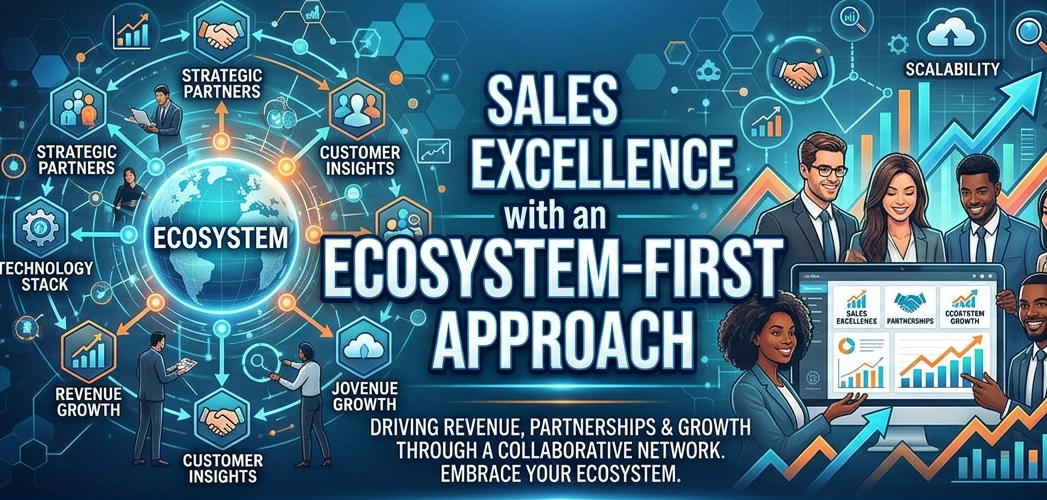
Sales excellence has evolved into a strategic leadership discipline in fintech, financial technology services, and payments. Organizations that consistently outperform competitors align sales execution with an ecosystem-first approach, creating value for customers, partners, suppliers, regulators, and shareholders simultaneously.
In maturing markets, leadership teams face the challenge of accelerating revenue growth without compromising profitability, customer trust, or long-term positioning. Traditional volume-driven strategies often yield short-term gains at the expense of margins, partnerships, and acquisition efficiency.
An ecosystem-first model addresses this by positioning sales as a value-creation mechanism across interconnected stakeholders. This integrated approach unlocks sustainable revenue growth while enhancing profitability and competitive resilience. This article outlines how CXOs, board members, and executive leaders can embed ecosystem thinking into sales excellence to build durable growth engines.
Table of Contents
Introduction
Sales excellence is frequently measured by revenue attainment, quota achievement, pipeline growth, and market share. These metrics remain essential, yet they provide an incomplete view in today’s interconnected fintech and payments landscape.
Payment processors rely on banking partners; fintech platforms depend on technology and compliance providers; merchants require seamless integration across acceptance, fraud prevention, settlement, and experience. Regulators shape operational models, while investors prioritize sustainable returns.
Sustainable revenue growth emerges not from isolated commercial wins but from the health of the broader ecosystem. This reality demands a redefinition of sales excellence i.e shifting from simply selling more to creating scalable value across stakeholders while delivering profitable organizational growth.
The Evolution of Sales Excellence
Historically, sales excellence emphasized individual performance and productivity metrics such as pipeline generation, conversion rates, territory coverage, product penetration, and revenue targets. These elements retain relevance but represent only part of modern commercial effectiveness.
In fintech and payments, value creation occurs increasingly through networks. A typical payment platform involves acquiring banks, issuing banks, processors, technology providers, merchants, consumers, regulators, and risk partners. Revenue pursued at the expense of ecosystem stability tends to prove unsustainable.
Aggressive pricing, for instance, may accelerate acquisition yet erode partner economics. Overemphasis on short-term targets can generate operational strain and diminish trust. True sales excellence therefore balances commercial ambition with ecosystem sustainability.
Why Ecosystem Thinking Matters?
An ecosystem-first approach recognizes that long-term success depends on the collective health of interconnected stakeholders. It re-frames leadership dialogue from “How do we maximize revenue?” to “How do we create sustainable value that expands opportunities for all participants?” This shift influences strategic decisions in key areas like:
Customer Value as a Core Driver: Customers evaluate providers based on outcomes, faster transactions, reduced friction, superior experiences, transparency, security, and efficiency rather than isolated products. Organizations that solve broader strategic challenges become trusted partners, driving higher retention, increased wallet share, lower acquisition costs, and stronger referrals.
Partner Success Fuels Growth: Fintech organizations frequently operate via partnerships, including Banking-as-a-Service, payment networks, embedded finance, and technology integrations. When partners thrive, the ecosystem expands, enabling stronger market reach and more durable revenue streams. Sales leaders attuned to partner economics uncover opportunities that transactional models overlook.
The Revenue Profitability Balance
Leadership teams often face pressure to accelerate customer acquisition, expand market share, enter new geographies, and launch products rapidly. While these efforts can generate strong top-line growth, revenue alone does not ensure enterprise value.
Several fintech organizations have achieved rapid revenue expansion alongside margin compression, rising customer acquisition costs, and declining returns on investment. An ecosystem-first strategy prioritizes growth quality by evaluating whether new customers are profitable, partnerships are sustainable, expansion improves efficiency, and margins strengthen over time. Sustainable profitability, not headline revenue, creates lasting enterprise value.
Leadership’s Role in Ecosystem Based Sales Excellence
Sales excellence extends beyond the sales function; it is a core leadership responsibility. Executive teams must establish enabling conditions for sustainable growth through three critical capabilities.
Strategic Alignment: Leadership must align functions sales, finance, operations, and compliance around shared objectives. A unified framework ensures growth, profitability, customer value, and risk management reinforce rather than conflict with one another.
Long-Term Orientation: Ecosystem development requires extended investment horizons. Boards and executives that support multi-year initiatives in partnerships, trust-building, and market credibility position their organizations for compounded returns.
Cultural Reinforcement: Organizations that reward customer success, partner enablement, cross-functional collaboration, ethical conduct, and sustainable profitability cultivate stronger commercial foundations than those focused solely on short-term revenue.
The Importance of Trust as a Commercial Asset
In payments and fintech, trust underpins critical financial activities and influences acquisition, retention, adoption, partnerships, and regulatory relations. Unlike technology, trust accumulates through consistent execution and cannot be quickly replicated.
Organizations prioritizing ecosystem trust gain durable advantages like lower churn, reduced sales friction, greater pricing power, stronger partner advocacy, and enhanced reputation. Leadership should treat trust as a strategic commercial asset, not merely an ethical imperative.
Technology as an Enabler, Not a Substitute
Technological innovations customer analytics, AI-assisted selling, predictive forecasting, partner platforms, and revenue intelligence play a vital role in enabling sales excellence. However, technology cannot compensate for weak strategy, misaligned incentives, or poor execution. The most effective organizations integrate advanced tools with human expertise, strategic discipline, and deep customer insight to support ecosystem value creation.
Measuring What Matters
Effective leadership supplements traditional metrics (revenue growth, new customer acquisition, pipeline volume, and close rates) with ecosystem oriented indicators.
- Customer Metrics: Retention rates, net revenue retention, customer lifetime value, and satisfaction scores.
- Partner Metrics: Partner generated revenue, retention rates, and ecosystem expansion.
- Profitability Metrics: Gross and contribution margins, customer acquisition efficiency, and revenue quality.
- Strategic Metrics: Market positioning, innovation adoption, cross-sell effectiveness, and ecosystem participation.
A balanced scorecard delivers a more accurate assessment of long-term commercial health.
Risks of Ignoring the Ecosystem
Pursuing growth without ecosystem consideration exposes organizations to channel conflict, margin erosion, customer fatigue, operational strain, and heightened regulatory scrutiny. Over time, these risks erode resilience and shareholder value.
Building the Future Growth Engine
Fintech and payments organizations should anchor future growth in five core principles:
- Create Value Before Extracting Value: Solve meaningful customer and partner challenges first.
- Align Incentives Across Stakeholders: Foster collective benefit for durable expansion.
- Balance Revenue and Profitability: Ensure top-line growth strengthens economic fundamentals.
- Invest in Trust: Build compounding competitive differentiation.
- Think Beyond Transactions: Prioritize long-term relationships for greater lifetime value.
Conclusion
Sales excellence in fintech, financial technology services, and payments has entered a new strategic era. Leading organizations are transitioning from transactional models to ecosystem based strategies that harmonize customer value, partner success, operational sustainability, and profitability. For boards, CXOs, and executive teams, the imperative is to build commercial systems that generate sustainable profits while strengthening the supporting ecosystem. Those who align stakeholder and shareholder interests around shared value creation will be best positioned for resilient, long-term success. Leadership action today realigning strategy, metrics, culture, and incentives will determine competitive advantage in an interconnected financial services landscape.
Disclaimer: This article is provided for informational and thought leadership purposes only. It does not constitute financial, legal, investment, or business advice. Market conditions and regulatory environments evolve; readers are encouraged to verify current applicability.