
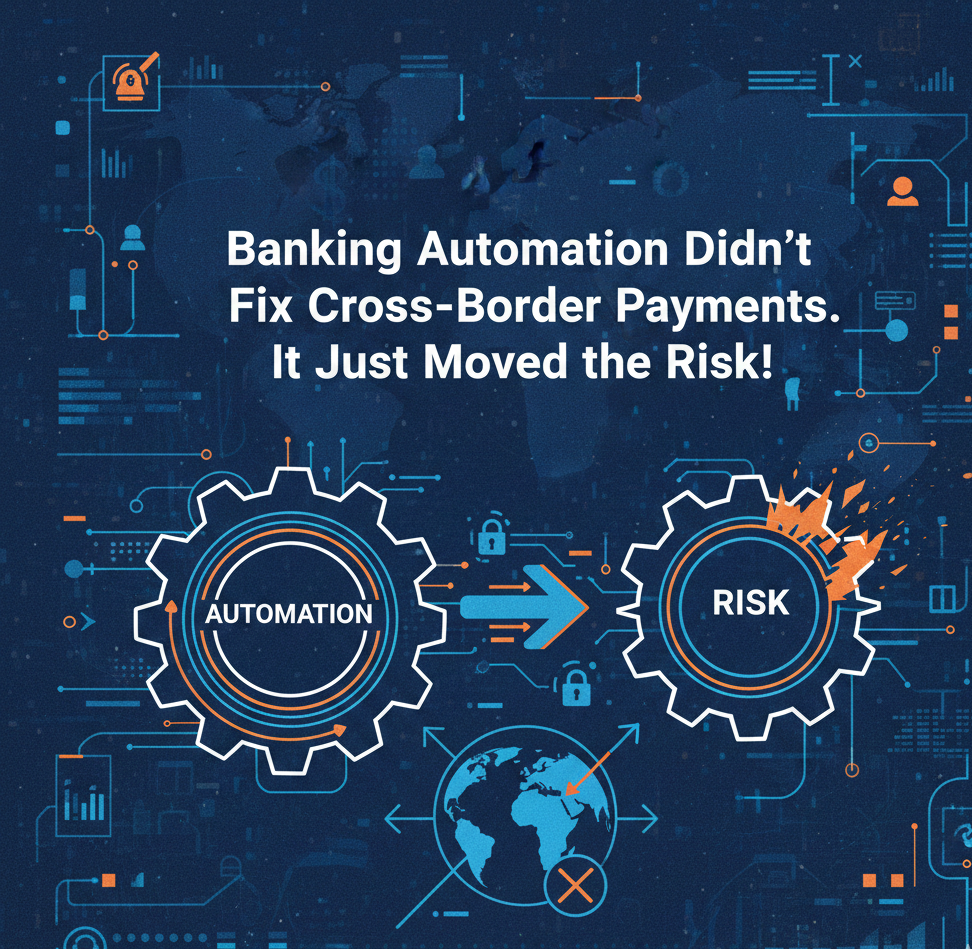
Banking Automation has unquestionably improved the mechanics of global payments and cross-border payments. Settlement is faster. Reconciliation is cleaner. Fraud detection is sharper. But after nearly two decades operating inside regulated, high-friction payment corridors; particularly across APAC, I have learned a harder truth: automation doesn’t eliminate risk; it redistributes it.
Speed replaces visibility. Efficiency trades off against regulatory resilience. AI closes one class of fraud while quietly opening another. For executives, the real challenge is no longer whether to automate, but where human judgment must remain non-negotiable, even when it slows growth.
Table of Contents
Executive Summary
Global payments infrastructure moves trillions of dollars annually. On paper, it looks modern. In practice, much of it still runs on stitched-together correspondent banking rails, legacy compliance workflows, and brittle operational assumptions. I have seen this first-hand.
In one APAC corridor we operated, a single cross-border payout touched:
- 3 correspondent banks
- 2 FX conversion layers
- 4 compliance checkpoints
- And more manual exception handling than anyone wanted to admit,
Automation promised relief. And to a degree, it delivered. Settlement times dropped. Unit economics improved. Revenue scaled. But something else happened quietly in parallel: our tolerance for fragility increased. When systems are slow and manual, everyone assumes they will break. When systems are fast and automated, leadership assumes they won’t.
That assumption is where most modern payment failures now originate.
- Speed vs. Regulatory Survivability
Every payments executive eventually faces this fork in the road:
- Option A: Move fast, automate aggressively, win market share
- Option B: Move cautiously, over-index on controls, preserve licenses
Both choices are defensible. Both are dangerous.
I’ve lived through choosing speed. In one regional rollout, we compressed onboarding timelines, leaned heavily on automated KYC scoring, and trusted downstream transaction monitoring to catch edge cases. Revenue came in quickly. Sales celebrated.
Six months later, compliance escalations followed.
Nothing illegal. Nothing malicious. But the regulator disagreed with our risk posture. We spent the next year rebuilding controls under scrutiny, freezing expansion, and explaining decisions that made sense commercially but not regulatorily.
Automation didn’t cause the problem. Our belief that automation could substitute for regulatory judgment did.
Since then, my bias has shifted:
In Tier-1 or politically sensitive corridors, I now accept slower growth in exchange for over-engineered compliance every time.
That decision costs revenue. It also keeps the company alive.
2. Transparency vs. Abstraction
Blockchain, real-time rails, AI reconciliation, these tools promise transparency. Ironically, they often increase abstraction at the executive level.
Dashboards look clean. Exceptions disappear. Latency vanishes. But when something does go wrong, very few people can explain why. I have watched senior leaders stare at real-time payment flows they no longer understand, trusting vendors and platforms because “the system says it cleared.”
That’s not transparency. That’s delegation without comprehension.
The most painful incidents I have seen were not caused by system failure, but by leadership being too far removed from how money actually moved.
Automation should simplify operations. It should not anesthetize executive curiosity.
3. Fraud Prevention vs. False Confidence
AI-driven fraud detection works, until it doesn’t.
We implemented ML based anomaly detection that materially reduced false positives and manual review. It was objectively better than what came before. Then we encountered a coordinated fraud pattern that mimicked legitimate enterprise behavior across borders. The model learned the wrong lesson quickly. By the time humans intervened, the loss was already crystallized.
The uncomfortable truth:
AI doesn’t fail loudly. It fails convincingly.
Today, I insist on human override mechanisms even when models outperform analysts statistically. Not because humans are better, but because someone must own the judgment call (with accountability) when incentives conflict.
4. Interoperability vs. Sovereignty
Cross-border automation only scales if systems talk to each other. Everyone agrees on this, until sovereignty enters the conversation.
I have watched interoperability initiatives stall not because of technology, but because regulators refused to cede control, data localization rules conflicted, or geopolitical risk reshaped priorities overnight.
De-dollarization, regional payment rails, domestic instant payment systems -these are not neutral technical evolutions. They are strategic power moves. Executives who treat them as purely operational upgrades are misreading the terrain.
What Automation Actually Changes for Leaders?
Automation shifts leadership responsibility in three ways:
- From execution to exception handling
- From speed advocacy to risk arbitration
- From system trust to system interrogation
The hardest part is psychological. When automation works 99.9% of the time, leaders stop asking uncomfortable questions. Until the 0.1% happens and suddenly nothing is intuitive anymore.
The Next 12–36 Months
Looking ahead, I expect three pressure points to intensify:
- Regulatory divergence will outpace platform standardization
- One global stack will not survive unchanged across regions.
- AI governance will become a board-level issue, not a tech issue
- Especially when fraud, bias, and explainability collide.
- Human judgment will become a differentiator again
- Not because technology regresses, but because risk concentrates faster than organizations adapt.
Executives who succeed will not driving the most automated organization. They will be the most clear-eyed about what automation cannot safely decide.
Payments have always evolved through tension. From correspondent banking to SWIFT, from batch settlement to real-time rails, progress has never been linear or clean. Automation is no different. The mistake is believing it resolves complexity. It doesn’t. It repackages complexity at higher speed. The leaders who last in this industry are not those who automate first, but those who know exactly where they refuse to automate judgment away.
Disclaimer: This article inspired from professional experience and judgment based on publicly available information and anonymized industry scenarios. The views expressed are personal and do not constitute financial, regulatory, or investment advice.