
Banking Automation Didn’t Fix Cross-Border Payments. It Just Moved the Hidden Risk!

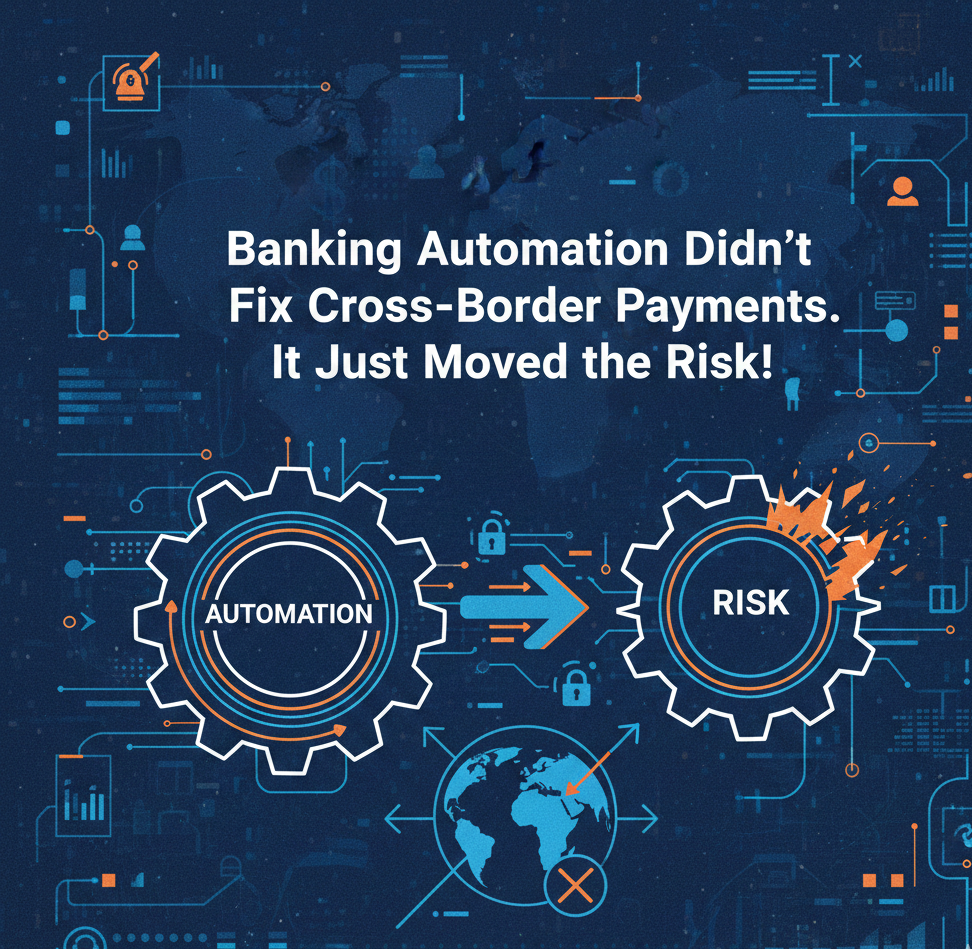
A conceptual infographic showing a blue gear labeled "Automation" passing an arrow to a burning gear labeled "Risk" over a world map, titled "Banking Automation Didn’t Fix Cross-Border Payments. It Just Moved the Risk!"

Banking Automation has unquestionably improved the mechanics of global and cross-border payments. Settlement is faster. Reconciliation is cleaner. Fraud detection is sharper.
But after nearly 2 decades operating inside regulated, high-friction payment corridors; particularly across APAC, I have learned a harder truth: automation doesn’t eliminate risk, it re-distributes it.

Speed replaces visibility. Efficiency trades off against regulatory resilience. AI closes one class of fraud while quietly opening another.

Cross-Functional Leadership Risks

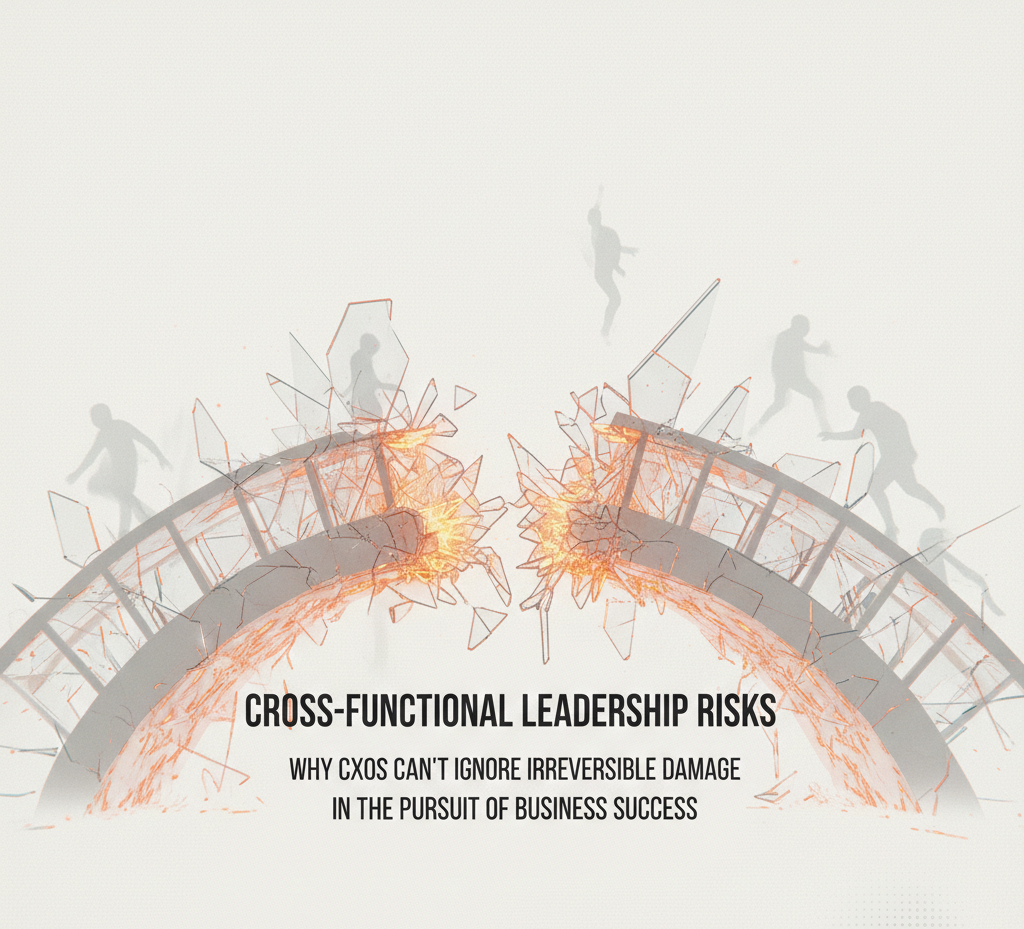
Conceptual illustration of a shattering glass bridge representing Cross-Functional Leadership Risks and the potential for irreversible damage in corporate strategy, featuring text for CXO business success insights.

Cross-functional leadership risks have evolved into existential threats in an AI-accelerated world,where matrixed organizations and rapid transformation amplify both opportunities and vulnerabilities. As enterprises dismantle silos to harness generative AI and agentic workflows,CXOs face a stark reality: unmanaged cross-functional dynamics don’t merely erode efficiency—they trigger permanent fractures in culture, trust, and market position. In 2026, … Read more

Firing Toxic Leaders: Why Ego-Driven Leadership Persists and Why CXOs must act decisively?

Firing Toxic Leaders: Why Ego-Driven Leadership Persists and Why CXOs Must Act Decisively" featuring icons of a cracked crown and a broken corporate ladder on a vintage parchment background.

Executive Summary

Ego driven, blame shifting leaders persist in large organizations not because CXOs fail to recognize them, but because of organizational incentives, political risk, and short term stability biases that reward their survival. In business, IT and Cybersecurity functions, these leaders deliver superficial continuity while eroding trust, talent density and operational resilience. The particular patterns does exist in almost every organization, and removing toxic leaders creates short term disruption along with political cost in some cases and retaining these creatures compounds long term value destruction. CXOs who misprice these trade-off defer from taking any actions until failures push through externally through talent attrition, project deliverable breakdowns or in some cases customer impacting incidents. By then, the cost of removal gets exponentially higher.

This article examines why ego driven leaders survive inside enterprises, how they damage outcomes across functions, and the governance frameworks that CXOs can deploy to remove them decisively without destabilizing the organization.


Read more

Compensation Architecture in Regulated Revenue Models.

A professional corporate banner for "Compensation Architecture in Regulated Revenue Models." The design features a dark blue and green gradient background with technical icons: a gear system with dollar signs, a handshake, and a shield over a bar graph. The text outlines three key goals: Align Incentives, Mitigate Risk, and Scale Profitably.

Compensation architecture shapes enterprise economics in regulated revenue models. Misaligned incentives commonly reward volume over sustainable value, encourage higher-risk exposures, and increase operational/compliance overheads. Volume-driven plans create apparent growth while eroding profitability and elevating regulatory scrutiny. At senior revenue levels, effective design enforces margin discipline, risk calibration, jurisdictional adaptation, and behavioral alignment toward long-term outcomes. … Read more

Credibility: The Most Expensive Decision in Global Payments Leadership

A conceptual image representing global payments leadership featuring a golden scale balanced over a digital globe. One side of the scale holds a crown and gold coins, while the other side holds a glowing blue brain with the word "CREDIBILITY" inscribed. The background features a dark, cinematic city skyline, emphasizing high-stakes financial decision-making.

In 2025’s compressing payments landscape—real-time rails eliminating float, AI surfacing risks instantly, embedded finance diluting margins, and ISO 20022 mandating richer data—credibility is the ultimate balance-sheet asset. Silent leadership (disciplined, low-ego execution) compounds it quietly. Leadership silence (avoidance disguised as caution) erodes it fatally. The executives who thrive will master the distinction: confront risks early and decisively, even when it costs short-term revenue.

Executive Summary

Global payments revenues hit approximately $2.5 trillion in 2025, processing trillions of transactions amid structural shifts: real-time payments surging (37% of merchants accepting them, with 80-90% expecting growth), ISO 20022 migration completing in November, AI-driven operations monetizing, and projected fraud losses climbing toward $400 billion cumulatively this decade.

Margins are under relentless pressure from embedded finance, instant rails, and competition. In this environment, leadership credibility—built through proactive risk confrontation and cultural resilience—determines who retains licenses, partners, and talent.

This piece contrasts silent leadership (aggressive internal action, public restraint) with leadership silence (deferred escalation on known weaknesses). The latter has fueled recent failures in bank-fintech models and fraud scandals. CXOs must audit unspoken risks now: silence is increasingly seen as intent by regulators and markets.

Read more

Embedded Finance: Owning Distribution vs Renting It

A split-screen conceptual illustration titled "Embedded Finance: Owning Distribution vs Renting It." The left side represents "Owning" with a glowing digital circuit tree, while the right side represents "Renting" with a hand paying fees at a gated toll-like entrance.

In embedded finance, one of the most critical decisions is whether to own distribution or rely on partners to rent it. Owning distribution gives control over customer experience, revenue, and margins—but it comes with capital and operational cost. Renting distribution through marketplaces, digital wallets, or banks accelerates scale, yet margins and client relationships are diluted. … Read more

Enterprise Cross-Border Payments 2026: CEO & SVP Playbook for $240 Trillion Market

Digital world map representing global enterprise payment rails, cross-border revenue strategy, and financial technology networks.

The Enterprise Cross-Border Payments 2026 landscape is undergoing a structural transformation. The fragmented network of correspondent banks—once slow, opaque, and costly—is giving way to a unified, data-rich, and autonomous financial fabric. For CEOs and SVPs of Sales, the next 12 months are shaping up as a “Liquidity War,” where competitive advantage comes not from simply moving money, but from optimizing the intelligence and data surrounding every transaction.

Executive Summary

The Enterprise Cross-Border Payments 2026 landscape is undergoing a structural transformation. Key takeaways for CEOs and SVPs:

  • Liquidity War: Optimize data and intelligence, not just money movement.
  • ISO 20022: Unlock semantic data for AI-driven treasury and risk management.
  • Instant Rails: Connect domestic real-time systems (UPI, Pix, FedNow) into multilateral corridors.
  • Stablecoins 2.0: Emerging as regulated B2B settlement rails with cost reduction potential.
  • Agentic AI: Deploy AI agents for FX optimization, compliance, and Smart Acceptance.
  • Regulatory Readiness: Embrace digital identity and Unified Trade Intelligence.
  • Strategic Action: Weaponize data, integrate stablecoins, govern AI, align sales to payment strategy.

Read more

Enterprise Fintech Infrastructure: The Strategic Bet to Win by 2030

Fintech Infrastructure

Fintech infrastructure is the true competitive lever for the next decade. Most executives mistakenly focus on user counts, global expansion, or flashy features, but these are tactical. The companies that own and standardize modular, API-first financial rails — embedding payments, credit, wallets, and compliance into ecosystems — will capture network effects, enforce regulatory moats, and generate scalable, high-margin revenue streams, leaving legacy banks struggling. Boards often misread this strategic inflection, but the top 1% of fintech leaders are already monetizing infrastructure at scale. Here’s why this bet is non-negotiable and how executive teams can act now..

Executive Summary

  • Embedded rails = largest moat; volume alone won’t win.
  • Legacy banks lag; regulatory and tech debt hinder agility.
  • Modular, API-first fintech stacks scale globally, reducing costs.
  • AI-driven compliance and risk create speed + cost advantage.
  • Capital allocation: stack > marketing; platform-first investment wins.
  • Talent strategy: platform-centric engineers > product-centric teams.

Read more

Cross-Functional Leadership: The Real Growth Engine for Faster SaaS & Fintech Launches

Cross-Functional Leadership: Accelerate SaaS Go-Live by 30% and boost revenues

Executive Summary

Cross-functional leadership as the growth engine: Most boards still believe software or fintech launch delays are caused by engineering bottlenecks or regulatory friction. They’re wrong. The real limiter is cross-functional misalignment—fragmented decision-making between product, engineering, compliance, operations, and marketing. Companies like Stripe, Revolut, and platforms leveraging Monite demonstrate that disciplined cross-functional leadership, combined with modular architecture and embedded APIs, can meaningfully accelerate time-to-market, boost adoption, and improve revenue capture. Boards that ignore this structural accelerator risk losing first-mover advantage, eroding market share, and increasing operational risk. Here’s why most boards are dangerously under-investing in this lever — and how the top 1% deploy it.

  • Cross-functional leadership reduces SaaS/fintech go-live timelines by 20–60% across multi-market launches.
  • Embedding pre-built APIs (payments, finance automation, banking connectivity) compresses development cycles from months to weeks.
  • Real-world examples (Stripe, Revolut, Monite, Plaid) show measurable time-to-market and adoption improvements.
  • AI orchestration tools streamline dependency tracking, risk identification, and team coordination.
  • Boards should prioritize empowered, modular teams, regulatory foresight, and strategic RACI governance.
  • Properly applied, cross-functional leadership converts operational efficiency into market share, revenue, and sustainable growth.

Read more