



Business Strategy: Revenue Growth or Revenue Illusion?

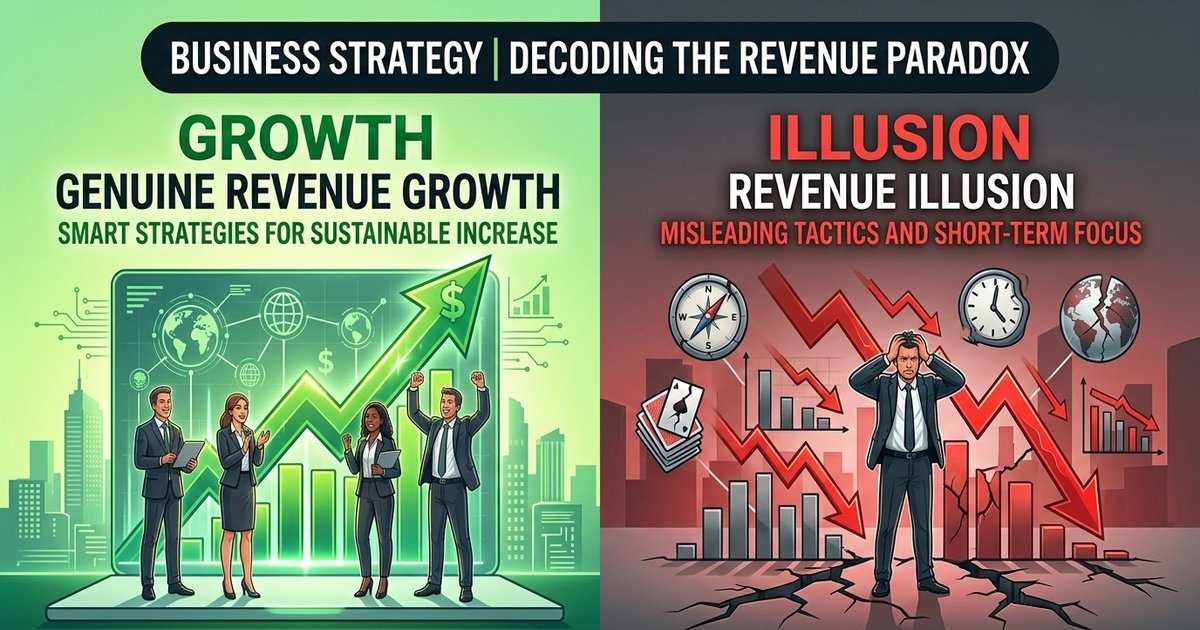
A split-screen business banner titled "Business Strategy | Decoding the Revenue Paradox." The left side, themed in green, shows "Genuine Revenue Growth" with a rising arrow and a diverse, celebrating professional team. The right side, themed in red, shows "Revenue Illusion" with a crashing arrow and a stressed businessman standing over a cracked floor.

In Business Strategy, margin expansion is the only reliable indicator of whether revenue growth in enterprise fintech is structural or simply borrowed time. I have sat in board reviews where topline acceleration was celebrated, new logos were highlighted, and pipeline coverage ratios created comfort. Yet beneath that comfort, contribution margins were thinning, regulatory friction was … Read more

Product-Market Fit: When Rational Foundations Collapse Under Organizational Entropy

Product-Market Fit banner featuring a crumbling architectural structure representing organizational entropy, with high-contrast text overlay.

Executive Summary Product-Market Fit (PMF) is rarely the root cause of failure in enterprise payments, fintech, or regulated banking environments. Collapse more often follows PMF validation, when organizational entropy, the gradual degradation of coherence through ego, diluted competence, political layering, and misaligned incentives, outpaces governance discipline. Ethical foundations aligned to direct or latent market needs … Read more

Leadership Value: The $100 Barber Lesson on Pricing Transformation in Enterprise Payments

Professional banner for "Leadership Value: The $100 Barber Lesson on Pricing Transformation in Enterprise Payments." The design features a stylized gold barber pole, $100 bills, and an upward-trending financial growth graph with credit card icons on a sleek dark navy and gold gradient background.

Leadership Value is the actual product in enterprise payments, even when we pretend it is technology. In late 2025, a barber went viral explaining why he charges $100+ for a haircut. He doesn’t sell fades. He sells confidence. The mirror is incidental. The transformation temporary or not is the value. Strip away the theatrics, and … Read more

Regional Growth Leakage: Why FX, Liquidity, and Governance Gaps Are Quietly Destroying Expansion ROI

Professional business banner titled Regional Growth Leakage featuring a world map background, a cracked piggy bank leaking currency, and a declining financial bar chart representing FX and liquidity gaps.

Regional Growth Leakage is rarely announced in earnings calls. It doesn’t trigger regulatory enforcement letters.It doesn’t look like a crisis. Yet across APAC, Africa, and emerging cross-border payments corridors, I’ve watched otherwise strong regional expansion strategies lose 8-20% of their expected ROI, not because demand was wrong, but because FX mechanics, liquidity sequencing, and governance … Read more

The Quiet Destruction of Margin in Cross-Border Growth: How Expansion Strategies Erode P&L Before Leadership Notices

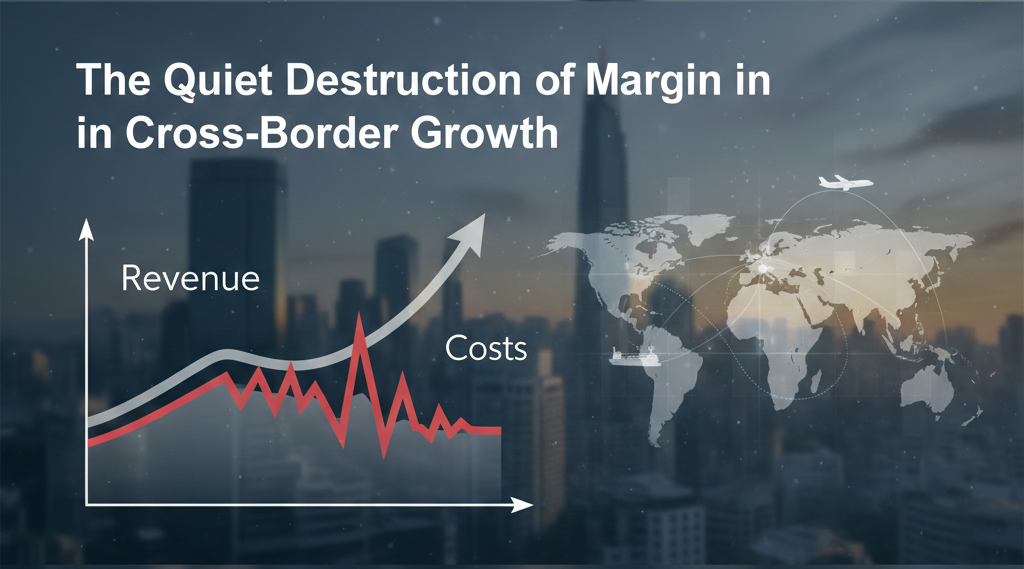
Business banner titled "The Quiet Destruction of Margin in Cross-Border Growth" featuring a financial graph where a rising revenue line is undercut by volatile red cost fluctuations against a global city backdrop.

The Quiet Destruction of Margin is rarely the result of a single bad decision. It is the cumulative outcome of well-intentioned growth layered on top of misunderstood power structures, regulatory latency, pricing optimism, and operational shortcuts that compound quietly until the P&L tells a story no one remembers authorizing.I have yet to see a cross-border … Read more

Customer Understanding is not a value. It’s a Trade-Off.

Infographic for Customer Understanding featuring icons for identifying needs, analyzing market trends, and developing marketing strategies.

Customer Understanding in banking automation and global payments is often treated a a value statement. In practice, it is a hard go-to-market trade-off. This article examines why shallow customer insight drives GTM failure, margin erosion, and post-sale churn; and why firms that invest in real operational understanding often pay a short-term revenue price before compounding long-term growth. Drawing on lived experiences across cross-border payments in regulated APAC markets, it unpacks the uncomfortable decisions leaders must make to build durable and non-commoditized revenue.

Enterprise Cross-Border Payments 2026: CEO & SVP Playbook for $240 Trillion Market

Digital world map representing global enterprise payment rails, cross-border revenue strategy, and financial technology networks.

The Enterprise Cross-Border Payments 2026 landscape is undergoing a structural transformation. The fragmented network of correspondent banks—once slow, opaque, and costly—is giving way to a unified, data-rich, and autonomous financial fabric. For CEOs and SVPs of Sales, the next 12 months are shaping up as a “Liquidity War,” where competitive advantage comes not from simply moving money, but from optimizing the intelligence and data surrounding every transaction.

Executive Summary

The Enterprise Cross-Border Payments 2026 landscape is undergoing a structural transformation. Key takeaways for CEOs and SVPs:

  • Liquidity War: Optimize data and intelligence, not just money movement.
  • ISO 20022: Unlock semantic data for AI-driven treasury and risk management.
  • Instant Rails: Connect domestic real-time systems (UPI, Pix, FedNow) into multilateral corridors.
  • Stablecoins 2.0: Emerging as regulated B2B settlement rails with cost reduction potential.
  • Agentic AI: Deploy AI agents for FX optimization, compliance, and Smart Acceptance.
  • Regulatory Readiness: Embrace digital identity and Unified Trade Intelligence.
  • Strategic Action: Weaponize data, integrate stablecoins, govern AI, align sales to payment strategy.

Read more

APAC Revenue Moats in 2026 — Why Asia‑Pacific Could Win the Global Payments Game

APAC revenue moats 2026

APAC revenue moats are being misunderstood in 2026 — many global payments leaders still mistake slowing per-transaction yields for structural decline. In reality, APAC’s shifting payments architecture, volume scale, regulatory tailwinds, and embedded trade flows are forging some of the deepest and most durable moats in global payments. The companies that recognize and build around these structural edges — rather than chasing Western-style credit-card economics — will dominate cross-border and digital payments into the next decade.

Here’s why most boards are getting this dangerously wrong — and what the top 1% are doing instead.

Executive Summary

  • Volume scale trumps yield compression. APAC cross‑border flows are on track to nearly double by 2032.
  • Structural shift to real‑time accounts & wallets. Real‑time (A2A) payment volumes in APAC are forecast to double over 2022–2027.
  • Revenue mix is re‑balancing — favoring transaction fees over interest income. As net‑interest income slows, transaction‑based revenues remain resilient globally.
  • Cross‑border demand is backed by remittances + trade corridors. APAC handles over US$700 billion in remittance flows yearly.
  • Innovation & interoperability (stablecoins, digital wallets, CBDCs) give first‑mover advantage. APAC leads in stablecoin adoption for trade settlements and remittances.
  • Regulation and geopolitical fragmentation raise barriers to entry — but deepen moats for incumbents. As global payment rails fragment, local/regional scale becomes a competitive advantage.

Read more

High-Performance Multi-Country SaaS GTM Strategy: Unlocking Sustainable Global Growth in 2025-2030

High-Performance Multi-Country SaaS GTM Strategy framework showing centralized control, regional adaptation, partner ecosystems, and AI-driven personalization for global revenue growth.

High-Performance Multi-Country SaaS GTM Strategy enables top SaaS companies in 2025 to achieve 15–25% YoY revenue growth through disciplined international expansion. Leaders like Salesforce (~30% revenue international, strong EMEA/APAC contributions) and HubSpot (~49% revenue international) balance global standardization with local adaptation via repeatable, data-driven playbooks.

This multi-country GTM approach requires centralized control with regional autonomy. High-growth firms prioritize markets by TAM, regulatory alignment, cultural fit, and cloud adoption. Localized pricing, partner ecosystems, and AI-driven personalization drive adoption while mitigating risks such as data sovereignty and compliance failures.

Executive Summary

  • Market prioritization and segmentation prevent over-extension and optimize ARR contribution.
  • Hybrid GTM (product-led + sales-assisted) adapts to local buyer preferences.
  • Partner ecosystems accelerate market entry while reducing regulatory friction.
  • AI-driven personalization improves conversion, onboarding, and retention.
  • Common pitfalls: over-standardization, regulatory gaps, poor localization.
  • Measurable outcomes: 15–25% international contribution within 2–3 years; compounding ARR.

Read more

Global Payments Revenue Leadership 2025: Governance, Scale, and Enterprise Growth

Global Payments

Scaling B2B Payments, Revenue Leadership — Most executives still treat global payments as a technology integration problem. In reality, after managing multi-region revenue portfolios exceeding directional multi-billion TPV and closing enterprise mandates across APAC, Europe, and North America, the true binding constraint is commercial governance: deliberate trade-offs across regulation, partnerships, and pricing that directly influence board-approved revenue thresholds, margin protection, and multi-year growth.

Regulatory fragmentation—illustrated by the EU’s Instant Payments Regulation (IPR) deadlines in January and October 2025—and Singapore’s evolving stablecoin frameworks, combined with moderated industry growth (McKinsey 2025: $2.5T revenues in 2024; ~4% CAGR to ~$3T by 2029), exposes a critical misread: feature-led platforms capture pilots; governance-led architectures capture multi-billion profit pools.


Executive Summary

  • Directed multi-billion TPV growth across 11+ jurisdictions with governance-first GTM strategies.
  • Exercised final authority on market expansion, accelerating enterprise conversions 3–5× via bank–fintech alignment.
  • Balanced regulated risk trade-offs to protect margins while unlocking new revenue corridors.
  • Operationalized compliance as a product, cutting legal cycles 30–50% and enabling succession-ready teams.
  • Scaled distributed global teams (100+ staff) with board-aligned KPIs on ACV, renewals, and regulatory exposure.
  • Translated infrastructure reliability into premium pricing, sustaining multi-market margins and non-linear revenue growth.

Read more