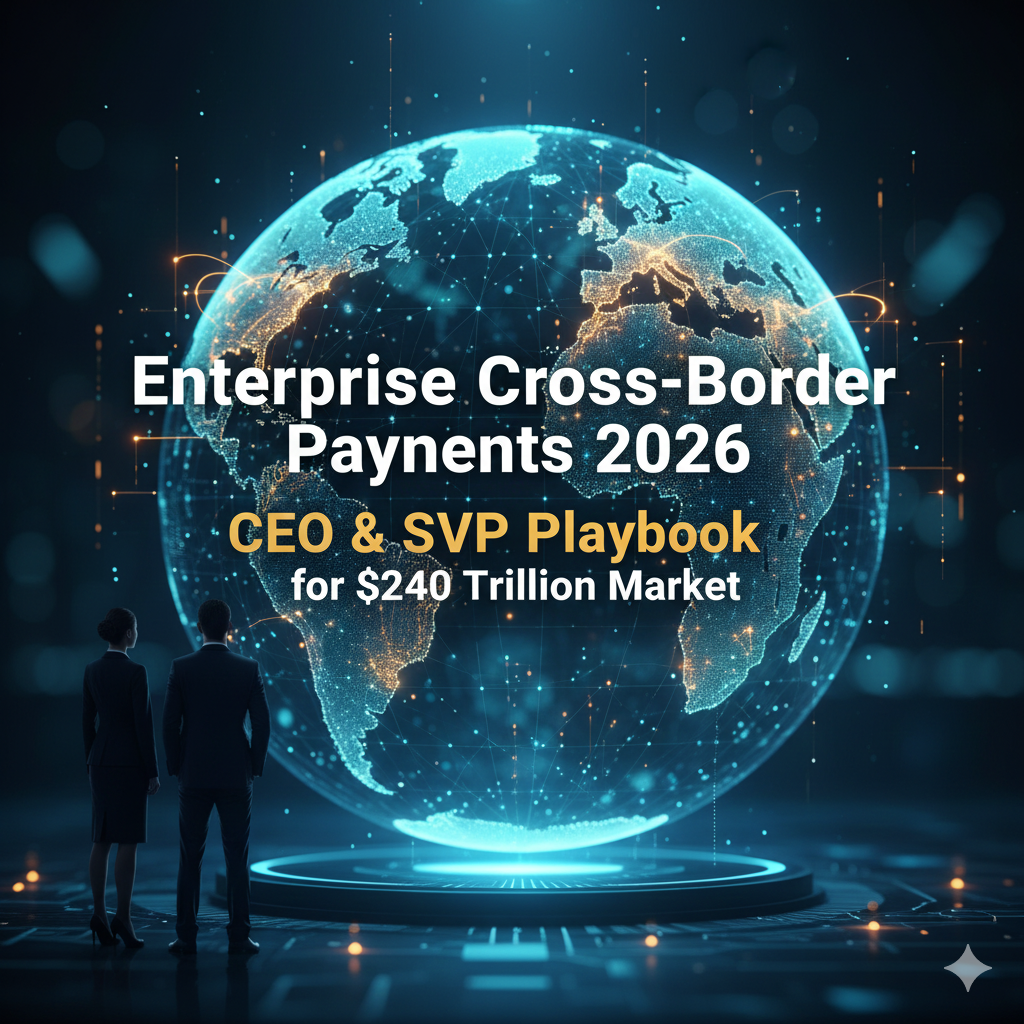
The Enterprise Cross-Border Payments 2026 landscape is undergoing a structural transformation. The fragmented network of correspondent banks—once slow, opaque, and costly—is giving way to a unified, data-rich, and autonomous financial fabric. For CEOs and SVPs of Sales, the next 12 months are shaping up as a “Liquidity War,” where competitive advantage comes not from simply moving money, but from optimizing the intelligence and data surrounding every transaction.
Executive Summary
The Enterprise Cross-Border Payments 2026 landscape is undergoing a structural transformation. Key takeaways for CEOs and SVPs:
- Liquidity War: Optimize data and intelligence, not just money movement.
- ISO 20022: Unlock semantic data for AI-driven treasury and risk management.
- Instant Rails: Connect domestic real-time systems (UPI, Pix, FedNow) into multilateral corridors.
- Stablecoins 2.0: Emerging as regulated B2B settlement rails with cost reduction potential.
- Agentic AI: Deploy AI agents for FX optimization, compliance, and Smart Acceptance.
- Regulatory Readiness: Embrace digital identity and Unified Trade Intelligence.
- Strategic Action: Weaponize data, integrate stablecoins, govern AI, align sales to payment strategy.
Table of Contents
The Macro View: Meeting the G20 Mandate
The North Star for the industry remains the G20 Roadmap for Enhancing Cross-Border Payments. The Financial Stability Board (FSB) has set ambitious targets for 2027:
| Metric | G20/FSB Target (2027) | Current Global Status (2025) |
|---|---|---|
| Cost | Global average < 1%, no corridors > 3% | ~3–6% for remittances; broader payments ~1–3% (World Bank / FSB) |
| Speed | 75% credited within 1 hour | ~30–40% within 1 hour (J.P. Morgan / FSB) |
| Transparency | 75% with end-to-end tracking | ~50–60% with upfront FX/fees (FSB) |
| Access | 90% of individuals with international payment access | ~90% via regulated FIs, gaps remain in underserved regions (FSB) |
1. The Interlinking of Instant Payment Systems (IPS)
The era of the “Batch Window” is over. Enterprise Cross-Border Payments 2026 now require Interlinked Real-Time Rails. Domestic systems like UPI, Pix, and FedNow are being connected into multilateral corridors, reducing cost and friction.
Why the C-Suite Must Care:
- ISO 20022 Strategic Value: The legacy MT message coexistence window ends in Nov 2025. ISO 20022 enables AI to read invoice data, purpose codes, and shipping details directly.
- 24/7 Liquidity Layer: SWIFT is piloting new rules and blockchain-based ledgers to enable near-instant cross-border transfers; operations must run continuously.
CEO Insight: ISO 20022 is not a format swap—it’s a data goldmine for real-time treasury, risk, and hedging strategies.
2. Stablecoin 2.0: The Institutional Grade Era
Regulated stablecoins are emerging as institutional cash equivalents for B2B settlements. Frameworks like Europe’s MiCA and pending U.S. regulations (GENIUS Act discussions) are shaping adoption.
Key Trends:
- Continuous Settlement: 24/7 USD-equivalent movement vs legacy SWIFT.
- Yield-Bearing Tokens: “Stablecoin 2.0” may pass Treasury yields (~4–5%) to holders.
Strategic Action: Evaluate Stablecoin-as-a-Service for emerging markets. Pilot programs report 50–90% transfer cost reductions, though widespread B2B adoption is projected at 5–10% by 2030. Monthly B2B stablecoin volumes reached $6.4B in late 2025.
3. The Generative AI Mandate: From Chatbots to Agents
By 2026, 70–80% of finance functions are expected to deploy AI in risk management, reporting, and payment optimization.
Enterprise Cross-Border Payments 2026 leverage AI agents to:
- Negotiate FX rates and execute payments optimally.
- Analyze transaction patterns for Smart Acceptance.
- Ensure compliance with AI maintainability for regulators like EBA.
Risk Alert: AI reduces false positives by 60% but is exploited for Digital Goods Fraud, projected to cost $27B by 2030.
4. The Regulatory Minefield: Sovereignty vs. Efficiency
Faster payments increase fraud exposure. Digital Identity Wallets and regulatory sandboxes (FCA, global equivalents) are essential for mitigation.
Trade Finance AML: Boards must implement Unified Trade Intelligence for real-time cargo and vessel anomaly detection.
Roadmap for Leadership
Enterprise Cross-Border Payments 2026 require CEOs and SVPs to:
- Weaponize Your Data: Move beyond processing to actionable intelligence using ISO 20022.
- Integrate Stablecoins: Treat regulated stablecoins as emerging B2B settlement rails.
- Govern AI Agents: Implement compliance and explainability frameworks proactively.
- Sales Alignment: Reposition teams to sell Payment Strategy (liquidity + margin protection) rather than just rails.
Firms optimizing Speed and Transparency today will define the $240 trillion landscape of 2026.
Sources:
- Mastercard: The future of payments: Six industry trends shaping 2026.
- J.P. Morgan: Bridging the gap: G20’s vision for inclusive and efficient global payments.
- World Bank: Remittance Prices Worldwide (Q1 2025 Data).
- Juniper Research: Digital Cross-border Remittances & B2B Forecasts 2025-2030.
- Capco: ISO 20022: The Silent Revolution (Nov 2025).
- FCA (UK): Stablecoin payments a priority for 2026.
- Additional citations: FSB, BIS, EY, PwC, Thunes, financialprofessionals.org.
Disclaimer: This article is based on publicly available information and industry reports as of 2025. All market figures and projections are directional estimates and may change. This content is for informational purposes only and does not constitute financial, legal, or regulatory advice. Readers should verify details independently before making decisions.