
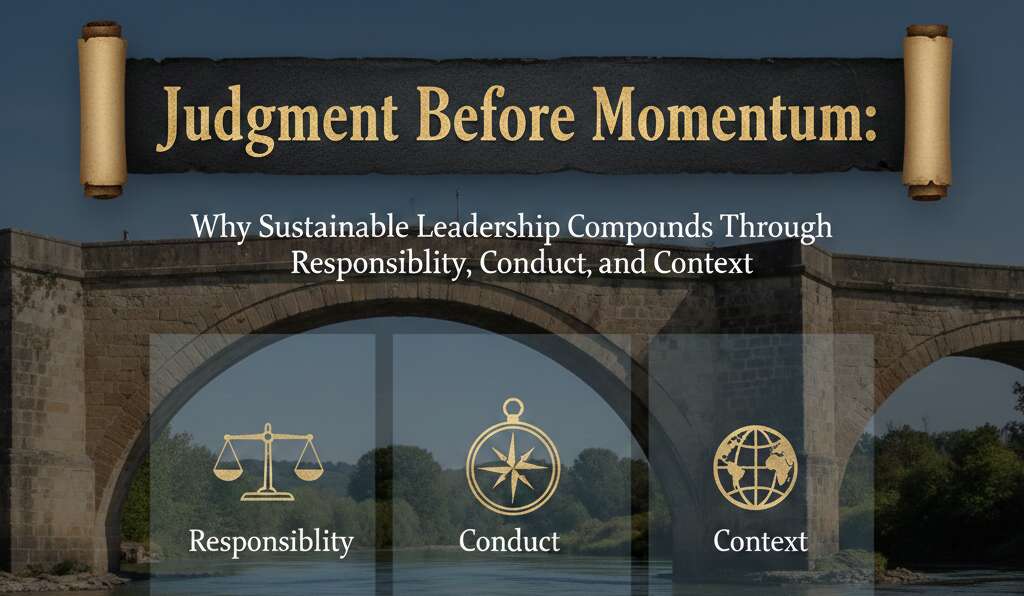
Judgment Before Momentum is not a philosophical preference; it is an operational necessity in regulated and capital-intensive businesses. Every leadership journey appears unique from the outside due to different markets, personalities, regulatory regimes, and commercial pressures. Yet beneath that variance lies a constant I have observed across nearly two decades in regulated payments, fintech infrastructure, and cross-border GTM systems: Wrong decisions may scale. They may look successful. But they do not mature into sustainable businesses.
In capital sensitive environments, decisions are not tested at the moment of execution. They are tested months later, when auditors examine them, regulators revisit them, counter parties recall them, and capital providers reprice risk accordingly. Judgment, therefore, is not about being right in the moment. It is about ensuring that what you approve today remains defensible under future scrutiny.
What determines whether a decision compounds or corrodes is rarely intelligence or intent. It is whether leadership judgment is anchored in three disciplines that rarely appear on strategy decks but govern outcomes relentlessly: Clarity of responsibility, Discipline of conduct, and Realism about context.
Miss any one of them, and momentum becomes a liability rather than an asset.
Table of Contents
Executive Summary
Judgment Before Momentum is the operating principle that sustainable leadership compounds only when decisions are anchored in responsibility, conduct, and context. In regulated payments, fintech infrastructure, and cross-border go-to-market environments, momentum can mask fragility, but it cannot cure it. Wrong decisions may scale. They may even produce short-term revenue acceleration. But they do not compound into durable enterprise value. In an era of tighter capital, regulatory memory, and heightened board scrutiny, disciplined judgment, not speed, charisma, or luck is what separates enduring leaders from temporarily successful ones.
The First Tension: Authority vs. Responsibility
One of the earliest leadership errors I made was assuming authority and responsibility scale together. They do not. In high growth fintech environments, authority often arrives early with title, budget, expansion mandates, decision rights. Responsibility accumulates more slowly and more quietly with regulatory exposure, second order compliance risk, downstream P&L fragility, reputational tail events. These two forces move at different speeds.
The Trade-Off
- Move fast with authority and accept partial responsibility
- Move deliberately with full responsibility and sacrifice speed
Both paths can be strategically valid. What is not valid is pretending they are the same.
I once led a regional expansion where we launched corridors before downstream compliance ownership was fully mapped across product, risk, and operations. Commercially, the case was sound. Demand materialized quickly. Revenue numbers looked strong. What followed was slower and structurally more expensive:
- Regulatory clarification requests that stalled settlements
- Authority gaps between compliance and commercial teams
- Revenue that was booked but difficult to recognize cleanly
- Escalations that consumed executive bandwidth
The decision was not illegal. It was not reckless. It was incomplete. The failure was not speed. It was the misalignment between decision authority and end-to-end accountability.
Sustainable leaders do not ask: “Can I approve this?”
They ask: “Who absorbs the damage if this is wrong and have I aligned authority with that accountability?”
That question alone filters out half of preventable strategic fragility. In regulated environments, responsibility is not symbolic. It is cumulative. If authority outpaces responsibility for too long, the organization eventually pays the difference with interest.
The Second Tension: Personal Brilliance vs. Behavioral Consistency
Aspiring leaders often over-invest in intellect and under-invest in conduct. This bias is understandable. Intelligence is measurable. Performance metrics are visible. Behavior feels abstract. But in complex organizations, behavior is the delivery system of strategy.
The Trade-off: –
- Rely on exceptional individuals to carry decisions.
- Design predictable behavioral standards that survive individual failure
I have seen exceptionally intelligent leaders weaken strong businesses by normalizing inconsistent conduct:
- Bending internal policy “just this once” to close a strategic deal
- Bypassing risk review because commercial urgency felt justified
- Tolerating corrosive internal behavior because performance metrics were strong
Individually, none of these actions feel existential. Collectively, they reprogram organizational norms. In one case, a high-performing regional leader routinely accelerated enterprise deals by bypassing risk checkpoints. Revenue surged, Targets were exceeded, Incentives aligned but, within eighteen months:
- Controls eroded across adjacent teams
- Audit findings increased
- Cross-functional trust deteriorated
- Risk review became performative rather than substantive
The leader did not fail because of intellectual deficiency. The leader failed because their conduct trained the organization incorrectly. Culture is not defined by stated values. It is defined by tolerated behavior. Wrong decisions rarely begin as catastrophic errors. They begin as normalized exceptions. In capital markets, behavioral predictability is often valued more highly than raw brilliance. Boards do not allocate capital based on charisma. They allocate it based on confidence in how decisions are made when no one is watching. Behavior compounds just as decisively as revenue.
The Third Tension: Moral Certainty vs. Situational Judgment
Another failure mode in leadership is confusing conviction with correctness. In regulated markets, leaders often cling to a single “right” operating philosophy, the cleanest governance structure, the most aggressive GTM model, the strictest risk posture, or the most expansionary one. Reality does not reward ideological purity. It rewards contextual fit.
The Trade-off: Apply universal principles rigidly, and Adapt execution to context without compromising integrity.
I have misjudged markets by importing frameworks that succeeded elsewhere:
- Governance models from a developed nation and applied too rigidly in frontier corridors
- Enterprise GTM playbooks transplanted into early stage ecosystems
- Risk thresholds calibrated without understanding informal enforcement realities
None of these decisions were unethical. None violated policy. But they were misaligned with context. The outcome was not collapse. It was something more corrosive:
- Stalled growth without clear failure
- Local leadership disengagement
- Friction between headquarters and market teams
- Silent opportunity cost
Good judgment is not about memorizing rules. It is about knowing which rule governs which environment. Sustainable leaders hold principles steady while flexing execution. Dogma is comfortable. Judgment is disciplined discomfort.
Why Wrong Decisions Do Not Mature
There is a persistent myth in startup and growth culture: that bad decisions can be “fixed later.” In regulated, reputation-sensitive, or capital-intensive businesses, this assumption is structurally flawed.
Wrong decisions leave residue: Process shortcuts that are difficult to unwind, Risk exposures that remain unowned, Institutional memory with regulators & partners, and Trust asymmetry across internal teams.
Even when corrected, they tax future velocity. Regulatory memory compounds, Reputational perception lingers, Counter parties adjust pricing, and Boards re-calibrate oversight intensity.
Risk is easier to introduce than to remove. I have never seen a structurally wrong decision age gracefully. I have seen many temporarily masked by growth. But masking is not maturity. Sustainability is not about eliminating error. It is about ensuring that errors are survivable and reversible. Most leadership errors in regulated systems are neither.
The Aspiring Leader’s Blind Spot
Early-stage and mid-stage leaders often focus on visible performance questions: How do I move faster? How do I demonstrate strategic boldness? and How do I appear credible to the board?
These are legitimate concerns. But the more consequential question is quieter:
What discipline must exist before I decide at all?
Decision quality is constrained long before the moment of approval:
- By whether responsibility is clearly mapped,
- By whether conduct is consistent under pressure,
- By whether context has been assessed without ego.
Without these conditions, even intelligent decisions decay over time. Speed without structure amplifies error. Authority without accountability amplifies exposure. Conviction without contextual awareness amplifies misalignment.
Outlook 12–36 Months: A Harder Environment for Immature Judgment
The operating environment is shifting. Tighter capital markets, Stricter regulatory scrutiny, Heightened enforcement in cross-border flows and More disciplined board oversight in fintech and payments infrastructure. In this environment, leadership judgment will be priced differently.
Boards and capital allocators will increasingly value:
- Decision reversibility over symbolic boldness
- Behavioral predictability over charismatic vision
- Leaders who understand consequences, not just options
The era of forgiving structurally weak decisions under the banner of “learning” is narrowing. When capital is abundant, fragility hides. When capital tightens, fragility surfaces. Judgment exercised before momentum accelerates correction costs. That is the differentiator.
Reflection
Every leader is different in temperament, background, and style. Sustainability, however, is not subjective. Wrong decisions do not fructify with time. They compound risk, erode trust, and quietly cap enterprise potential. The leaders who endure are not necessarily the most brilliant or the fastest.
They are the ones who anchor decisions in: Responsibility that is fully mapped, Conduct that is predictably disciplined, and Context that is honestly assessed.
This is not inspirational leadership theory. It is structural reality in regulated and capital-sensitive businesses. Judgment before momentum is not caution. It is architecture. And architecture, not luck, is what allows leadership to compound.
Disclaimer: This article reflects personal professional insights based on publicly available information and anonymized industry experience. The views expressed are personal and do not constitute financial, regulatory, or investment advice.