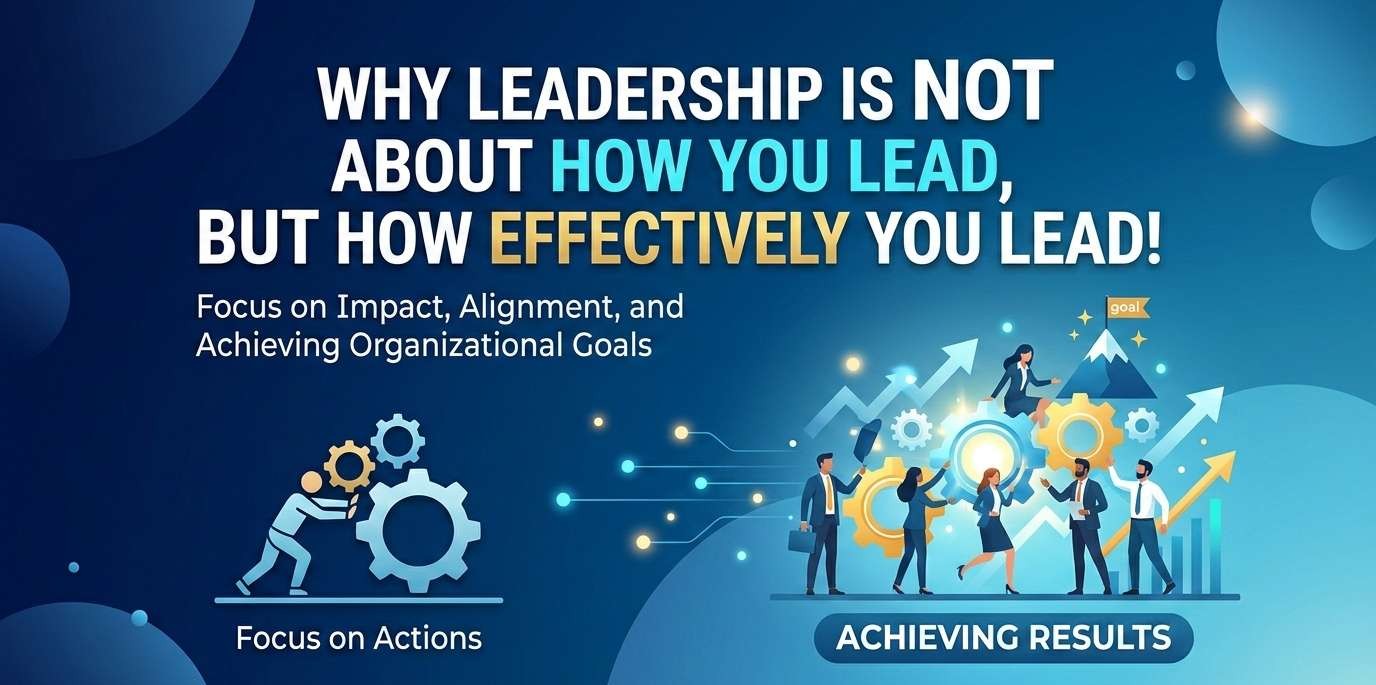
Leadership Is not about How You Lead but knowing How Effectively You Lead, a distinction that separates symbolic leadership from strategic leadership. For decades, leadership literature has largely focused on style: transformational leadership, servant leadership, democratic leadership, visionary leadership, and dozens of other conceptual models. These frameworks attempt to describe how leaders interact with teams, make decisions, and communicate direction.
However, in high-performance organizations, particularly those operating in complex industries such as global payments, fintech infrastructure, and enterprise technology the central leadership question is no longer about style. The central question is:
Is leadership producing measurable strategic outcomes?
A leader can possess excellent communication skills, inspire teams, and cultivate a positive culture. Yet if revenue stagnates, execution falters, innovation slows, and strategic positioning weakens, the leadership cannot be considered effective.
Leadership effectiveness is ultimately an outcome discipline.
The most respected leaders in modern enterprises understand this deeply. They treat leadership not as an identity but as a continuous performance system, one where feedback loops, data, execution velocity, and talent development are constantly measured and recalibrated. This shift from leadership style to leadership effectiveness represents one of the most important evolutions in modern executive thinking.
Table of Contents
Executive Summary
Leadership Is not about How You Lead but Knowing How Effectively You Lead, this principle captures one of the most misunderstood realities of modern executive leadership. In an era of performance dashboards, digital transformation, and increasingly complex revenue ecosystems, leadership effectiveness is no longer defined by charisma, authority, or even intent. It is defined by measurable impact.
Organizations across global payments, enterprise technology, and fintech increasingly operate in systems where outcomes, not leadership styles determine sustainability. A leader may be visionary, collaborative, or authoritative, but the decisive factor is whether their leadership consistently translates into measurable progress: revenue growth, operational resilience, talent retention, and long-term strategic positioning.
Too many leadership conversations focus on how leaders lead: communication style, personality traits, motivational tactics, or management philosophies. While these elements have value, they are secondary. What truly matters is the effectiveness of leadership outcomes; the ability to align people, capital, and strategy toward results that compound over time.
In modern enterprises, effective leadership behaves like a strategic operating system. It continuously measures whether direction, decisions, and execution are producing the intended results. Leaders who fail to measure effectiveness often fall into a dangerous trap: they believe they are leading well simply because they are leading actively. This article examines why leadership effectiveness not leadership style is the defining metric of modern leadership. It introduces practical frameworks that executives can use to measure leadership impact, highlights the hidden risks of style-driven leadership thinking, and presents a strategic blueprint for leaders who want to transform leadership from a performative function into a measurable engine of enterprise value creation.
The Leadership Style Trap
Leadership style discussions often dominate boardrooms, executive coaching sessions, and business literature. Terms like collaborative leader, empathetic leader, or visionary leader are frequently used as markers of leadership quality. Yet these descriptors can be misleading. Leadership style is an input, not an outcome.
A leader may adopt a collaborative style but still preside over slow decision-making. Another may be directive but deliver extraordinary operational efficiency. A third may be inspirational yet struggle to convert vision into execution. When organizations overemphasize leadership style, three risks emerge:
- Performance Illusion
- Leaders may appear effective because they communicate well, inspire teams, or demonstrate emotional intelligence. However, if measurable results fail to materialize, leadership effectiveness remains questionable.
- Cultural Comfort Over Strategic Progress
- Teams sometimes prefer leaders who make them feel comfortable rather than leaders who drive difficult but necessary strategic decisions. Over time, this preference can weaken execution discipline.
- Misaligned Leadership Evaluation
- Boards and executive committees may evaluate leaders based on personality traits rather than measurable outcomes, creating an environment where leadership perception outweighs leadership performance.
Leadership effectiveness corrects these distortions by introducing a simple test: Did leadership produce measurable progress?
The Leadership Effectiveness Equation
To move beyond style-based leadership thinking, organizations must adopt a more rigorous framework for evaluating leadership impact. A useful way to conceptualize leadership effectiveness is through what can be called the Leadership Effectiveness Equation:
Leadership Effectiveness = Strategic Clarity × Execution Velocity × Organizational Alignment
Each component is essential.
- Strategic Clarity
- Effective leaders provide clear direction about where the organization is going and why it matters.
- Ambiguity at the leadership level creates cascading confusion across the organization. When strategy lacks clarity, teams waste energy interpreting priorities instead of executing them.
- Strategic clarity requires leaders to answer three essential questions consistently:
- What problem are we solving?
- Why does it matter now?
- What does success look like?
- Without these answers, even the most talented teams struggle to deliver meaningful results.
- Execution Velocity
- Strategy without execution is simply ambition.
- Leadership effectiveness is closely tied to how quickly and reliably organizations translate strategy into action. Execution velocity depends on several factors:
- Decision-making speed
- Cross-functional coordination
- Resource allocation discipline
- Operational accountability
- Organizations with effective leadership tend to move faster, not because they rush decisions, but because their structures support rapid execution.
- Execution velocity often becomes the most visible indicator of leadership effectiveness.
- Organizational Alignment
- Even strong strategies and fast execution fail when teams are misaligned.
- Organizational alignment ensures that departments, functions, and individuals move in the same strategic direction.
- Leaders who understand effectiveness focus intensely on alignment mechanisms such as:
- Clear objectives and key results (OKRs)
- Transparent performance metrics
- Cross-functional collaboration structures
- Incentive alignment
- When alignment is strong, organizations behave like coordinated systems rather than fragmented departments.
Why Self-Awareness Defines Effective Leadership?
Leadership effectiveness also depends heavily on self-awareness. Leaders who understand how their decisions affect outcomes are far more capable of adjusting course when necessary. In contrast, leaders who rely purely on instinct or authority may struggle to recognize when their leadership approach is producing unintended consequences.
Self-aware leaders continuously ask difficult questions:
- Are our strategic decisions producing measurable progress?
- Are our teams empowered to execute effectively?
- Are we solving the right problems?
This mindset transforms leadership from a static role into a learning system. Leadership becomes less about defending past decisions and more about improving future outcomes.
Measuring Leadership Effectiveness
If leadership effectiveness matters more than leadership style, organizations must develop better ways to measure it. Several indicators provide meaningful signals.
Revenue Quality – Not just revenue growth, but the quality and sustainability of revenue streams. Leaders who prioritize short-term growth without structural profitability may appear successful temporarily but weaken long-term enterprise value.
Execution Reliability – How consistently does the organization deliver on its strategic commitments? Missed product launches, delayed initiatives, or recurring operational failures often signal leadership alignment problems rather than team capability gaps.
Talent Retention and Development – High-performing organizations typically retain strong talent while continuously developing future leaders. Leadership effectiveness is reflected in the strength of the leadership pipeline, not just the performance of the current leadership team.
Strategic Adaptability – Markets evolve, technologies shift, regulations change but effective leaders demonstrate the ability to adapt strategies without destabilizing organizations. Adaptability requires both strategic flexibility and organizational resilience.
The Hidden Discipline of Leadership Reflection
One of the most underrated practices among highly effective leaders is structured reflection. Reflection is not passive thinking. It is an analytical process where leaders evaluate whether their decisions are producing intended outcomes. Questions often include:
- Which strategic decisions delivered the highest impact?
- Where did execution break down?
- What leadership assumptions proved incorrect?
Leaders who build reflection into their leadership routines improve faster than those who operate purely in reactive mode. In many ways, reflection functions as a leadership feedback system.
From Leadership Identity to Leadership Impact
Many leaders subconsciously define themselves by their leadership identity. They see themselves as: Visionary leaders, Culture builders, Operational leaders and Strategic thinkers.
While identity can shape leadership behavior, it can also create blind spots. Effective leaders shift focus from identity to impact. Instead of asking: “What kind of leader am I?” They ask: “What outcomes is my leadership producing?” This shift fundamentally changes how leaders operate.
It encourages: Data-driven decision-making, Honest performance evaluation and Continuous strategic improvement. Leadership becomes less about maintaining a persona and more about delivering results.
Leadership Effectiveness in Complex Industries
Industries such as global payments, fintech infrastructure, and enterprise technology illustrate the importance of leadership effectiveness particularly well. These sectors operate under conditions of: High regulatory complexity, Rapid technological innovation, Intense competitive pressure and Global operational scale.
In such environments, leadership style alone cannot sustain organizations. Leaders must orchestrate complex systems involving technology platforms, financial flows, regulatory frameworks, and global partnerships. Effectiveness therefore depends on system-level thinking. Leaders must understand how strategy, infrastructure, capital allocation, and operational execution interact to produce enterprise value.
Organizations that master this orchestration often dominate their industries, not because their leaders are the most charismatic, but because their leadership systems are the most effective.
The Leadership Effectiveness Playbook
Executives who want to strengthen leadership effectiveness can adopt several practical disciplines.
- Define Leadership Outcomes
- Clearly identify what leadership success looks like across strategic, financial, and operational dimensions.
- Build Leadership Dashboards
- Just as organizations track business metrics, leaders should track leadership performance indicators, including execution speed, team alignment, cross-functional team integration and strategic milestone completion.
- Encourage Honest Feedback
- Create structures where teams can provide upward feedback about leadership decisions and execution challenges.
- Institutionalize Reflection
- Regular leadership reviews should analyze not only results but also the leadership decisions that produced those results.
- Focus on System-Level Impact
- Effective leaders evaluate how their decisions influence entire organizational systems, not just isolated initiatives.
The Future of Leadership
As organizations become more complex and data-driven, leadership effectiveness will become increasingly measurable. Future leadership models will likely emphasize:
- data-informed decision making
- cross-functional orchestration
- execution systems
- measurable strategic impact
Leadership will increasingly resemble enterprise engineering, designing and managing systems that produce consistent results. In this environment, leadership identity will matter less than leadership outcomes.
Conclusion
Leadership is not about How You Lead but Knowing How Effectively You Lead captures a fundamental shift in modern executive thinking. Leadership style still matters. Communication, empathy, and vision all contribute to organizational culture and morale. However, they cannot substitute for measurable impact.
Ultimately, leadership is judged by outcomes:
- Did the organization move closer to its strategic goals?
- Did teams execute effectively?
- Did the enterprise become stronger, more resilient, and more valuable?
Leaders who understand this distinction treat leadership as a performance discipline rather than a personality trait. They build systems that measure effectiveness, encourage reflection, and continuously improve execution. In doing so, they transform leadership from a symbolic role into what it was always meant to be: A measurable force that shapes the trajectory of organizations and the legacy of those who lead them.
Disclaimer: The views expressed in this article reflect professional insights on leadership effectiveness and organizational strategy and are intended for informational and thought-leadership purposes only. They should not be interpreted as prescriptive business, management, or organizational advice. Readers should evaluate and adapt these ideas within the context of their own organizational realities and strategic objectives.