
Sustainable Fintech: Embedding ESG into Cross-Border Payments and Banking Automation – Outlook 2025–2030

ESG framework applied to sustainable fintech cross-border payment systems

Sustainable fintech is no longer a marketing footnote. In 2025, ESG is no longer a compliance checkbox—it’s a strategic lever for profitability, risk mitigation, and global expansion. Global cross-border payments messaging and flows approach ~$1 quadrillion annually (including wholesale/FX per IMF 2025), while retail/commercial markets hit ~$220-250B in value with flows projected to $290T by 2030. Stablecoin on-chain volumes reached ~$27-30T in 2024 (largely trading + payments, including bot activity). Fintechs and banks embedding ESG at the infrastructure layer—leveraging AI for real-time reporting, blockchain/stablecoins for traceable low-friction flows, and ISO 20022 for rich data—are unlocking profit pools in sustainable trade finance, green remittances, and carbon-conscious lending. Laggards face penalties, divestment, and obsolescence in a decarbonizing economy.

Executive Summary

  • ESG integration turns cross-border payments from cost centers into revenue drivers via green products/efficiency.
  • Stablecoins/blockchain enable low-cost, instant settlements with indirect carbon reductions (fewer intermediaries).
  • AI automation streamlines ESG reporting/compliance, delivering 30-40% efficiency gains in workflows.
  • ISO 20022 migration (completed Nov 2025) enables structured data for transparency and potential ESG tagging.
  • Climate fintech funding surges; sustainable startups outperform broader sector in VC.
  • First movers build moats, tapping multi-trillion sustainable finance opportunities by 2030.

Read more

The Growth and Future of Multirail Payment Ecosystems: Why “One Rail to Rule Them All” Is Dead”

Multirail payment ecosystems

Multirail payment ecosystems are becoming the new operating system of global fintech as CXOs move beyond single-rail dependencies. Bold as many legacy-treasurers and CFOs may be, the era of a single dominant payment rail is over — and the real battleground will be defined by orchestration, not dominance. Real-time account-to-account (A2A) systems, diverse rails (cards, open-banking APIs, digital wallets, RTP networks) and AI-powered orchestration layers are converging. Boards that assume “cards + SWIFT = safe” are dangerously wrong. Here’s why most boards are getting this dangerously wrong — and what the top 1% are doing instead.

Executive Summary

Understanding Multirail Payment Ecosystems
  • Multirail convergence: A2A, real-time, cards, wallets — payment flows are fragmenting; orchestration is becoming the strategic asset.
  • A2A explosion: Real-time A2A is growing globally — >70 countries now support RTP; volumes to double by 2028.
  • Cost & speed advantage: A2A/instant rails threaten 15–25% of future card-transaction growth globally.
  • Interoperability as growth lever: True value lies in cross-rail and cross-border interoperability; fragmentation is the principal bottleneck.
  • AI-driven orchestration rising: AI routing and orchestration significantly reduce payment failures and improve efficiency.
  • Compliance & risk as strategic constraints: Regulatory, liquidity, FX, and fraud-management complexity demand re-architecting.

Read more

Enterprise Fintech Infrastructure: The Strategic Bet to Win by 2030

Fintech Infrastructure

Fintech infrastructure is the true competitive lever for the next decade. Most executives mistakenly focus on user counts, global expansion, or flashy features, but these are tactical. The companies that own and standardize modular, API-first financial rails — embedding payments, credit, wallets, and compliance into ecosystems — will capture network effects, enforce regulatory moats, and generate scalable, high-margin revenue streams, leaving legacy banks struggling. Boards often misread this strategic inflection, but the top 1% of fintech leaders are already monetizing infrastructure at scale. Here’s why this bet is non-negotiable and how executive teams can act now..

Executive Summary

  • Embedded rails = largest moat; volume alone won’t win.
  • Legacy banks lag; regulatory and tech debt hinder agility.
  • Modular, API-first fintech stacks scale globally, reducing costs.
  • AI-driven compliance and risk create speed + cost advantage.
  • Capital allocation: stack > marketing; platform-first investment wins.
  • Talent strategy: platform-centric engineers > product-centric teams.

Read more

APAC Revenue Moats in 2026 — Why Asia‑Pacific Could Win the Global Payments Game

APAC revenue moats 2026

APAC revenue moats are being misunderstood in 2026 — many global payments leaders still mistake slowing per-transaction yields for structural decline. In reality, APAC’s shifting payments architecture, volume scale, regulatory tailwinds, and embedded trade flows are forging some of the deepest and most durable moats in global payments. The companies that recognize and build around these structural edges — rather than chasing Western-style credit-card economics — will dominate cross-border and digital payments into the next decade.

Here’s why most boards are getting this dangerously wrong — and what the top 1% are doing instead.

Executive Summary

  • Volume scale trumps yield compression. APAC cross‑border flows are on track to nearly double by 2032.
  • Structural shift to real‑time accounts & wallets. Real‑time (A2A) payment volumes in APAC are forecast to double over 2022–2027.
  • Revenue mix is re‑balancing — favoring transaction fees over interest income. As net‑interest income slows, transaction‑based revenues remain resilient globally.
  • Cross‑border demand is backed by remittances + trade corridors. APAC handles over US$700 billion in remittance flows yearly.
  • Innovation & interoperability (stablecoins, digital wallets, CBDCs) give first‑mover advantage. APAC leads in stablecoin adoption for trade settlements and remittances.
  • Regulation and geopolitical fragmentation raise barriers to entry — but deepen moats for incumbents. As global payment rails fragment, local/regional scale becomes a competitive advantage.

Read more

Cross-Functional Leadership: The Real Growth Engine for Faster SaaS & Fintech Launches

Cross-Functional Leadership: Accelerate SaaS Go-Live by 30% and boost revenues

Executive Summary

Cross-functional leadership as the growth engine: Most boards still believe software or fintech launch delays are caused by engineering bottlenecks or regulatory friction. They’re wrong. The real limiter is cross-functional misalignment—fragmented decision-making between product, engineering, compliance, operations, and marketing. Companies like Stripe, Revolut, and platforms leveraging Monite demonstrate that disciplined cross-functional leadership, combined with modular architecture and embedded APIs, can meaningfully accelerate time-to-market, boost adoption, and improve revenue capture. Boards that ignore this structural accelerator risk losing first-mover advantage, eroding market share, and increasing operational risk. Here’s why most boards are dangerously under-investing in this lever — and how the top 1% deploy it.

  • Cross-functional leadership reduces SaaS/fintech go-live timelines by 20–60% across multi-market launches.
  • Embedding pre-built APIs (payments, finance automation, banking connectivity) compresses development cycles from months to weeks.
  • Real-world examples (Stripe, Revolut, Monite, Plaid) show measurable time-to-market and adoption improvements.
  • AI orchestration tools streamline dependency tracking, risk identification, and team coordination.
  • Boards should prioritize empowered, modular teams, regulatory foresight, and strategic RACI governance.
  • Properly applied, cross-functional leadership converts operational efficiency into market share, revenue, and sustainable growth.

Read more

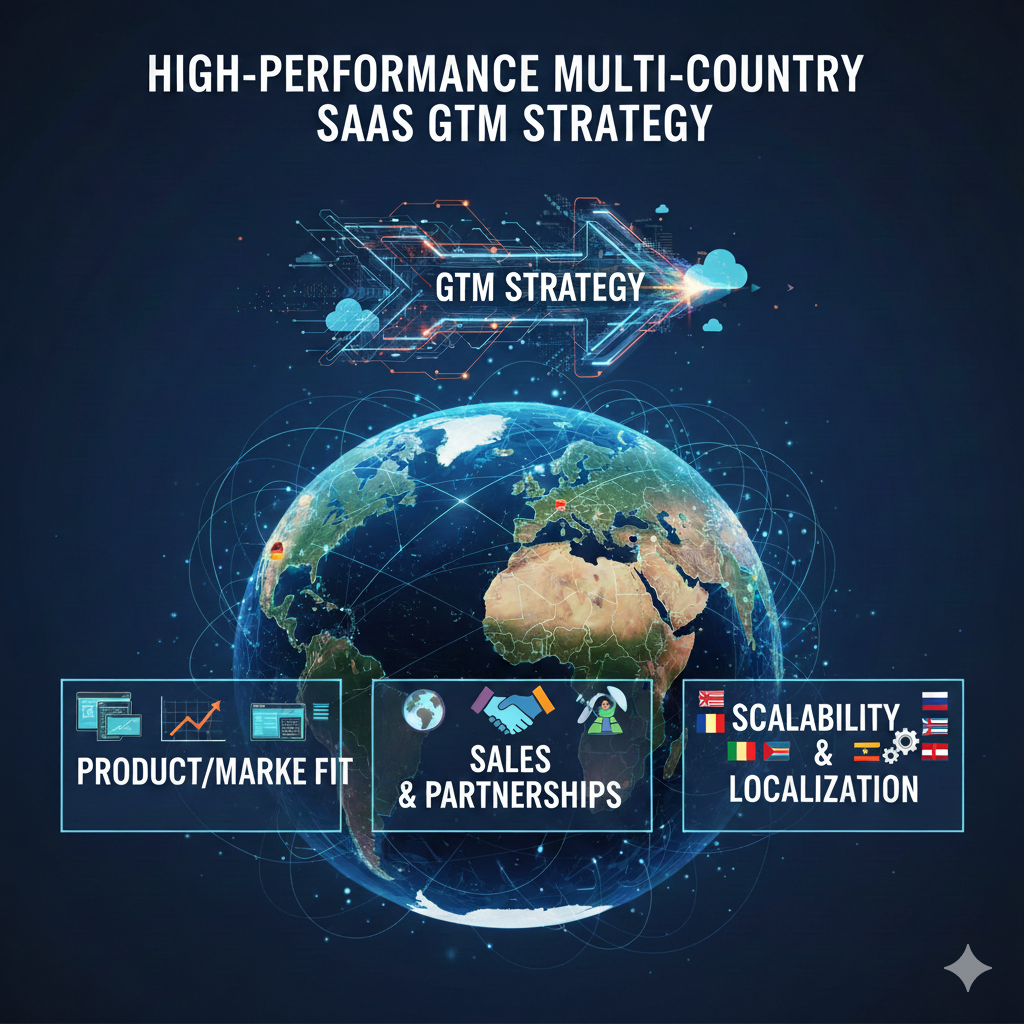
High-Performance Multi-Country SaaS GTM Strategy: Unlocking Sustainable Global Growth in 2025-2030

High-Performance Multi-Country SaaS GTM Strategy framework showing centralized control, regional adaptation, partner ecosystems, and AI-driven personalization for global revenue growth.

High-Performance Multi-Country SaaS GTM Strategy enables top SaaS companies in 2025 to achieve 15–25% YoY revenue growth through disciplined international expansion. Leaders like Salesforce (~30% revenue international, strong EMEA/APAC contributions) and HubSpot (~49% revenue international) balance global standardization with local adaptation via repeatable, data-driven playbooks.

This multi-country GTM approach requires centralized control with regional autonomy. High-growth firms prioritize markets by TAM, regulatory alignment, cultural fit, and cloud adoption. Localized pricing, partner ecosystems, and AI-driven personalization drive adoption while mitigating risks such as data sovereignty and compliance failures.

Executive Summary

  • Market prioritization and segmentation prevent over-extension and optimize ARR contribution.
  • Hybrid GTM (product-led + sales-assisted) adapts to local buyer preferences.
  • Partner ecosystems accelerate market entry while reducing regulatory friction.
  • AI-driven personalization improves conversion, onboarding, and retention.
  • Common pitfalls: over-standardization, regulatory gaps, poor localization.
  • Measurable outcomes: 15–25% international contribution within 2–3 years; compounding ARR.

Read more

Global Payments Revenue Leadership 2025: Governance, Scale, and Enterprise Growth

Global Payments

Scaling B2B Payments, Revenue Leadership — Most executives still treat global payments as a technology integration problem. In reality, after managing multi-region revenue portfolios exceeding directional multi-billion TPV and closing enterprise mandates across APAC, Europe, and North America, the true binding constraint is commercial governance: deliberate trade-offs across regulation, partnerships, and pricing that directly influence board-approved revenue thresholds, margin protection, and multi-year growth.

Regulatory fragmentation—illustrated by the EU’s Instant Payments Regulation (IPR) deadlines in January and October 2025—and Singapore’s evolving stablecoin frameworks, combined with moderated industry growth (McKinsey 2025: $2.5T revenues in 2024; ~4% CAGR to ~$3T by 2029), exposes a critical misread: feature-led platforms capture pilots; governance-led architectures capture multi-billion profit pools.


Executive Summary

  • Directed multi-billion TPV growth across 11+ jurisdictions with governance-first GTM strategies.
  • Exercised final authority on market expansion, accelerating enterprise conversions 3–5× via bank–fintech alignment.
  • Balanced regulated risk trade-offs to protect margins while unlocking new revenue corridors.
  • Operationalized compliance as a product, cutting legal cycles 30–50% and enabling succession-ready teams.
  • Scaled distributed global teams (100+ staff) with board-aligned KPIs on ACV, renewals, and regulatory exposure.
  • Translated infrastructure reliability into premium pricing, sustaining multi-market margins and non-linear revenue growth.

Read more