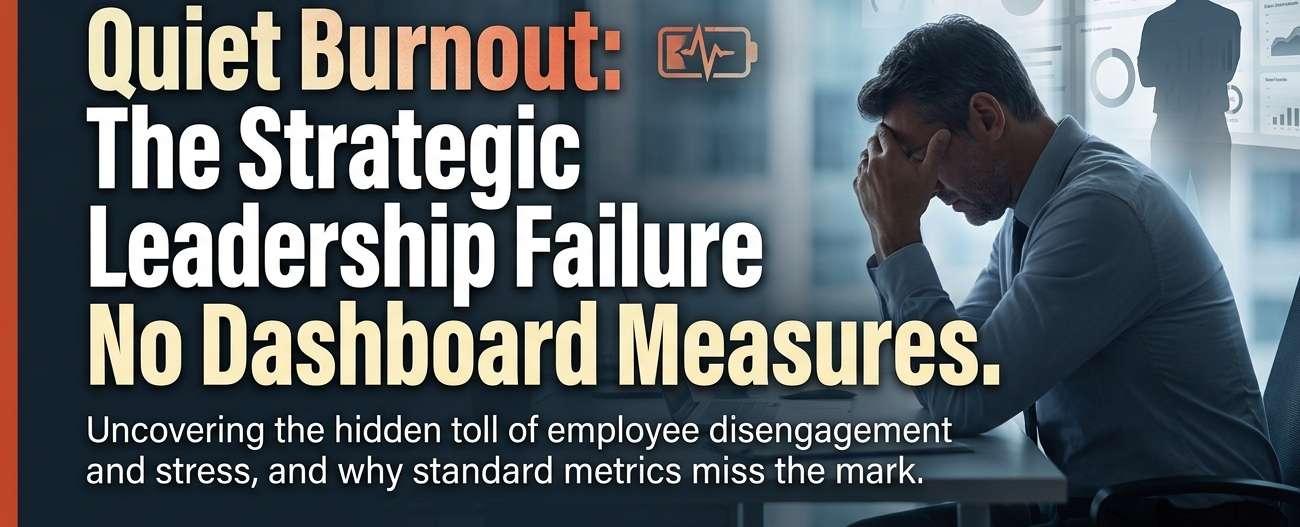
Quiet Burnout begins silently, unseen on dashboards, hidden behind flawless operational metrics. Teams execute flawlessly, KPIs are met, and meetings run on schedule but underneath, cognitive engagement is draining away. Leaders who mistake stability for health may unknowingly allow their organization to lose the sharpest minds to disengagement, slowing innovation and strategic growth.
Table of Contents
Executive Summary
Quiet Burnout is more than a modern workplace phenomenon, it is a strategic leadership blind spot. Unlike visible exhaustion, Quiet Burnout does not trigger alarms, HR interventions, or urgent performance reviews. Employees continue to deliver operational results, attend meetings, and hit deadlines. Yet, their intellectual engagement, strategic thinking, and discretionary effort quietly erode. For senior leaders, this represents a subtle but significant drain on organizational energy, innovation, and long-term growth. The most critical organizational decline is often not loud or visible; it is the gradual disengagement of high performers who no longer challenge assumptions or contribute strategic insight. Leaders who recognize and address Quiet Burnout can transform operational compliance into sustainable organizational intelligence, while considering systemic pressures and broader environmental factors.
The Misdiagnosis of Burnout in Modern Organizations
Leadership often equates burnout with visible signs: absenteeism, emotional outbursts, declining output. This conventional view overlooks the most subtle and challenging form: employees who continue to function without fully investing their cognitive energy. Quiet Burnout can manifest as: Limited initiative, Minimal strategic questioning, Reluctance to challenge assumptions, and Mechanical task execution. Leaders who do not detect this pattern may misinterpret operational stability as organizational health. The true measure of team vitality is not attendance or completion rates it is intellectual engagement, discretionary thinking, and strategic curiosity, influenced by organizational systems, external pressures, and individual context.
How Quiet Burnout Forms Inside Organizations
Quiet Burnout is rarely the fault of individual employees. Instead, it emerges from a combination of systemic, environmental, and operational factors. Key drivers include:
- Continuous Operational Pressure – Ongoing execution cycles reduce time for reflection, innovation, or strategic thought.
- Strategic Ambiguity – When employees cannot see how their work contributes to purpose, engagement may decline.
- Over-Measurement – Dashboards capture outputs but rarely track cognitive effort or idea generation.
- Meeting-Driven Cultures – Dense scheduling leaves limited space for independent thinking.
- Leadership and Environmental Stressors – Organizational changes, market volatility, or leadership fatigue can subtly shift engagement norms.
The insight: Quiet Burnout is an organizational and systemic phenomenon, not simply an individual issue. Employees may adapt by “going through the motions,” but the organization may incur long-term strategic costs if disengagement spreads.
The Strategic Cost of Quiet Burnout
Quiet Burnout rarely triggers immediate alarms in quarterly performance reviews, yet its long-term impact is significant:
- Innovation Capacity Declines
- Teams may stop asking “Why?” or “Is there a better way?”
- The organization risks losing its ability to evolve ideas into market advantage.
- Strategic Friction Reduces
- Constructive disagreement drives refinement and improvement. Quiet Burnout may limit debate, resulting in decision-making that appears smooth but is less resilient or innovative.
- Leadership Pipeline Weakens
- Future leaders emerge from employees who challenge assumptions, propose ideas, and engage deeply. Quiet Burnout can reduce these behaviors over time, affecting strategic continuity and renewal.
In essence, organizations may remain operationally functional while gradually losing capacity for forward-thinking and adaptation. Recognizing these subtle patterns is crucial to sustaining long-term performance.
Strategic Leadership Responsibility
Addressing Quiet Burnout is a leadership mandate, not a purely HR concern. Leaders must treat cognitive engagement as a critical organizational resource, alongside capital and operational capacity.
Key leadership practices include:
- Create Thinking Space – Protect blocks of time for reflection, analysis, and strategic exploration beyond routine execution.
- Encourage Intellectual Friction – Reward constructive debate and questions as signals of engagement and curiosity.
- Measure Engagement Beyond Output – Observe who proposes ideas, questions strategy, and drives improvement.
- Reconnect Execution With Purpose – Ensure team members understand the strategic significance of their work, and consider external factors influencing engagement.
Leaders who implement these practices transform operational compliance into sustainable organizational intelligence, while remaining mindful of environmental and systemic contributors to burnout.
Insight
The most significant risk to organizational performance is often silent disengagement rather than visible exhaustion. Quiet Burnout subtly reduces strategic momentum, intellectual curiosity, and leadership renewal. Boards, executives, and senior leaders must view disengagement as a strategic risk and respond thoughtfully, addressing both organizational design and external pressures.
Sustainable growth requires more than completing tasks, it relies on teams remaining cognitively engaged, strategically curious, and intellectually active. Quiet Burnout signals a slow energy decline, and leaders who proactively recognize it can maintain both operational efficiency and strategic vitality.
Quiet Burnout is not merely an employee issue, it is a systemic and leadership challenge that no dashboard measures.
Disclaimer: This article is intended for informational and thought-leadership purposes only. The views expressed do not constitute medical, psychological, or professional advisory services. Individuals experiencing symptoms of burnout or related conditions should consult qualified healthcare or mental-health professionals. Organizations implementing the practices discussed are encouraged to align them with their policies and applicable legal requirements.