
Enterprise Cross-Border Payments 2026: CEO & SVP Playbook for $240 Trillion Market

Digital world map representing global enterprise payment rails, cross-border revenue strategy, and financial technology networks.

The Enterprise Cross-Border Payments 2026 landscape is undergoing a structural transformation. The fragmented network of correspondent banks—once slow, opaque, and costly—is giving way to a unified, data-rich, and autonomous financial fabric. For CEOs and SVPs of Sales, the next 12 months are shaping up as a “Liquidity War,” where competitive advantage comes not from simply moving money, but from optimizing the intelligence and data surrounding every transaction.

Executive Summary

The Enterprise Cross-Border Payments 2026 landscape is undergoing a structural transformation. Key takeaways for CEOs and SVPs:

  • Liquidity War: Optimize data and intelligence, not just money movement.
  • ISO 20022: Unlock semantic data for AI-driven treasury and risk management.
  • Instant Rails: Connect domestic real-time systems (UPI, Pix, FedNow) into multilateral corridors.
  • Stablecoins 2.0: Emerging as regulated B2B settlement rails with cost reduction potential.
  • Agentic AI: Deploy AI agents for FX optimization, compliance, and Smart Acceptance.
  • Regulatory Readiness: Embrace digital identity and Unified Trade Intelligence.
  • Strategic Action: Weaponize data, integrate stablecoins, govern AI, align sales to payment strategy.
Read more

Sustainable Fintech: Embedding ESG into Cross-Border Payments and Banking Automation – Outlook 2025–2030

ESG framework applied to sustainable fintech cross-border payment systems

Sustainable fintech is no longer a marketing footnote. In 2025, ESG is no longer a compliance checkbox—it’s a strategic lever for profitability, risk mitigation, and global expansion. Global cross-border payments messaging and flows approach ~$1 quadrillion annually (including wholesale/FX per IMF 2025), while retail/commercial markets hit ~$220-250B in value with flows projected to $290T by 2030. Stablecoin on-chain volumes reached ~$27-30T in 2024 (largely trading + payments, including bot activity). Fintechs and banks embedding ESG at the infrastructure layer—leveraging AI for real-time reporting, blockchain/stablecoins for traceable low-friction flows, and ISO 20022 for rich data—are unlocking profit pools in sustainable trade finance, green remittances, and carbon-conscious lending. Laggards face penalties, divestment, and obsolescence in a decarbonizing economy.

Executive Summary

  • ESG integration turns cross-border payments from cost centers into revenue drivers via green products/efficiency.
  • Stablecoins/blockchain enable low-cost, instant settlements with indirect carbon reductions (fewer intermediaries).
  • AI automation streamlines ESG reporting/compliance, delivering 30-40% efficiency gains in workflows.
  • ISO 20022 migration (completed Nov 2025) enables structured data for transparency and potential ESG tagging.
  • Climate fintech funding surges; sustainable startups outperform broader sector in VC.
  • First movers build moats, tapping multi-trillion sustainable finance opportunities by 2030.

Read more

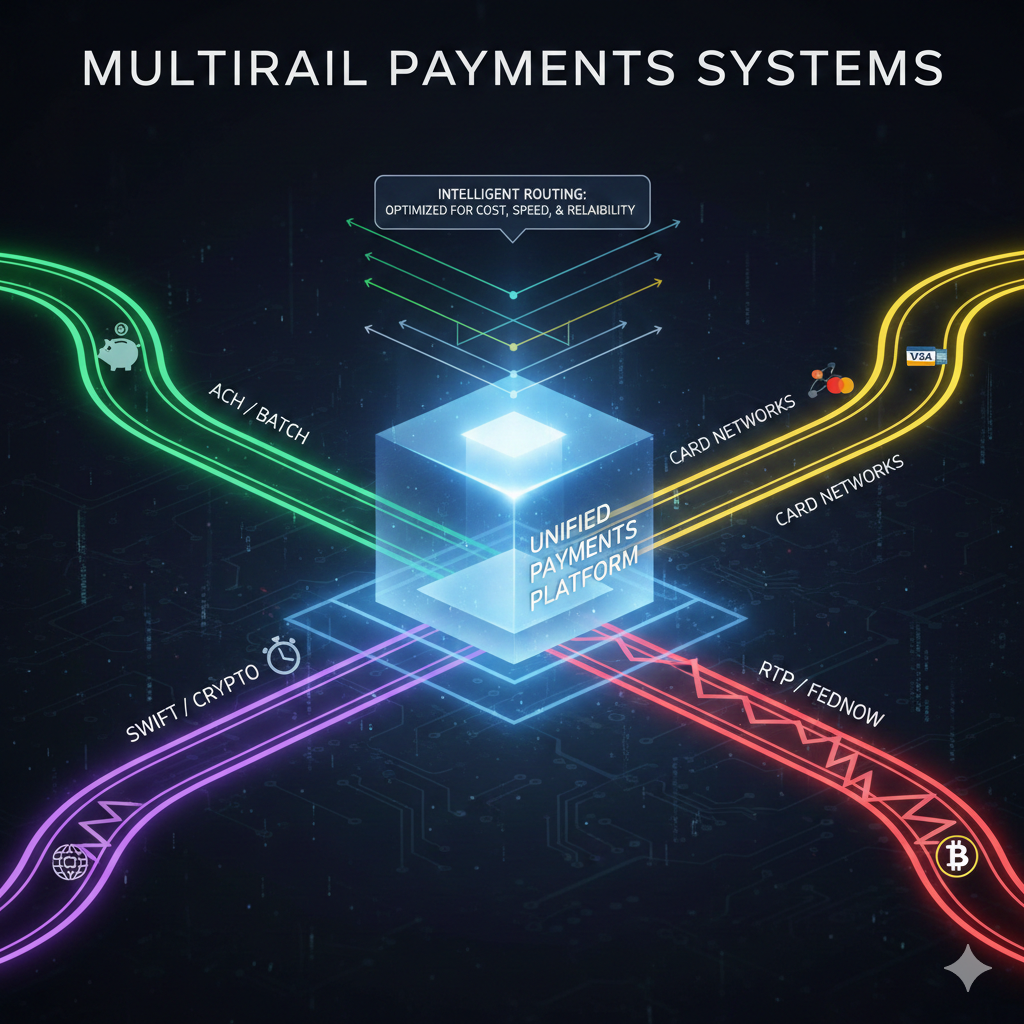
The Growth and Future of Multirail Payment Ecosystems: Why “One Rail to Rule Them All” Is Dead”

Multirail payment ecosystems

Multirail payment ecosystems are becoming the new operating system of global fintech as CXOs move beyond single-rail dependencies. Bold as many legacy-treasurers and CFOs may be, the era of a single dominant payment rail is over — and the real battleground will be defined by orchestration, not dominance. Real-time account-to-account (A2A) systems, diverse rails (cards, open-banking APIs, digital wallets, RTP networks) and AI-powered orchestration layers are converging. Boards that assume “cards + SWIFT = safe” are dangerously wrong. Here’s why most boards are getting this dangerously wrong — and what the top 1% are doing instead.

Executive Summary

Understanding Multirail Payment Ecosystems
  • Multirail convergence: A2A, real-time, cards, wallets — payment flows are fragmenting; orchestration is becoming the strategic asset.
  • A2A explosion: Real-time A2A is growing globally — >70 countries now support RTP; volumes to double by 2028.
  • Cost & speed advantage: A2A/instant rails threaten 15–25% of future card-transaction growth globally.
  • Interoperability as growth lever: True value lies in cross-rail and cross-border interoperability; fragmentation is the principal bottleneck.
  • AI-driven orchestration rising: AI routing and orchestration significantly reduce payment failures and improve efficiency.
  • Compliance & risk as strategic constraints: Regulatory, liquidity, FX, and fraud-management complexity demand re-architecting.

Read more

APAC Revenue Moats in 2026 — Why Asia‑Pacific Could Win the Global Payments Game

APAC revenue moats 2026

APAC revenue moats are being misunderstood in 2026 — many global payments leaders still mistake slowing per-transaction yields for structural decline. In reality, APAC’s shifting payments architecture, volume scale, regulatory tailwinds, and embedded trade flows are forging some of the deepest and most durable moats in global payments. The companies that recognize and build around these structural edges — rather than chasing Western-style credit-card economics — will dominate cross-border and digital payments into the next decade.

Here’s why most boards are getting this dangerously wrong — and what the top 1% are doing instead.

Executive Summary

  • Volume scale trumps yield compression. APAC cross‑border flows are on track to nearly double by 2032.
  • Structural shift to real‑time accounts & wallets. Real‑time (A2A) payment volumes in APAC are forecast to double over 2022–2027.
  • Revenue mix is re‑balancing — favoring transaction fees over interest income. As net‑interest income slows, transaction‑based revenues remain resilient globally.
  • Cross‑border demand is backed by remittances + trade corridors. APAC handles over US$700 billion in remittance flows yearly.
  • Innovation & interoperability (stablecoins, digital wallets, CBDCs) give first‑mover advantage. APAC leads in stablecoin adoption for trade settlements and remittances.
  • Regulation and geopolitical fragmentation raise barriers to entry — but deepen moats for incumbents. As global payment rails fragment, local/regional scale becomes a competitive advantage.

Read more