
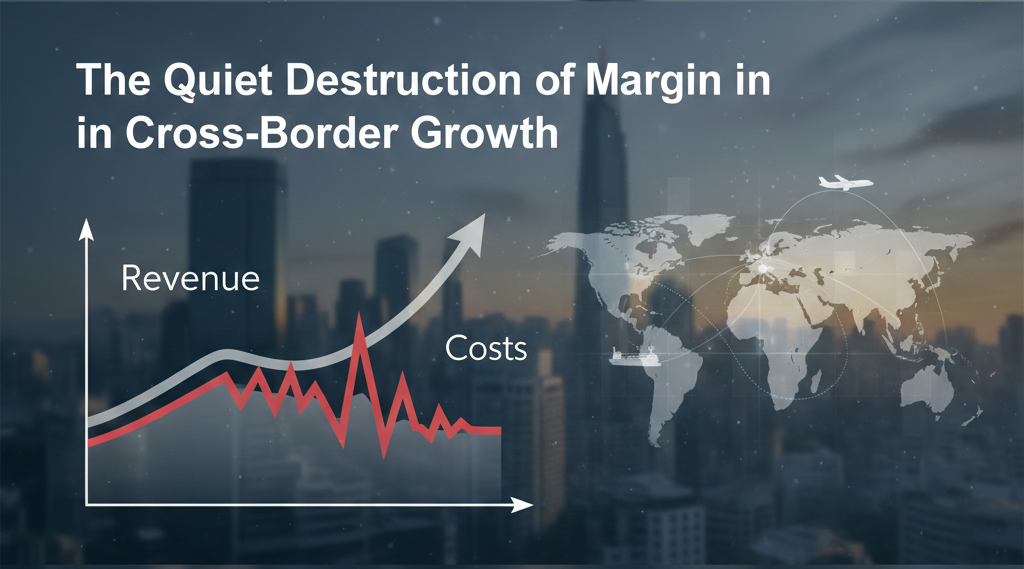
The Quiet Destruction of Margin is rarely the result of a single bad decision. It is the cumulative outcome of well-intentioned growth layered on top of misunderstood power structures, regulatory latency, pricing optimism, and operational shortcuts that compound quietly until the P&L tells a story no one remembers authorizing.
I have yet to see a cross-border payments or embedded finance business fail because it lacked ambition. Most fail or more accurately, bleed, because leadership confuses revenue expansion with economic expansion. Growth feels visible. Margin erosion does not. Especially in regulated, multi-jurisdictional corridors where authority is fragmented and accountability diffused.
This article examines how cross-border growth strategies systematically destroy margin, not through fraud or incompetence, but through governance blind spots, sequencing errors, and second-order effects leaders underestimate or choose not to confront.
Executive Summary
Cross-border growth introduces a structural tension: speed to market versus margin integrity. Boards and executive teams often prioritize footprint expansion, corridor count, and top-line momentum, while margin degradation accumulates invisibly through FX leakage, regulatory drag, operational workarounds, and authority gaps.
The damage is rarely immediate. It appears as “temporary compression,” “investment phase pressure,” or “market entry costs.” But over time, these justifications harden into permanent structural inefficiencies that are difficult and politically expensive to unwind. The core failure is not strategy. It is governance calibration.
Table of Contents
Expansion Velocity vs. Economic Control
Every cross-border growth story begins with a rational trade-off:
- Expand fast to capture corridors, partners, and enterprise logos
- Or expand deliberately with slower sequencing, tighter controls, and higher initial friction
Both choices are defensible. The cost of each is not symmetrical.
In practice, most leadership teams choose velocity, because markets reward narrative momentum, not margin discipline. The mistake is assuming control can be retrofitted later at marginal cost. It cannot.
Once pricing promises are embedded in contracts, once operational exceptions become “how things work here,” once regulatory dependencies are externalized to partners, you are no longer managing a growth strategy. You are managing inherited fragility.
Hidden Failure Mode: Margin Dies in the Gaps, Not the Lines
Margin destruction in cross-border systems does not occur where leadership looks. It occurs between functions:
- Between FX pricing and treasury reality
- Between compliance interpretation and operational execution
- Between partner SLAs and actual authority to enforce them
- Between what sales commits and what operations can economically deliver
In one APAC corridor expansion I was involved in, headline unit economics looked sound: Take-rate positive. Volumes scaling. Client acquisition accelerating. Twelve months later, the corridor was unprofitable.
Not because pricing was wrong, but because pricing assumed perfect behaviour across five entities that did not share incentives, reporting standards, or risk exposure. Each exception looked trivial. Collectively, they erased 180 basis points of margin. No dashboard flagged it early. No single leader “owned” the loss.
That is how margin dies quietly.
Damage Mechanism #1: FX Optimism and Phantom P&L
FX is the most abused line item in cross-border growth models.
| Leadership models assume | Reality delivers |
| Stable spreads | Intraday volatility absorbed operationally |
| Predictable netting | Corridor-specific liquidity traps |
| Minimal slippage | Forced conversions at inopportune times |
| Rational partner behaviour | Partners monetizing opacity |
The result is Phantom P&L, profit that exists in forecasts but not in cash reality. Worse, FX losses are often buried under “cost of funds,” “ops variance,” or “temporary volatility,” making them politically invisible. By the time treasury raises concerns, the corridor is strategically “too important” to slow down.
Damage Mechanism #2: Regulatory Sequencing Errors
Regulation does not block growth. Bad sequencing does.
Many cross-border expansions rely on interim structures:
- Sponsored licenses
- Agent models
- Downstream dependencies
- Local partner interpretations
These are valid, but only if leadership understands where authority truly sits.
I have seen businesses scale volume through corridors where:
- They bore compliance liability
- Partners controlled enforcement
- Regulators held ambiguous expectations
Margin erosion followed in the form of:
- Manual remediation
- Transaction holds
- Retroactive compliance requirements
- Forced staffing increases
None of these show up as “regulatory costs” in the board deck. They show up as margin compression that executives explain away as “scale friction.” It is not friction. It is structural misalignment.
Damage Mechanism #3: Sales-Led Commitments Without Margin Governance
Cross-border growth is often sales-led by necessity. Enterprise deals anchor corridors.
The problem arises when:
- Sales incentives reward deal closure, not corridor profitability
- Pricing exceptions become normalized
- Operational constraints are overridden “for this client only”
Every exception creates a precedent. Every precedent creates a shadow cost. Over time, operations teams build bespoke workflows that cannot be automated, treasury absorbs unpredictable exposure, and finance loses the ability to attribute margin loss to specific decisions. At that point, margin erosion is no longer reversible without political fallout.
Reputation Impact: When Margin Failure Becomes Trust Failure
Margin erosion is not just a financial problem. It becomes a reputational liability.
As margins compress:
- Service reliability declines
- Exception handling slows
- Client communication becomes defensive
- Partner relationships fray
Eventually, clients sense instability not in balance sheets, but in responsiveness and confidence. The brand narrative shifts from “scaling leader” to “operationally stretched.”
By the time boards notice reputational drag, the root cause is already embedded in growth architecture.
Board Responsibility: What Oversight Usually Misses
Boards rarely ask the wrong questions. They ask them too late.
Common oversight failures include:
• Reviewing corridor performance at aggregate level
• Accepting “temporary compression” without expiry conditions
• Treating compliance and margin as separate discussions
• Rewarding growth narratives without downside accounting
Effective boards force clarity on:
• Who controls margin, not who reports it
• Where authority sits during exceptions
• Which costs scale non-linearly with volume
• What must be true for margin recovery to occur
Absent this, boards inadvertently sponsor the quiet destruction of margin.
The Cost of Inaction
Once margin erosion becomes structural, options narrow:
• Repricing risks client churn
• Re-architecting ops disrupts delivery
• Exiting corridors damages narrative
• Accountability triggers leadership conflict
The longer action is delayed, the more expensive correction becomes financially and politically. Most firms do not “fix” margin destruction. They live with it until growth slows and the model collapses under its own complexity.
Forward-Looking Implications
Cross-border businesses entering the next cycle will face:
• Tighter regulatory scrutiny
• Reduced tolerance for FX opacity
• Investor pressure on quality of revenue
• Slower forgiveness for margin ambiguity
The winners will not be the fastest expanders, but those who:
• Embed margin governance into GTM decisions
• Align incentives across sales, ops, and treasury
• Treat regulatory sequencing as a P&L decision
• Design growth architectures that assume friction, not perfection
Growth will still matter. But unmanaged growth will be punished.
The quiet destruction of margin in cross-border growth is not a mystery. It is a governance failure disguised as ambition. Leaders who survive the next phase will be those willing to slow down just enough to see where profit is actually made and where it is silently lost.
Disclaimer
This article reflects the author’s professional insights based on publicly available information and anonymized industry experience. Views expressed are personal and do not constitute financial, regulatory, or investment advice.