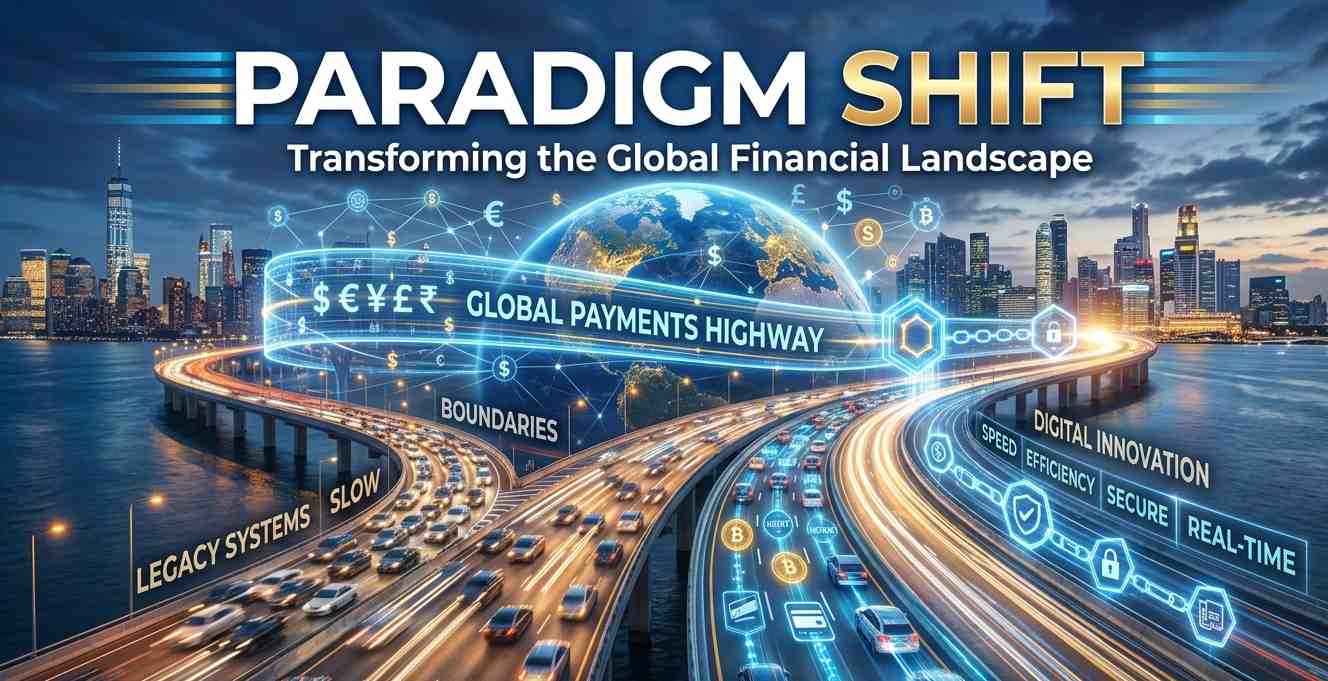
Paradigm Shift on the Global Payments Highway represents a fundamental redefinition of how value, data, and trust move across borders. What began as digitization has evolved into a structural replatforming of global commerce. Instant payment systems span over 70+ countries, ISO 20022 is becoming the universal data language, and tokenized financial infrastructures are transitioning from experimentation to controlled deployment.
Yet this acceleration is not linear. It is shaped by regulatory mandates, compliance frameworks, and geopolitical realignments that are simultaneously constraining and enabling progress. This is where most leadership teams miscalculate. They treat regulation as friction, geopolitics as risk, and infrastructure as cost.
In reality, these forces are converging into a new operating system for global payments, one where regulation becomes distribution, compliance becomes product, and infrastructure becomes monetization leverage. This article introduces and operationalizes the Regulatory Revenue Flywheel, a strategic model designed for leaders who intend not just to adapt to the shift, but to institutionalize advantage within it.
Table of Contents
Executive Summary
Paradigm Shift on the Global Payments Highway is no longer just a transformation of infrastructure, it is the emergence of a new revenue architecture defined by what can be termed the ‘Regulatory Revenue Flywheel’. In this model, regulation, technology, and commercialization are no longer sequential constraints but interlocking growth drivers.
Traditional correspondent banking models are being displaced by real-time, interoperable, and tokenized ecosystems powered by ISO 20022, stablecoins, and unified multi-currency ledgers. While these advancements promise speed and efficiency, they introduce structured “speed breakers” in the form of regulatory fragmentation, compliance intensity, and geopolitical divergence. However, these are not obstacles, they are design inputs. Organizations that systematically convert regulatory complexity into product capability, and product capability into scalable revenue, will outperform peers in both growth and resilience.
For boards, CEOs, and SVP Sales leaders, the implication is decisive: the winners in global payments will not be those who navigate the highway fastest, but those who engineer the flywheel that defines how the highway operates.
The Evolving Highway: From Transaction Rails to Programmable Ecosystems
Global payments are undergoing a transition from linear processing systems to multi-layered programmable ecosystems. This shift is defined by four foundational transformations:
- Real-Time, Always-On Infrastructure: Settlement is moving from batch-based cycles (T+1, T+2) to continuous execution. This redefines liquidity, compresses working capital cycles, and shifts customer expectations toward immediacy.
- ISO 20022 as the Data Spine: ISO 20022 is not just a messaging upgrade, it is a data monetization layer. Structured, enriched data enables automated reconciliation, predictive analytics, and embedded compliance.
- Tokenized Money and Stablecoin Utility: Programmable money introduces conditional execution, atomic settlement, and round-the-clock liquidity. This reduces dependency on intermediaries and unlocks new treasury models.
- Unified Multi-Currency Ledgers: Shared infrastructures reduce pre-funding requirements, optimize FX exposure, and enable simultaneous asset and payment settlement.
Strategic Insight: This is not a faster version of the old system, it is a different system altogether. Payments are no longer endpoints; they are embedded, invisible, and programmable components of broader commercial workflows.
Speed Breakers Re-framed: Regulation as Structured Advantage
The prevailing narrative frames regulation as a barrier. This is strategically incomplete. Regulation is, in fact, the most underutilized competitive moat in global payments. There are three Layers of Regulatory Friction.
- Jurisdictional Fragmentation: Divergent licensing, capital controls, and compliance frameworks increase operational complexity.
- Data and Transparency Mandates: Enhanced requirements around originator/beneficiary data, auditability, and traceability demand robust data infrastructure.
- Operational Resilience Requirements: Institutions must demonstrate system integrity, cyber resilience, and continuity under stress scenarios.
Re-framing the Reality: These are not constraints, they are standardization mechanisms that:
- Increase trust across counter parties
- Raise barriers to entry
- Reward institutions with superior infrastructure
Critical Shift: Organizations that embed compliance at the architectural level do not just meet regulatory requirements, they convert them into scalable capabilities.
The Regulatory Revenue Flywheel: A New Growth Architecture
At the center of this paradigm shift is a repeatable, compounding model: ‘The Regulatory Revenue Flywheel’
- Regulatory Complexity → Capability Development: Invest in compliance infrastructure (AI monitoring, ISO 20022 data models, real-time screening).
- Capability Development → Productization: Convert compliance capabilities into external offerings (Compliance-as-a-Service, fraud analytics, identity verification).
- Productization → Ecosystem Adoption: Distribute these capabilities across partners, fintechs, and corporates.
- Ecosystem Adoption → Data Scale & Network Effects: Increased usage generates richer data, improving accuracy and efficiency.
- Data Scale → Revenue Expansion & Competitive Moat: Enhanced insights drive new products, pricing power, and client stickiness.
Then the cycle repeats, stronger each time.
Monetizing the Flywheel: Where Revenue Actually Emerges
Theoretical frameworks only matter if they translate into revenue. The flywheel unlocks five high-impact monetization layers:
- Compliance-as-a-Service (CaaS): Transform regulatory infrastructure into a platform offering. Smaller institutions outsource compliance, creating recurring, high-margin revenue.
- Data-Driven Financial Intelligence: ISO 20022 data enables predictive cash flow tools, automated reconciliation, and real-time risk scoring, services that can be priced at premium tiers.
- Tokenized Treasury & Liquidity Solutions: Enable corporates to optimize global liquidity in real time, reducing idle capital and improving yield.
- Embedded Payments as Infrastructure: Payments become a feature within platforms (ERP, supply chain, marketplaces), generating usage-based revenue and deep integration.
- Programmable Finance & Smart Transactions: Conditional payments, escrow automation, and atomic settlement create entirely new product categories.
Key Insight: Revenue is no longer generated at the transaction layer, it is generated at the capability and orchestration layer.
Geopolitical Polarization: From Risk to Route Optimization
Geopolitical fragmentation is often viewed as systemic risk. Strategically, it is a routing opportunity.
What is Actually Happening?
- Regional payment systems are expanding
- Local currency settlement is increasing
- Multi- CBDC experiments are accelerating
- Cross-border dependencies are being diversified
What This Means for Leaders? Instead of a single global highway, we now have a multi-rail network.
Winning capability: Dynamic orchestration. The ability to: Route transactions across multiple systems, optimize for cost, speed, & compliance and switch rails in real time
Strategic Advantage: Institutions that maintain neutral, interoperable connectivity become: Risk mitigators, Efficiency optimizer, and Strategic partners for multinational clients.
Geopolitical complexity does not reduce opportunity, it multiplies monetizable pathways.
Strategic Imperatives for SVP Sales and Executive Leadership
The paradigm shift fundamentally changes how revenue is generated and sold.
- From Product Selling → Infrastructure Positioning: Clients no longer buy payment products, they buy capabilities embedded in their workflows.
- From Pricing Transactions → Pricing Outcomes: Revenue models shift towards Liquidity optimization, Value Efficiency gains and Risk reduction.
- From Regional Coverage → Multi-Rail Orchestration: Sales narratives must emphasize Corridor flexibility, Regulatory expertise, and Execution certainty.
- From Compliance Obligation → Client Value Proposition: Compliance becomes a sales differentiator, not a backend function.
Execution Blueprint: Operationalizing the Flywheel
To institutionalize advantage, organizations must execute with discipline:
| Phase 1: Strategic Diagnostic – Assess infrastructure maturity – Map regulatory exposure – Identify monetization gaps | Phase 2: Architecture Modernization – Implement ISO 20022-native systems – Deploy AI-driven compliance – Enable API-based interoperability |
| Phase 3: Product Layer Activation – Launch compliance platforms – Introduce tokenized treasury solutions – Build embedded payment capabilities | Phase 4: Ecosystem Scaling – Partner with fintechs and regional networks – Expand distribution channels |
| Phase 5: Continuous Intelligence Loop – Leverage data for optimization – Refine pricing and offerings – Reinforce flywheel momentum |
Conclusion
Paradigm Shift on the Global Payments Highway is not simply a transformation to be managed. it is a system to be engineered. The defining question for leadership is no longer: How do we navigate regulatory complexity? It is: How do we monetize it systematically and repeatedly?
Organizations that build the Regulatory Revenue Flywheel will not compete on speed alone, they will control the economics of the ecosystem itself. They will transform compliance into distribution, infrastructure into leverage, and geopolitics into optionality. In doing so, they will not just participate in the future of global payments, they will define its operating model. The highway is expanding. The rails are multiplying. The rules are evolving. But the winners will be those who design the flywheel that makes all of it commercially inevitable.
Disclaimer: This article is provided for general informational and strategic discussion purposes only. It does not constitute financial, legal, regulatory, or investment advice. Opinions expressed reflect synthesized industry analysis and are subject to change. Organizations should consult qualified professional advisors before implementing any strategies discussed herein.