








The Peter Principle Trap: How Modern Organizations Promote Talent Until It Stops Performing

A wide horizontal banner titled "How Modern Organizations Promote Talent Until It Stops Performing." The graphic features a colorful split-screen illustration: on the left, employees are climbing a golden ladder toward success. On the right, an overwhelmed employee struggles at the top of a rocky peak, dropping a heavy box labeled "New Role/Complex Challenges," signifying a performance failure.

The Peter Principle describes a deceptively simple phenomenon: individuals in a hierarchy tend to rise to their level of incompetence. In isolation, this sounds like an observational insight. In reality, it is a systemic design flaw embedded in how most organizations evaluate, reward, and promote talent. In high-growth sectors such as global payments and fintech, … Read more

Paradigm Shift on the Global Payments Highway: Engineering the Regulatory Revenue Flywheel in an Era of Geopolitical Polarization

A cinematic digital banner featuring a high-speed futuristic highway representing the global payments infrastructure. The left side shows congested traffic labeled "Legacy Systems," while the right side transitions into a glowing blue data stream labeled "Digital Innovation," featuring icons for speed, security, and real-time processing against a modern city skyline at dusk.

Paradigm Shift on the Global Payments Highway represents a fundamental redefinition of how value, data, and trust move across borders. What began as digitization has evolved into a structural replatforming of global commerce. Instant payment systems span over 70+ countries, ISO 20022 is becoming the universal data language, and tokenized financial infrastructures are transitioning from … Read more

Revenue Leadership Stack – Understanding Durable Growth in Global Payments and Fintech for 2026

A high-tech digital banner titled "Revenue Leadership Stack." The image features a glowing 3D vertical stack of blocks representing business components like Strategy, Data Analytics, and Global Payments. To the right, bold text reads "Understanding Durable Growth in Global Payments and Fintech for 2026," set against a futuristic dark teal background with a digital city skyline and data network patterns.

Revenue Leadership Stack serves as a strong indicator that an organization is evolving from transactional sales toward engineered revenue systems. In global payments and fintech automation, revenue is no longer realized solely at contract signature. It is constructed, protected, and expanded across a multi-stage lifecycle that extends well beyond initial deal closure.Enterprise engagements often span months, … Read more

Execution Discipline in Global Payments: Why Adding Zeros Too Early Destroys Revenue Architecture

A professional digital banner titled "Execution Discipline in Global Payments." The background features a glowing blue world map with interconnected data lines. Central graphics include metallic gears, a secure padlock icon, a speed meter for efficiency, and two stylized digital handshakes representing successful cross-border transactions.

Execution Discipline in Global Payments is often misunderstood as speed, aggression, and expansion velocity. In reality, it is about sequencing, capital awareness, and structural restraint. In cross-border payments, treasury infrastructure, and banking automation, growth narratives frequently celebrate revenue acceleration. Corridor expansion, enterprise logo acquisition, and automation rollouts are positioned as evidence of strategic success. But … Read more

Revenue Architecture Under Stress: When Cross-Functional Friction Becomes Structural Revenue Risk

A dramatic conceptual image featuring a complex system of metallic gears and stone blocks cracking and splintering under pressure. A bolt of lightning strikes the center of the mechanism against a dark, stormy city skyline. The text reads: "REVENUE ARCHITECTURE UNDER STRESS: When Cross-Functional Friction Becomes Structural Revenue Risk."

Revenue Architecture is the single most underestimated variable in modern payments and technology automation businesses. It is not pipeline. It is not quota. It is not CRM dashboards. It is the integrated operating system that connects sales velocity, product readiness, compliance throughput, financial guardrails, onboarding capacity, and margin discipline. When Revenue Architecture is coherent, growth … Read more

Client Escalation Is a Margin Event: How SVP Revenue Leaders Defend P&L While Preserving Enterprise Relationships

A professional corporate banner with a dark navy blue background featuring a blurred cityscape and silhouettes of business professionals. The left side displays a gold line graph icon and the bold white text "ESCALATION IS A MARGIN EVENT." The right side contains the subtext "Learn How SVP Revenue Leaders Defend P&L While Preserving Enterprise Relationships" next to a small gold shield icon. A "ProfitGuard Advisors" logo is in the bottom right corner.

Client Escalations are never just emotional, they are economic precursor of incoming. In enterprise fintech, payments, or regulated B2B environments, a single client escalation can represent: 8-20% of annual revenue concentration, multi-year contract exposure, renewal risk cascading across regions, immediate margin compression, internal delivery burnout and board-level reporting implications When escalations hit the executive layer, … Read more

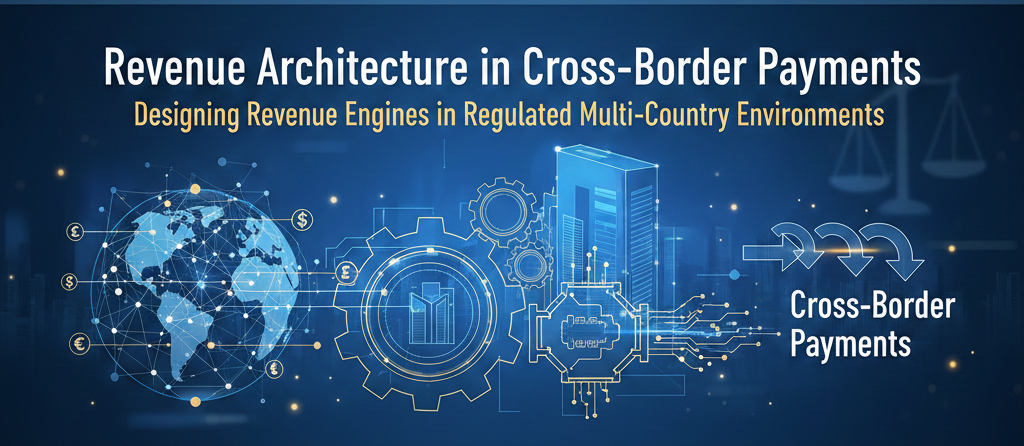
Revenue Architecture in Cross-Border Payments: Designing Revenue Engines in Regulated Multi-Country Environments

Professional digital banner for "Revenue Architecture in Cross-Border Payments," featuring a glowing global network, financial gear mechanisms, and circuit board motifs on a dark blue background to represent FinTech infrastructure and international regulation.

Revenue Architecture in Cross-Border Payments is the structural backbone of any serious multi-country fintech operating inside regulated environments. It determines how revenue behaves under licensing constraints, liquidity requirements, FX volatility, and compliance overhead, not just how revenue is booked in CRM dashboards. Too often, growth in cross-border payments is framed as a sales achievement. In … Read more

Global Revenue Systems: Designing for Multi-Market Growth

Professional horizontal banner with a dark teal and blue gradient background featuring the text "Designing Global Revenue Systems for Multi-Market Growth." The background includes an abstract network of interconnecting lines, arrows, and global currency symbols like the Dollar, Euro, and Yen.

Global revenue systems sit at the intersection of strategy, execution, and risk. Expanding internationally exposes businesses to regulatory friction, FX volatility, and culturally diverse buying behaviors. In my experience leading multi-country revenue operations in APAC, the same pricing strategy that worked in Singapore could erode margins by 8–12% in a neighboring market if applied blindly. … Read more

The Invisible Toll: Hidden Fees in Fintech Payments Are Not Accidental – They are the Business Model

A conceptual digital illustration titled "The Invisible Toll." It features a glowing, shattered glass credit card suspended over stacks of physical coins. Inside the card, glowing red, vein-like structures form a complex, tangled knot, representing a hidden system. Two small, glowing red figures stand on the coins, appearing to manipulate the card from below. The background is a dark, cinematic digital space filled with bokeh light patterns and data streams.

Hidden fees in fintech payments are not accidental pricing anomalies. They are a deliberate revenue architecture optimized for opacity. As cross border payment volumes scale; fintechs increasingly rely on FX spreads, routing deductions, and ancillary charges to subsidise ‘free’ or low headline cost products. While these fees partially compensate for genuine operational complexity, liquidity, compliance, fraud and regulatory fragmentation. Their concealment shifts them from cost recovery into value extraction. For enterprises, the impact is structural margin leakage, forecasting distortion, underpaid invoices, and silent erosion of supplier trust. At scale, hidden fees function as an ungoverned tax on global commerce.

Regulatory pressure and infrastructure advances are now compressing the industry’s ability to hide these costs. The next generation of winners will not eliminate fees, but will reprice trust through explicit FX, predictable settlement, and enterprise grade transparency. CXOs who accept ‘free’ pricing without interrogating its monetization mechanics are complicit in the leakage they later attempt to optimize away.

  • Hidden fees in fintech payments are intentional revenue levers; not system failures.
  • FX spreads and cross-border markups subsidize low headline pricing and growth.
  • Opacity preserves margins but destroys enterprise predictability and trust.
  • For businesses, hidden fees create material P&L leakage, not minor friction.
  • Infrastructure and regulation are reducing technical excuses for concealment.
  • Future winners will charge transparently, not necessarily cheaply.
  • CXOs who ignore fee mechanics outsource governance to payment vendors.

Read more