
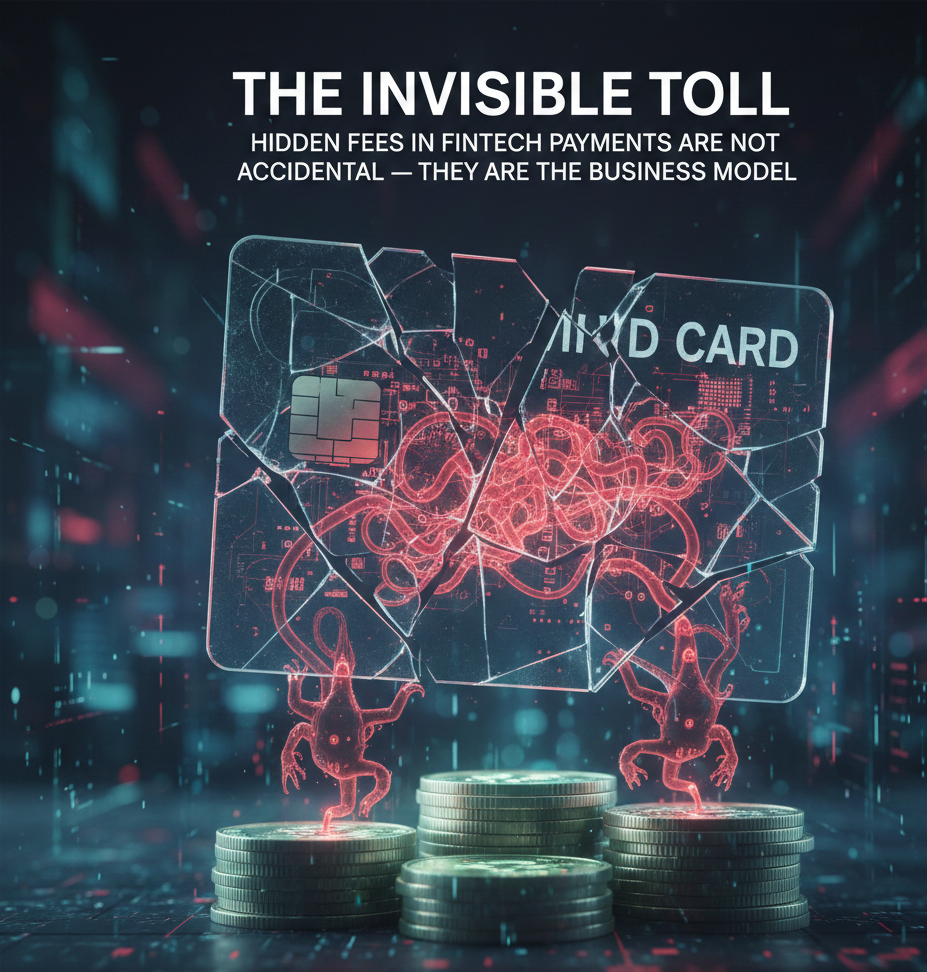
Hidden fees in fintech payments are not accidental pricing anomalies. They are a deliberate revenue architecture optimized for opacity. As cross border payment volumes scale; fintechs increasingly rely on FX spreads, routing deductions, and ancillary charges to subsidise ‘free’ or low headline cost products. While these fees partially compensate for genuine operational complexity, liquidity, compliance, fraud and regulatory fragmentation. Their concealment shifts them from cost recovery into value extraction. For enterprises, the impact is structural margin leakage, forecasting distortion, underpaid invoices, and silent erosion of supplier trust. At scale, hidden fees function as an ungoverned tax on global commerce.
Regulatory pressure and infrastructure advances are now compressing the industry’s ability to hide these costs. The next generation of winners will not eliminate fees, but will reprice trust through explicit FX, predictable settlement, and enterprise grade transparency. CXOs who accept ‘free’ pricing without interrogating its monetization mechanics are complicit in the leakage they later attempt to optimize away.
- Hidden fees in fintech payments are intentional revenue levers; not system failures.
- FX spreads and cross-border markups subsidize low headline pricing and growth.
- Opacity preserves margins but destroys enterprise predictability and trust.
- For businesses, hidden fees create material P&L leakage, not minor friction.
- Infrastructure and regulation are reducing technical excuses for concealment.
- Future winners will charge transparently, not necessarily cheaply.
- CXOs who ignore fee mechanics outsource governance to payment vendors.
Table of Contents
The Problem Most Leaders Underestimate
In global fintech, hidden fees are rarely a bug. They are a feature. A routine international payment still illustrates this point. A $100 transfer to a contractor appears ‘low-cost’ or even ‘free’ at initiation. Only after execution does the reality surface: a 3-4% FX spread embedded in the exchange rate that is layered with processing or routing fees that quietly remove another 1-2%. The sender pays more than expected; the recipient receives less than invoiced. What looked like efficiency ends up costing 5-7% of transaction value. This is not anecdotal. It is systemic. For CXOs operating cross-border supply chains, global payrolls, marketplaces or remote first teams, the issue is no longer whether hidden fees exist. It is whether these fees represent legitimate compensation for real complexity or a deliberate extraction strategy engineered to be invisible. The uncomfortable reality is that both can be true simultaneously.
Payments Scale Has Exploded, But Transparency Has Not
By 2024-25 global payments revenues reached approximately $2.4 Trillion annually with fintechs capturing a rapidly expanding share. Cross Border Flows, B2B trade, gig payouts, remittances, SaaS subscriptions remain the most profitable segment of the market. Not because they are the most technologically advanced but because they remain the least transparent. FX markups, intermediary deductions, cross-border processing and settlement charges generate billons in ancillary revenue. In many corridors 3-5% FX spreads remain standard practice even as infrastructure improves and marginal transaction cost fall. Executives should be explicit about what this means. Hidden fees are not a rounding error. They are a core monetization layer.
The Industry’s Defense and Why It Only Half Holds?
Fintech providers are correct about one thing, cross-border payments are operationally hard. Moving money internationally requires:
- Liquidity provisioning across currencies
- FX risk management and hedging
- Sanctions screening, AML and KYC enforcement
- Fraud prevention and chargeback coverage
- Regulatory compliance across fragmented jurisdictions
Traditional SWIFT based transfers can still involve engaging with multiple correspondent banks and each ensures in deducting fees and time. Costs of US$25-30 per transaction excluding FX remain common on legacy rails. Even modern fintech platforms incur meaningful costs. Liquidity must be per-funded. Compliance infrastructure scales with volume and not intent. Fraud losses are asymmetric. From this angel fees are not inherently abusive. They fund reliability, reach and risk absorption. That argument collapses when fees are designed intentionally to obscure rather than being explicitly priced.
Where the Models Breaks: Opacity as Strategy
The credibility problem begins when platforms embed value extraction in places users are least equipped to see it. FX spreads hidden inside exchange rates. ‘Free’ transfers monetized downstream. Weekend markups, cross-border card assessments, and settlement deductions revealed only after completion. This is not transparency failure. It is drip pricing (a tactic regulators already recognize in airlines, hospitality and telecom sector).
Platforms such as Paypal, Stripe, and other continue to generate significant margin from
- 3-4% FX conversion markups
- Cross-Border card assessments (1-2%)
- Withdrawal, settlement, and routing fees layered on top
Even fintechs positioning themselves as transparent are not immune. Revolut’s weekend FX surcharges are a reminder that fair pricing often degrades under scale and volatility. For enterprises, the damage compounds quietly:
- Invoices arrives underpaid
- Supplier margins erode
- Forecasts drift
- Reconciliation costs spike
- Trust degrades without single escalation
A US$1,000 invoice landing as US$940 is not friction. It is systematic value leakage.
The Trade-Off Leaders Avoid Naming
There is a strategic tension most fintech leaders understand but rarely articulate.
- Full Transparency compresses margins.
- Opacity preserves pricing power.
- Low Headline fees accelerate adoption.
Embedded FX spreads subsidize growth. This model allowed fintechs to scale faster than banks ever could. But it also created a structural trust deficit, especially among enterprises that prioritize predictability over UX novelty.
For CXO the trade off is unavoidable because they chose either of the one below options:
- Accept Opacity and Optimize for growth
- Or demand transparency and absorb higher visible costs.
There is no free lunch. What matters is whether customers understand which lunch they are being served with or without their discretion.
Regulations and Infrastructure Are Closing the Gap
By 2025 the external pressure is unmistakable. They are :
- EU regulators are pushing for clearer and transparent FX disclosure at point of transaction
- US policymakers are extending ‘junk fee’ scrutiny into financial services
- Cross Border transparency is increasingly framed as SME and consumer protection.
At the same time the technical excuses are eroding. Instant payment rails, localized routing, AI-driven path leading to optimization, and stablecoin based settlement are exposing how much of today’s fee stack reflects margin preservation rather than necessity. The question is no longer whether transparency will increase, but which business models survive when it does?
The Leadership Question That Actually Matters
Hidden fees did not emerge because fintech leaders are unethical. They emerged because:
- Growth was rewarded
- Margins were expected
- Transparency was optional
But in a hyper competitive and inter-connected digital world opacity becomes a real liability. The next generation of payments winners will not eliminate fees entirely- to imagine this is unrealistic.
They will re-price trust:
- Explicit FX
- Predictable settlement outcomes
- Fewer post transactions ad hoc deductions
- Enterprise grade disclosures aligned to real P&L impact.
For CXOs responsibility cut both ways. If you accept ‘free’ pricing models without interrogating how money is made, you are outsourcing to vendors and inheriting the leakage later. Efficiency that depends on invisibility is not efficiency. It is differed cost! Hidden fees are not inherently exploitative. But hidden fees that remain hidden by design eventually are. Fintechs promise was not just speed and access; it was better finance. That promise cannot survive if transparency is traded away for short term revenue optimization. The companies that win the next decade of global payments wont be the cheapest on surface They will be the ones disciplined enough to show where the money actually goes and strong enough to compete anyway but with transparency.
Source: ConsumerFinance, Wise, PayPal, Financialit, TheStar, Reuters, TOI, SBR
Disclaimer: This article reflects professional insights based on publicly available information, industry reports and anonymized experience as on December 2025. The contents are for informational only and does not constitute financial, investment or payment advice. Fees, pricing structures, and regulations vary by provider corridor and transaction type and may change without notice. Views expresses are personal and not affiliated with any organization.