The Quiet Destruction of Margin in Cross-Border Growth: How Expansion Strategies Erode P&L Before Leadership Notices

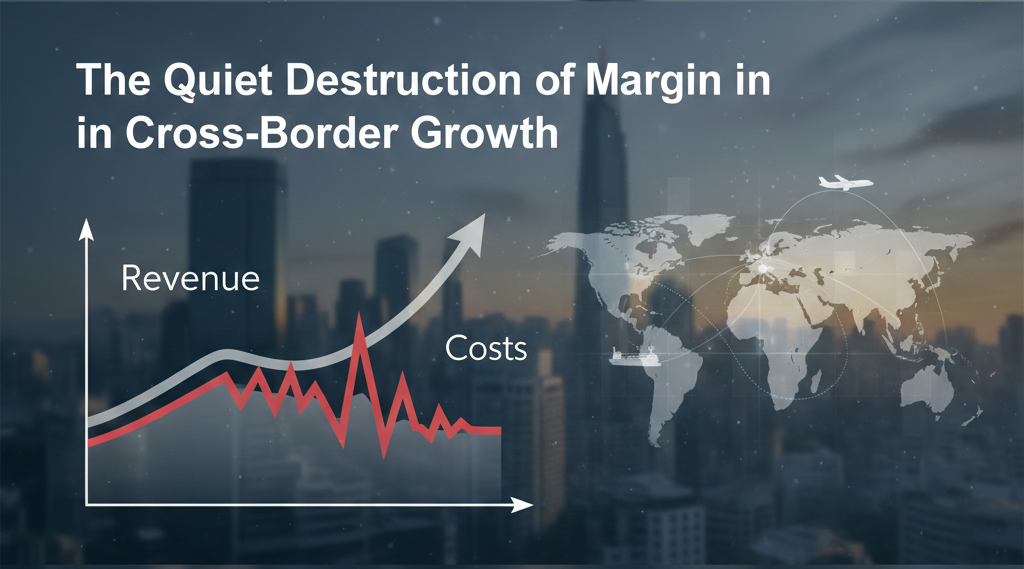
Business banner titled "The Quiet Destruction of Margin in Cross-Border Growth" featuring a financial graph where a rising revenue line is undercut by volatile red cost fluctuations against a global city backdrop.

The Quiet Destruction of Margin is rarely the result of a single bad decision. It is the cumulative outcome of well-intentioned growth layered on top of misunderstood power structures, regulatory latency, pricing optimism, and operational shortcuts that compound quietly until the P&L tells a story no one remembers authorizing.I have yet to see a cross-border … Read more

Asian and Southeast Asian FX Challenges: The Hidden Balance-Sheet Risk Boards Still Underestimate

Wide banner featuring the title "Asian and Southeast Asian Foreign Exchange (FX) challenges" over a futuristic skyline with financial data overlays and professionals analyzing currency trends.

Asian and Southeast Asian FX challenges are not theoretical market volatility problems. They are operational, regulatory, and authority distribution failures that compound quietly long before treasury flags a variance or finance books a miss. I have spent more than a decade operating inside cross-border payments, remittances, and embedded finance across regulated Asian and Southeast Asian … Read more

FX Transparency in Banking: Why Opaque Cross-Border Payments Still Destroy Trust

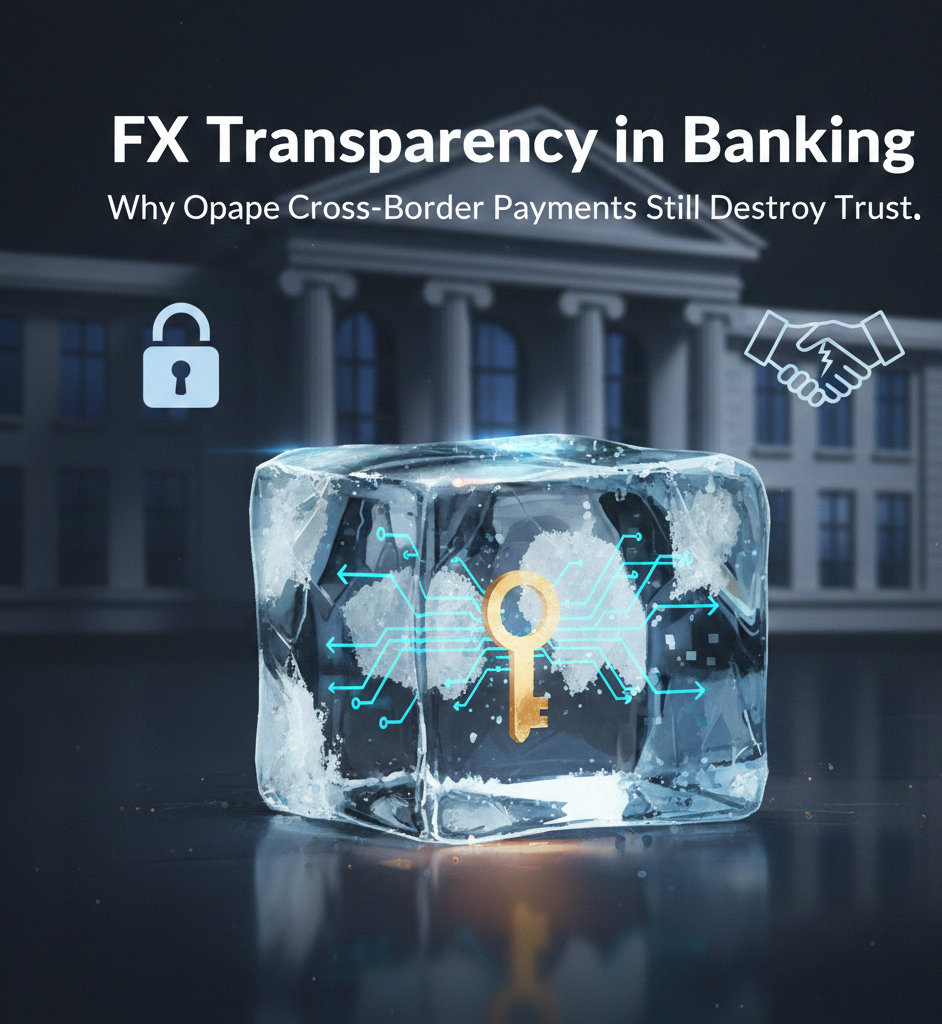
Conceptual image representing FX transparency in banking featuring a golden key frozen in an ice block in front of a bank building, illustrating why opaque cross-border payments destroy customer trust.

Executive Summary

FX transparency in banking is no longer a compliance discussion. It is a commercial reckoning. As cross-border payments volumes exceed $194 trillion annually and move towards $320 trillion by 2032, opaque foreign exchange pricing, embedded spreads, and undisclosed intermediary fees continue to extract billions from corporates and consumers while quietly eroding trust in traditional banking rails. Past misconduct from FX benchmark manipulation to rate opacity was not an anomaly but the predictable outcome of a system designed around limited visibility. This article examines why FX opacity persists, how it distorts P&L outcomes and operational predictability, and why banks that fail to adopt transparent FX models will steadily lose relevance to fintechs and regulator-backed alternatives.

FX opacity in banking is a structural profit centre masquerading as market complexity. Without full transparency on rates, spreads, and fees, trust will continue to collapse; and incumbents will keep losing ground to transparent, API-led competitors.
Read more

The Invisible Toll: Hidden Fees in Fintech Payments Are Not Accidental – They are the Business Model

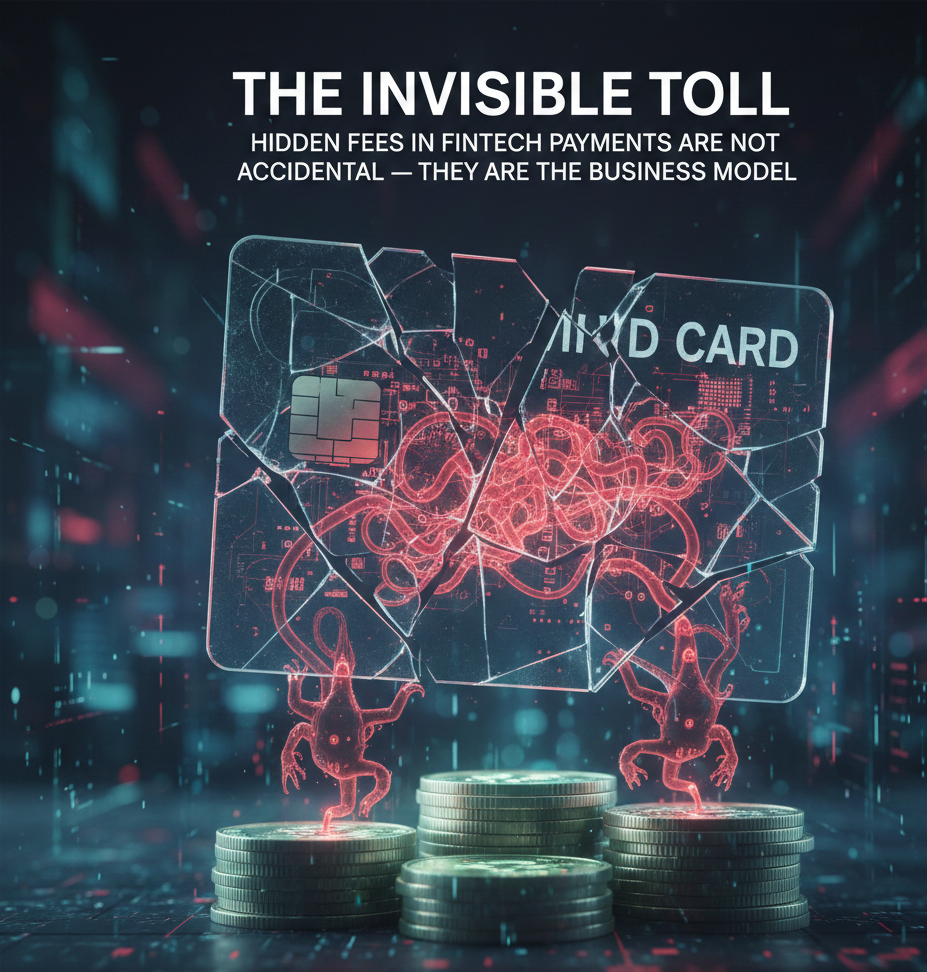
A conceptual digital illustration titled "The Invisible Toll." It features a glowing, shattered glass credit card suspended over stacks of physical coins. Inside the card, glowing red, vein-like structures form a complex, tangled knot, representing a hidden system. Two small, glowing red figures stand on the coins, appearing to manipulate the card from below. The background is a dark, cinematic digital space filled with bokeh light patterns and data streams.

Hidden fees in fintech payments are not accidental pricing anomalies. They are a deliberate revenue architecture optimized for opacity. As cross border payment volumes scale; fintechs increasingly rely on FX spreads, routing deductions, and ancillary charges to subsidise ‘free’ or low headline cost products. While these fees partially compensate for genuine operational complexity, liquidity, compliance, fraud and regulatory fragmentation. Their concealment shifts them from cost recovery into value extraction. For enterprises, the impact is structural margin leakage, forecasting distortion, underpaid invoices, and silent erosion of supplier trust. At scale, hidden fees function as an ungoverned tax on global commerce.

Regulatory pressure and infrastructure advances are now compressing the industry’s ability to hide these costs. The next generation of winners will not eliminate fees, but will reprice trust through explicit FX, predictable settlement, and enterprise grade transparency. CXOs who accept ‘free’ pricing without interrogating its monetization mechanics are complicit in the leakage they later attempt to optimize away.

  • Hidden fees in fintech payments are intentional revenue levers; not system failures.
  • FX spreads and cross-border markups subsidize low headline pricing and growth.
  • Opacity preserves margins but destroys enterprise predictability and trust.
  • For businesses, hidden fees create material P&L leakage, not minor friction.
  • Infrastructure and regulation are reducing technical excuses for concealment.
  • Future winners will charge transparently, not necessarily cheaply.
  • CXOs who ignore fee mechanics outsource governance to payment vendors.

Read more

Global Payments Trends 2025: Power Shifts, Risk Transfer, and Margin Compression Reshaping the Industry

Futuristic fintech graphic illustrating "Global Payments Trends 2025" for PaymentRails, featuring stablecoin and embedded payments data flowing into a "Leverage" lever, highlighting power shifts, risk transfer, and margin compression.

Global payments in 2025 are no longer a race for faster rails or broader reach. In 2025, the fintech landscape have matured beyond speed and reach. Real-time rails, APIs, and ISO 20022 are now baseline. The real transformation is structural: innovation redistributes control, margins, and balance-sheet risk—often from incumbents to platforms and fintechs.

For executives, the question shifts from “How do we innovate?” to “Who captures value as payments become invisible, programmable, and embedded?”

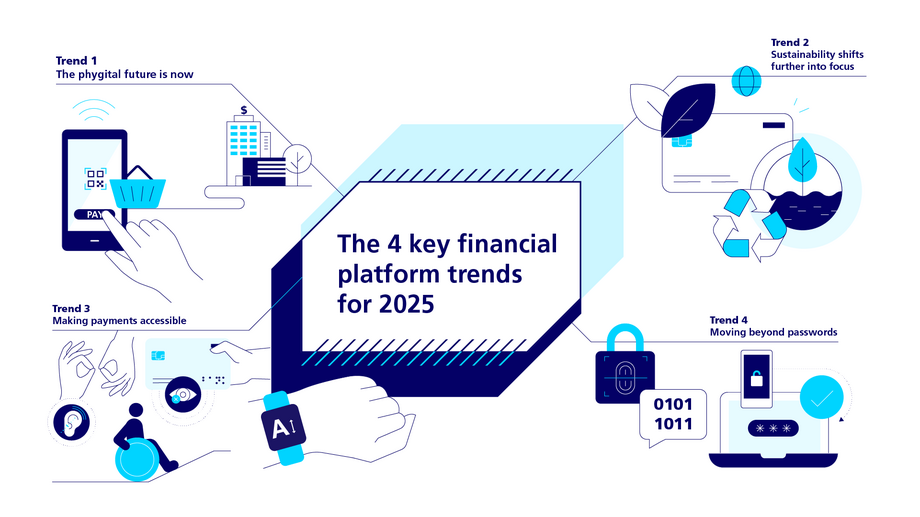
Spotlight-4-Key-Trends-Platforms

Executive Summary

Payments mechanics are converging into utilities. Differentiation now lies in data control, decision logic, risk governance, and margin defense amid automation.

Key forces:

  • Embedded finance transfers risk to distribution points.
  • Real-time systems unlock liquidity but heighten fragility.
  • Modular stacks accelerate commoditization.
  • AI reallocates margins probabilistically.
  • Sustainability incentives (or lack thereof) shape outcomes.

Leaders who explicitly govern these shifts will dominate; those relying on innovation alone risk value leakage.

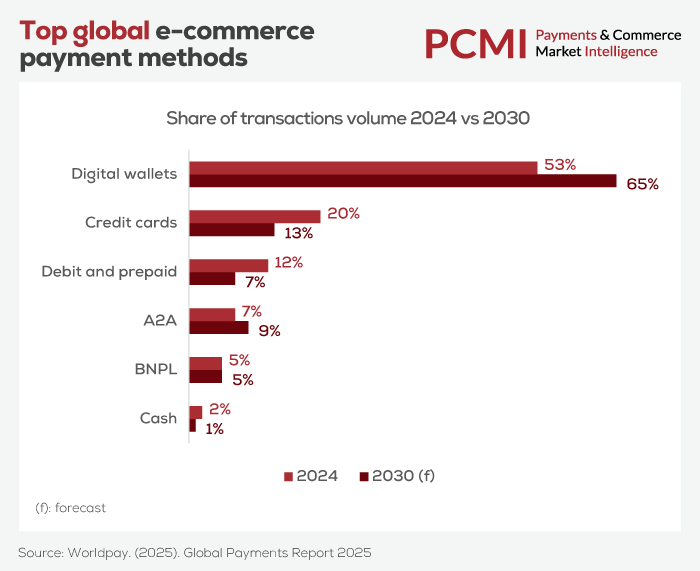
Top_Global_Payment_Methods_2025

Read more

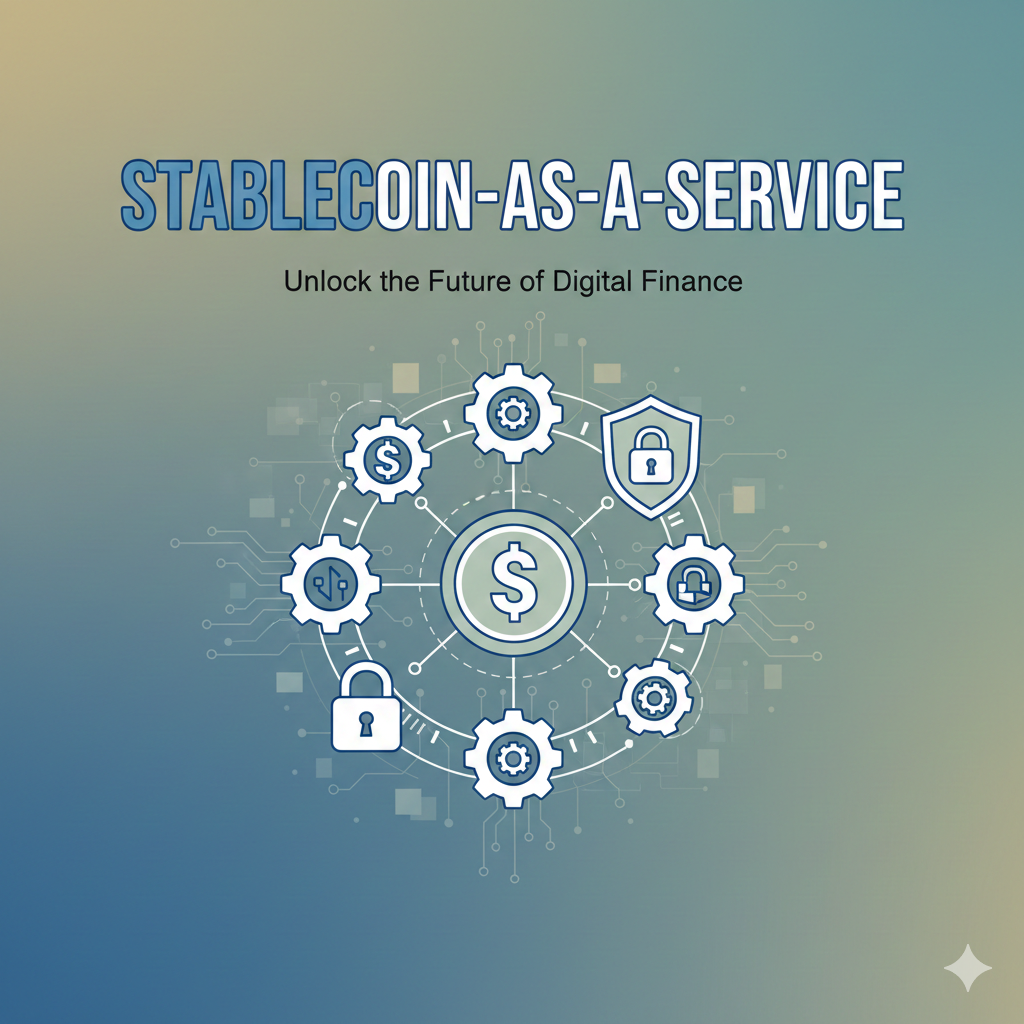
Stablecoin-as-a-Service: How Coinbase Is Building the Future of Global Payments

Chart showing stablecoin market capitalization growth to over $310 billion in December 2025, highlighting USDC and global adoption trends

Executive Summary

  • Stablecoin-as-a-service is moving payments from experimentation to production.
  • Coinbase is productizing USDC payments for merchants and enterprises at scale.
  • Distribution, regulation, and reserve economics form Coinbase’s first-mover moat.
  • Revenue is driven by volume, on-platform balances, and reserve yield sharing.
  • Execution risks remain: liquidity shocks, banking exposure, and regulation.
  • Success would position Coinbase as core payments infrastructure, not a crypto exchange.

Read more

The Growth and Future of Multirail Payment Ecosystems: Why “One Rail to Rule Them All” Is Dead”

Multirail payment ecosystems

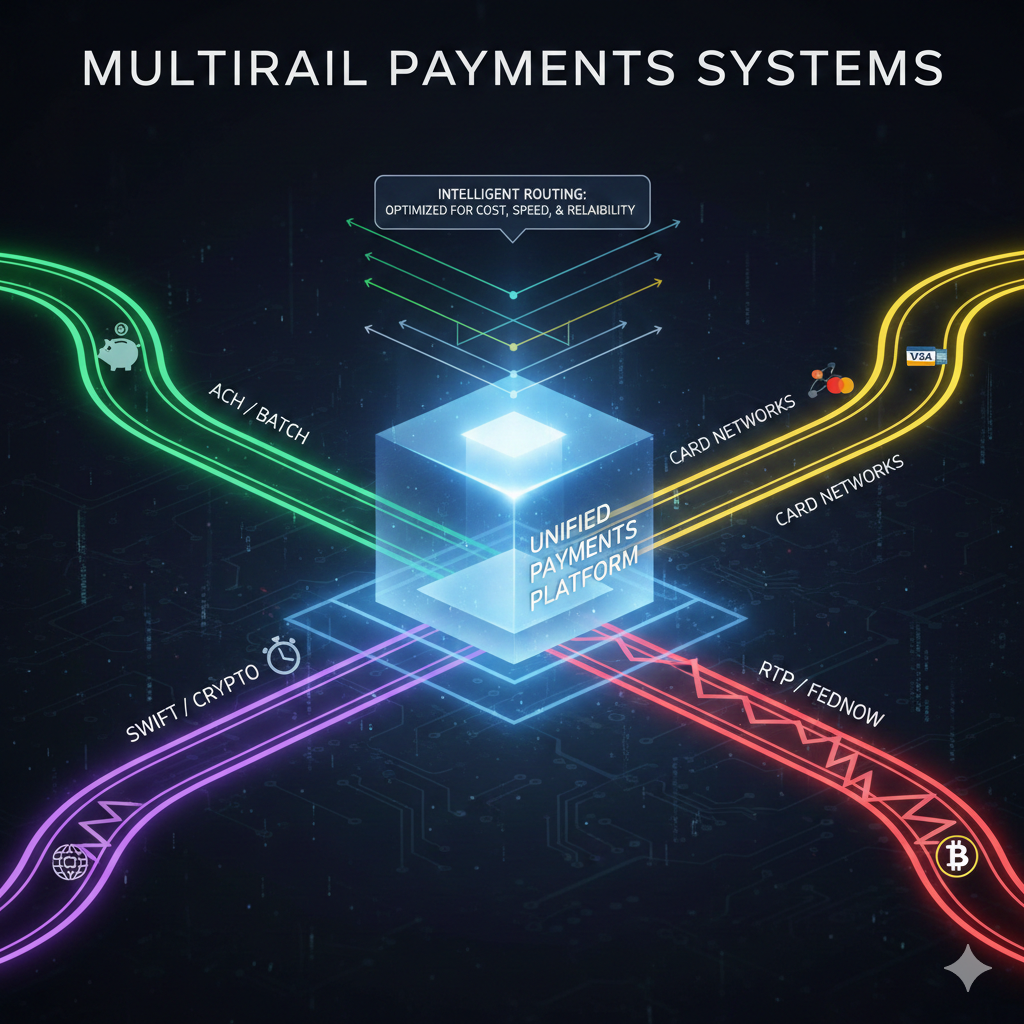
Multirail payment ecosystems are becoming the new operating system of global fintech as CXOs move beyond single-rail dependencies. Bold as many legacy-treasurers and CFOs may be, the era of a single dominant payment rail is over — and the real battleground will be defined by orchestration, not dominance. Real-time account-to-account (A2A) systems, diverse rails (cards, open-banking APIs, digital wallets, RTP networks) and AI-powered orchestration layers are converging. Boards that assume “cards + SWIFT = safe” are dangerously wrong. Here’s why most boards are getting this dangerously wrong — and what the top 1% are doing instead.

Executive Summary

Understanding Multirail Payment Ecosystems
  • Multirail convergence: A2A, real-time, cards, wallets — payment flows are fragmenting; orchestration is becoming the strategic asset.
  • A2A explosion: Real-time A2A is growing globally — >70 countries now support RTP; volumes to double by 2028.
  • Cost & speed advantage: A2A/instant rails threaten 15–25% of future card-transaction growth globally.
  • Interoperability as growth lever: True value lies in cross-rail and cross-border interoperability; fragmentation is the principal bottleneck.
  • AI-driven orchestration rising: AI routing and orchestration significantly reduce payment failures and improve efficiency.
  • Compliance & risk as strategic constraints: Regulatory, liquidity, FX, and fraud-management complexity demand re-architecting.

Read more