


Product-Market Fit: When Rational Foundations Collapse Under Organizational Entropy

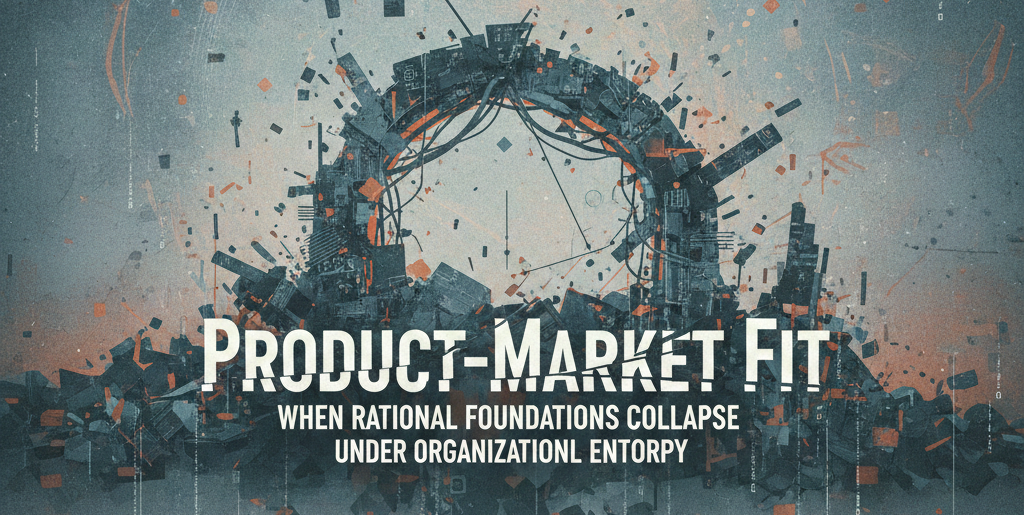
Product-Market Fit banner featuring a crumbling architectural structure representing organizational entropy, with high-contrast text overlay.

Executive Summary Product-Market Fit (PMF) is rarely the root cause of failure in enterprise payments, fintech, or regulated banking environments. Collapse more often follows PMF validation, when organizational entropy, the gradual degradation of coherence through ego, diluted competence, political layering, and misaligned incentives, outpaces governance discipline. Ethical foundations aligned to direct or latent market needs … Read more

Leadership Value: The $100 Barber Lesson on Pricing Transformation in Enterprise Payments

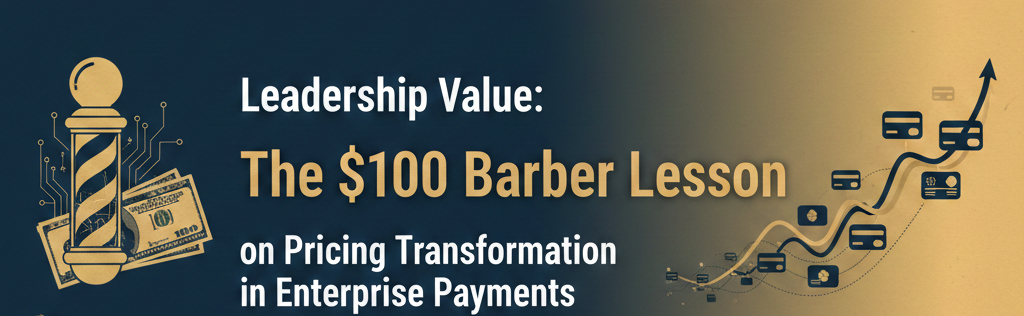
Professional banner for "Leadership Value: The $100 Barber Lesson on Pricing Transformation in Enterprise Payments." The design features a stylized gold barber pole, $100 bills, and an upward-trending financial growth graph with credit card icons on a sleek dark navy and gold gradient background.

Leadership Value is the actual product in enterprise payments, even when we pretend it is technology. In late 2025, a barber went viral explaining why he charges $100+ for a haircut. He doesn’t sell fades. He sells confidence. The mirror is incidental. The transformation temporary or not is the value. Strip away the theatrics, and … Read more

Client Escalation Is a Margin Event: How SVP Revenue Leaders Defend P&L While Preserving Enterprise Relationships

A professional corporate banner with a dark navy blue background featuring a blurred cityscape and silhouettes of business professionals. The left side displays a gold line graph icon and the bold white text "ESCALATION IS A MARGIN EVENT." The right side contains the subtext "Learn How SVP Revenue Leaders Defend P&L While Preserving Enterprise Relationships" next to a small gold shield icon. A "ProfitGuard Advisors" logo is in the bottom right corner.

Client Escalations are never just emotional, they are economic precursor of incoming. In enterprise fintech, payments, or regulated B2B environments, a single client escalation can represent: 8-20% of annual revenue concentration, multi-year contract exposure, renewal risk cascading across regions, immediate margin compression, internal delivery burnout and board-level reporting implications When escalations hit the executive layer, … Read more

Information and Communication Are the Stealth Pillars of Stable Management

Professional corporate banner featuring the quote "Information and Communication are the Stealth Pillars of Stable Management" in white sans-serif font over a dark blue digital background with glowing technological pillars.

Information and communication underpin every resilient management system, yet they are rarely treated as core leadership duties. Organizations preach transparency while quietly punishing anyone who demands real context. The result: management layers that look aligned until stress reveals the shallow shared understanding. When information routes through people instead of systems, leaders don’t manage, they become … Read more

Stakeholder Management is not a Soft Skill. It is the Operating System of Strategy.

A weathered bronze plaque mounted on a stone wall featuring the embossed text: "Stakeholder Management is not a Soft Skill. It is the Operating System of Strategy."

Stakeholder management is routinely discussed in leadership forums as a communication skill or a cultural competency. In boardrooms, it is still too often treated as an execution detail important, but delegable. That framing is no longer tenable. In regulated, politically layered markets across APAC, stakeholder management has become a first-order governance variable. Strategies do not … Read more

The Perils of Epicaricacy: A Quiet Leadership Instinct!

An antique parchment scroll banner featuring the title "THE PERILS OF EPICARICACY: A QUIET LEADERSHIP INSTINCT!" The center contains an illustration of a lone silhouette standing on a cliff overlooking a crumbling castle under a stormy sky, framed by a border of thorns.

The Perils of Epicaricacy: A Quiet Leadership Instinct I Had to Unlearn. I didn’t recognize it the first time it happened. A competitor I knew reasonably well lost a key regulatory approval. Nothing dramatic, no headlines, no scandal. Just a delayed expansion that quietly stalled their momentum. I remember reading the update on my phone between meetings. My first reaction wasn’t concern.

It was relief. I didn’t smile. I didn’t say anything out loud. But internally, something loosened. Pressure eased. The bar felt lower for a moment. And that’s what bothered me later, not the thought itself, but how natural it felt. There’s a word for that reaction: epicaricacy. Most people know it as schadenfreude—taking pleasure, however small, in someone else’s misfortune. I used to think this was a personal flaw you either had or didn’t. Over time, I’ve come to see it differently. In senior leadership roles, especially in competitive and regulated environments, this instinct is surprisingly easy to acquire and dangerously hard to notice. Not because leaders are malicious. But because the conditions quietly reward it. I know some will agree and others won’t. But this exist.

Read more

Great Leaders Prioritize People — The Uncomfortable Economics of Talent in Global Payments

Futuristic digital graphic with a light yellow background and tech-circuitry patterns featuring the centered text "Great Leaders Prioritize People."

Great Leaders have far farsightedness. In Global Payments and cross-border payments talent decisions are more than HR. They are economic imperatives with long term consequences. Leaders who strategically invest in skilled teams, compliance expertise, and managerial capability drive higher profitability, operational resilience, and regulatory compliance. This article explore the uncomfortable trade-offs between short-term margin protection and long-term execution capacity, offering insights for CXOs navigating APAC payments infrastructure, fintech workforce strategy, and banking automation challenges.