



Global Payments Leadership: When to Guide and When to Step Back for Growth?

A professional split-screen banner for "Global Payments Leadership." The left side shows a diverse team of executives standing on a digital globe with the text "When to Guide..." The right side features a glowing upward arrow with professionals ascending, accompanied by the text "...and when to step back for growth?" The design uses a sophisticated blue and gold color palette.

Global payments remain high-friction: layered correspondent networks, FX swings, multi-jurisdictional compliance (e.g., evolving PSD3 in Europe, APAC data residency rules, African instant-payment mandates), and now agentic AI introducing autonomous transaction flows. Leaders face the perennial question: When to step in versus step back?From scaling operations in APAC (real-time schemes like FAST/UPI linkages) and Africa I … Read more

AI in Enterprise Contract Negotiation: Why Human Oversight Still Protects Margin, Risk, and Regulatory Exposure?

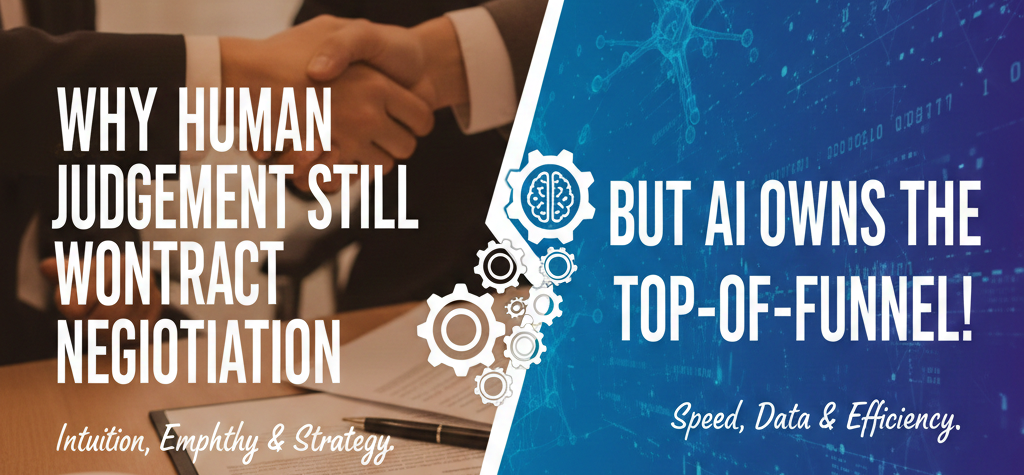
A split-screen banner showing a professional handshake in a law office on the left and a digital blue neural network on the right, representing the balance between human judgment in negotiations and AI efficiency in top-of-funnel lead generation.

AI in Enterprise Contract Negotiation conversation has matured. The question is no longer whether AI can draft clauses or suggest redlines. It can. The real question is governance: Where must optimization stop and executive accountability begin? In enterprise payments and cross-border fintech, contracts do not simply close revenue. They allocate: In APAC markets, operational resilience … Read more

Information and Communication Are the Stealth Pillars of Stable Management

Professional corporate banner featuring the quote "Information and Communication are the Stealth Pillars of Stable Management" in white sans-serif font over a dark blue digital background with glowing technological pillars.

Information and communication underpin every resilient management system, yet they are rarely treated as core leadership duties. Organizations preach transparency while quietly punishing anyone who demands real context. The result: management layers that look aligned until stress reveals the shallow shared understanding. When information routes through people instead of systems, leaders don’t manage, they become … Read more

Stakeholder Management is not a Soft Skill. It is the Operating System of Strategy.

A weathered bronze plaque mounted on a stone wall featuring the embossed text: "Stakeholder Management is not a Soft Skill. It is the Operating System of Strategy."

Stakeholder management is routinely discussed in leadership forums as a communication skill or a cultural competency. In boardrooms, it is still too often treated as an execution detail important, but delegable. That framing is no longer tenable. In regulated, politically layered markets across APAC, stakeholder management has become a first-order governance variable. Strategies do not … Read more

Regional Growth Leakage: Why FX, Liquidity, and Governance Gaps Are Quietly Destroying Expansion ROI

Professional business banner titled Regional Growth Leakage featuring a world map background, a cracked piggy bank leaking currency, and a declining financial bar chart representing FX and liquidity gaps.

Regional Growth Leakage is rarely announced in earnings calls. It doesn’t trigger regulatory enforcement letters.It doesn’t look like a crisis. Yet across APAC, Africa, and emerging cross-border payments corridors, I’ve watched otherwise strong regional expansion strategies lose 8-20% of their expected ROI, not because demand was wrong, but because FX mechanics, liquidity sequencing, and governance … Read more

The Perils of Epicaricacy: A Quiet Leadership Instinct!

An antique parchment scroll banner featuring the title "THE PERILS OF EPICARICACY: A QUIET LEADERSHIP INSTINCT!" The center contains an illustration of a lone silhouette standing on a cliff overlooking a crumbling castle under a stormy sky, framed by a border of thorns.

The Perils of Epicaricacy: A Quiet Leadership Instinct I Had to Unlearn. I didn’t recognize it the first time it happened. A competitor I knew reasonably well lost a key regulatory approval. Nothing dramatic, no headlines, no scandal. Just a delayed expansion that quietly stalled their momentum. I remember reading the update on my phone between meetings. My first reaction wasn’t concern.

It was relief. I didn’t smile. I didn’t say anything out loud. But internally, something loosened. Pressure eased. The bar felt lower for a moment. And that’s what bothered me later, not the thought itself, but how natural it felt. There’s a word for that reaction: epicaricacy. Most people know it as schadenfreude—taking pleasure, however small, in someone else’s misfortune. I used to think this was a personal flaw you either had or didn’t. Over time, I’ve come to see it differently. In senior leadership roles, especially in competitive and regulated environments, this instinct is surprisingly easy to acquire and dangerously hard to notice. Not because leaders are malicious. But because the conditions quietly reward it. I know some will agree and others won’t. But this exist.

Read more

From Engagement Theater to Economic Signal: Turning Customer Interaction into Measurable Business Impact

Split-screen business banner showing a transition from blue "Engagement Theater" with digital customer interactions to an orange "Economic Signal" with a rising growth chart and currency symbols, illustrating measurable business impact.

Engagement with customer is treated as article of faith in most boardrooms. Dashboards glow with NPS scores, app DAUs, click-through rates, and campaign attribution charts dense enough to intimidate a data scientist. The assumption is implicit and rarely challenged: more engagement equals more value.

After nearly two decades operating inside regulated, multi-country payments businesses across APAC, I no longer accept that assumption. I have seen organizations with world-class engagement metrics quietly destroy margin. I have also watched others with modest, almost non-glamorous customer interaction outperform peers on cash generation, renewal durability, and regulatory survivability. The difference was never how much customers engaged. It was whether engagement was engineered as an economic signal or left as theater.

This article examines the uncomfortable trade-offs leaders face when attempting to convert customer engagement into measurable business impact. Not marketing impact. Not sentiment. P&L impact. And why most engagement strategies fail precisely because they avoid those trade-offs.

Read more

The Quiet Destruction of Margin in Cross-Border Growth: How Expansion Strategies Erode P&L Before Leadership Notices

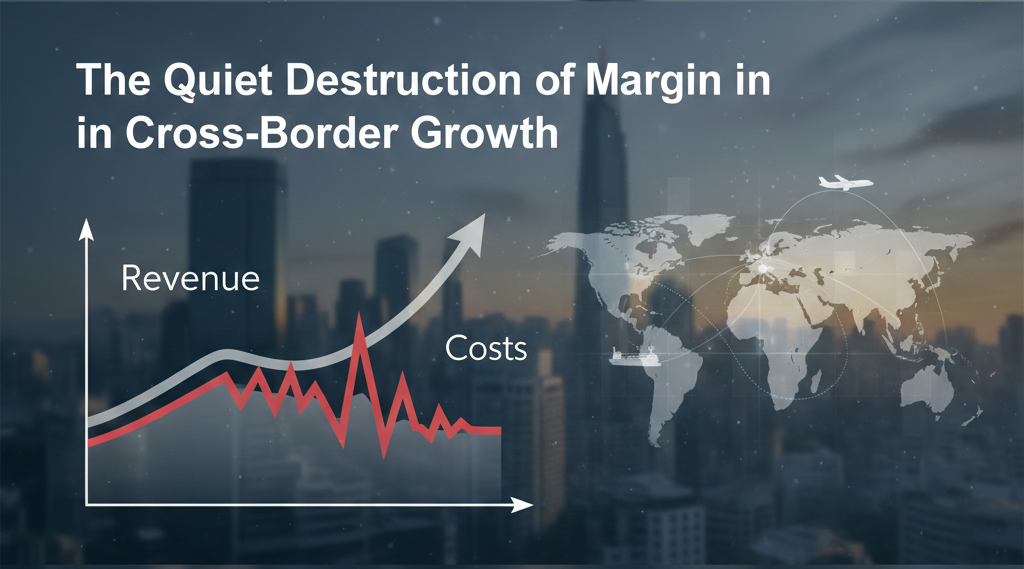
Business banner titled "The Quiet Destruction of Margin in Cross-Border Growth" featuring a financial graph where a rising revenue line is undercut by volatile red cost fluctuations against a global city backdrop.

The Quiet Destruction of Margin is rarely the result of a single bad decision. It is the cumulative outcome of well-intentioned growth layered on top of misunderstood power structures, regulatory latency, pricing optimism, and operational shortcuts that compound quietly until the P&L tells a story no one remembers authorizing.I have yet to see a cross-border … Read more

Asian and Southeast Asian FX Challenges: The Hidden Balance-Sheet Risk Boards Still Underestimate

Wide banner featuring the title "Asian and Southeast Asian Foreign Exchange (FX) challenges" over a futuristic skyline with financial data overlays and professionals analyzing currency trends.

Asian and Southeast Asian FX challenges are not theoretical market volatility problems. They are operational, regulatory, and authority distribution failures that compound quietly long before treasury flags a variance or finance books a miss. I have spent more than a decade operating inside cross-border payments, remittances, and embedded finance across regulated Asian and Southeast Asian … Read more

Decision Velocity: The Only C‑Suite Metric That Matters in 2026 And the Governance Failure It Quietly Introduces

Decision Velocity graphic for Stratvaults featuring a terracotta winged arrow and circuit board icon on a light golden background, symbolizing AI-driven executive speed and strategy in the agentic web.

Decision Velocity, the capacity to make high‑stakes decisions with incomplete, contradictory, or time‑degrading information has become a defining executive differentiator in 2026. In fintech, cross‑border payments, and regulated infrastructure, speed of judgment now separates firms that adapt from those that stall.
But Decision Velocity is not a pure virtue. Boards that celebrate speed without recalibrating governance, risk ownership, and accountability structures are creating a new failure mode: fast decisions with slow institutional understanding. This article examines why Decision Velocity now dominates C‑suite performance and where it quietly breaks organizations when boards fail to evolve alongside it.

Read more