




The Perils of Epicaricacy: A Quiet Leadership Instinct!

An antique parchment scroll banner featuring the title "THE PERILS OF EPICARICACY: A QUIET LEADERSHIP INSTINCT!" The center contains an illustration of a lone silhouette standing on a cliff overlooking a crumbling castle under a stormy sky, framed by a border of thorns.

The Perils of Epicaricacy: A Quiet Leadership Instinct I Had to Unlearn. I didn’t recognize it the first time it happened. A competitor I knew reasonably well lost a key regulatory approval. Nothing dramatic, no headlines, no scandal. Just a delayed expansion that quietly stalled their momentum. I remember reading the update on my phone between meetings. My first reaction wasn’t concern.

It was relief. I didn’t smile. I didn’t say anything out loud. But internally, something loosened. Pressure eased. The bar felt lower for a moment. And that’s what bothered me later, not the thought itself, but how natural it felt. There’s a word for that reaction: epicaricacy. Most people know it as schadenfreude—taking pleasure, however small, in someone else’s misfortune. I used to think this was a personal flaw you either had or didn’t. Over time, I’ve come to see it differently. In senior leadership roles, especially in competitive and regulated environments, this instinct is surprisingly easy to acquire and dangerously hard to notice. Not because leaders are malicious. But because the conditions quietly reward it. I know some will agree and others won’t. But this exist.
Read more

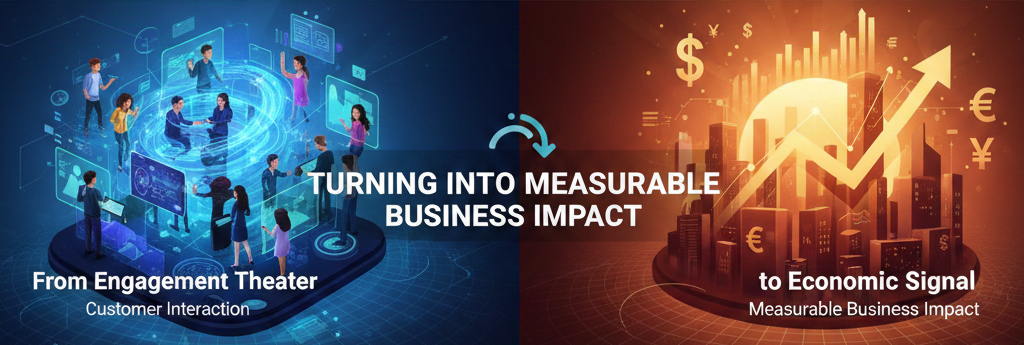
From Engagement Theater to Economic Signal: Turning Customer Interaction into Measurable Business Impact

Split-screen business banner showing a transition from blue "Engagement Theater" with digital customer interactions to an orange "Economic Signal" with a rising growth chart and currency symbols, illustrating measurable business impact.

From engagement theatre to economic signal with customer is treated as article of faith in most boardrooms. Dashboards glow with NPS scores, app DAUs, click-through rates, and campaign attribution charts dense enough to intimidate a data scientist. The assumption is implicit and rarely challenged: more engagement equals more value.

After nearly two decades operating inside regulated, multi-country payments businesses across APAC, I no longer accept that assumption. I have seen organizations with world-class engagement metrics quietly destroy margin. I have also watched others with modest, almost non-glamorous customer interaction outperform peers on cash generation, renewal durability, and regulatory survivability. The difference was never how much customers engaged. It was whether engagement was engineered as an economic signal or left as theater.

This article examines the uncomfortable trade-offs leaders face when attempting to convert customer engagement into measurable business impact. Not marketing impact. Not sentiment. P&L impact. And why most engagement strategies fail precisely because they avoid those trade-offs.

Read more

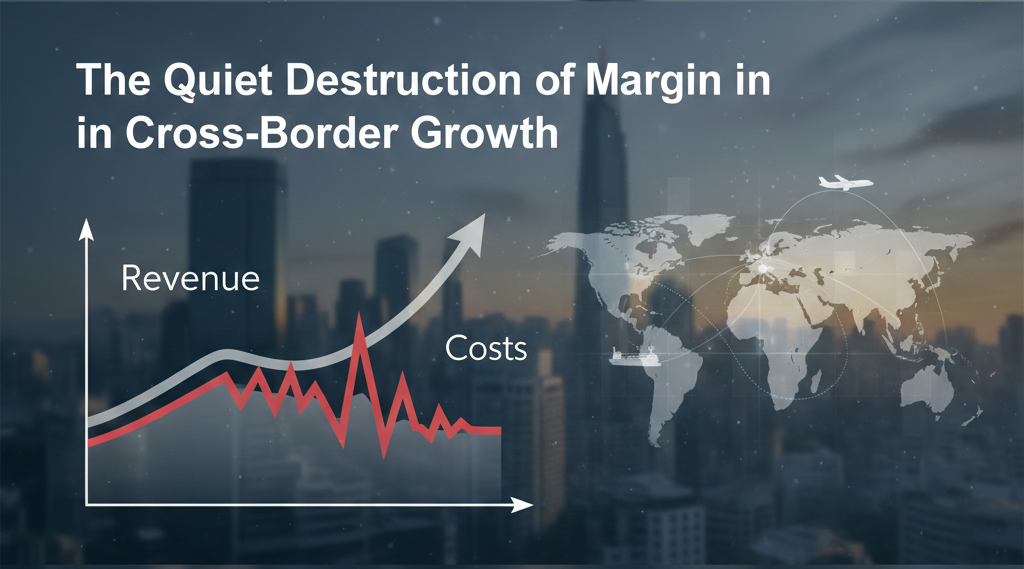
The Quiet Destruction of Margin in Cross-Border Growth: How Expansion Strategies Erode P&L Before Leadership Notices

Business banner titled "The Quiet Destruction of Margin in Cross-Border Growth" featuring a financial graph where a rising revenue line is undercut by volatile red cost fluctuations against a global city backdrop.

The Quiet Destruction of Margin is rarely the result of a single bad decision. It is the cumulative outcome of well-intentioned growth layered on top of misunderstood power structures, regulatory latency, pricing optimism, and operational shortcuts that compound quietly until the P&L tells a story no one remembers authorizing.I have yet to see a cross-border … Read more

Asian and Southeast Asian FX Challenges: The Hidden Balance-Sheet Risk Boards Still Underestimate

Wide banner featuring the title "Asian and Southeast Asian Foreign Exchange (FX) challenges" over a futuristic skyline with financial data overlays and professionals analyzing currency trends.

Asian and Southeast Asian FX challenges are not theoretical market volatility problems. They are operational, regulatory, and authority distribution failures that compound quietly long before treasury flags a variance or finance books a miss. I have spent more than a decade operating inside cross-border payments, remittances, and embedded finance across regulated Asian and Southeast Asian … Read more

Decision Velocity: The Only C‑Suite Metric That Matters in 2026 And the Governance Failure It Quietly Introduces

Decision Velocity graphic for Stratvaults featuring a terracotta winged arrow and circuit board icon on a light golden background, symbolizing AI-driven executive speed and strategy in the agentic web.

Decision Velocity, the capacity to make high‑stakes decisions with incomplete, contradictory, or time‑degrading information has become a defining executive differentiator in 2026. In fintech, cross‑border payments, and regulated infrastructure, speed of judgment now separates firms that adapt from those that stall.
But Decision Velocity is not a pure virtue. Boards that celebrate speed without recalibrating governance, risk ownership, and accountability structures are creating a new failure mode: fast decisions with slow institutional understanding. This article examines why Decision Velocity now dominates C‑suite performance and where it quietly breaks organizations when boards fail to evolve alongside it.

Read more

The Phantom P&L: Why Your APAC Payment Corridor Is Bleeding Revenue Through Authority Gaps

Here are the individual text elements for your image: Alt Text "The Phantom P&L" written in a terracotta-colored, Gothic-style font centered on a solid light green background

Phantom P&L is the revenue loss that never appears on your income statement, but quietly erodes your APAC payment corridors through authorization latency. In 2020, I watched a South Asia based fintech lose $4.2M in six months on a single cross-border corridor (SGD-IDR-USD). Not from fraud. Not from regulatory rejection. But from authorization latency.

The country manager in Jakarta had accountability for $18M annual revenue. She lacked authority to approve vendor contracts above SGD20,000 without cascading sign-offs through Regional HQ. A critical liquidity provider switch necessary because Bank Indonesia (BI) suddenly required enhanced KYC documentation and it stalled for 11 weeks. During those 77 days, transactions routed through a backup corridor charging 34 bps higher FX spreads. The leakage was $47,000 daily. By the time we got the approval for the vendor change, the original liquidity provider had frozen their facility entirely under new BI guidance.

This is not “accountability without authority.” This is the Phantom P&L—a shadow profit-and-loss center created when regulatory compliance owns the no but operational leadership owns the failure.

Read more

Recovering Credibility After an Executive Escalation: The High Cost of the “Yes” Man!

A professional graphic designed for corporate leadership and management training. The image features high-contrast blue typography against a vibrant yellow background, highlighting the title "Recovering Credibility After An Executive Escalation." This visual serves as a primary header for articles, blog posts, or LinkedIn content focused on crisis management, professional reputation repair, and workplace communication strategies. It is optimized for professionals seeking actionable advice on navigating high-stakes office dynamics and restoring their standing with senior leadership.

Recovering credibility in enterprise fintech infrastructure, particularly regarding cross-border payments in APAC, is the most dangerous stance for a revenue leader to take, as it often leads to an unqualified early “yes” when underlying constraints make delivery improbable.

I walked into the wreckage of exactly that decision about few years ago. A Tier‑1 global corporate client had been sold a “rapid go‑live” narrative for a multi‑corridor integration that casually dismissed the realities of APAC regulatory onboarding, fragmented liquidity provisioning, and our own engineering capacity. By the time the account landed on my desk, dissatisfaction had already metastasized into a full executive escalation. Termination language was on the table. Our CEO, CRO, and executive leadership were all copied in emails. Nobody was talking about solutions anymore, only blame.

What followed wasn’t a heroic recovery driven by speed or persuasion. We clawed the account back by doing the one thing enterprise clients never expect from a vendor under fire: we slowed everything down deliberately, publicly, and without mitigation language.

That decision carried real cost. It also permanently reshaped how I think about credibility, GTM discipline, and executive judgment in regulated markets.


Read more

Leadership’s Harsh Reality in 2026: There Is No Predefined Road its Only the Costly Movement of Walking the Talk

Bold orange 3D typography reading 'LEADERSHIP REALITIES' centered on a clean, light off-white textured background.

In 2026, true leadership isn’t about perfect plans or rigid roadmaps-it’s the costly, authentic act of walking the talk amid agentic AI acceleration, geopolitical fragmentation, and capital discipline. Discover why CXOs must embrace visible movement over illusory predictability to build credibility, navigate trade-offs, and forge progress in a world with no predefined path. Will you pay the price of real leadership?

Banking Automation Didn’t Fix Cross-Border Payments. It Just Moved the Hidden Risk!

A conceptual infographic showing a blue gear labeled "Automation" passing an arrow to a burning gear labeled "Risk" over a world map, titled "Banking Automation Didn’t Fix Cross-Border Payments. It Just Moved the Risk!"

Banking Automation has unquestionably improved the mechanics of global and cross-border payments. Settlement is faster. Reconciliation is cleaner. Fraud detection is sharper.
But after nearly 2 decades operating inside regulated, high-friction payment corridors; particularly across APAC, I have learned a harder truth: automation doesn’t eliminate risk, it re-distributes it.

Speed replaces visibility. Efficiency trades off against regulatory resilience. AI closes one class of fraud while quietly opening another.

Great Leaders Prioritize People — The Uncomfortable Economics of Talent in Global Payments

Futuristic digital graphic with a light yellow background and tech-circuitry patterns featuring the centered text "Great Leaders Prioritize People."

Great Leaders have far farsightedness. In Global Payments and cross-border payments talent decisions are more than HR. They are economic imperatives with long term consequences. Leaders who strategically invest in skilled teams, compliance expertise, and managerial capability drive higher profitability, operational resilience, and regulatory compliance. This article explore the uncomfortable trade-offs between short-term margin protection and long-term execution capacity, offering insights for CXOs navigating APAC payments infrastructure, fintech workforce strategy, and banking automation challenges.