RBI’s Silver Loan Policy 2026 Unlock Household Wealth or Create New Credit Risks

A diverse team of professionals collaborating in a high-tech office environment. A woman stands pointing at a large digital screen displaying various data charts and graphs, while a man in the foreground interacts with a glowing 3D holographic interface. Other team members use laptops and digital tablets, symbolizing modern financial analysis, innovation, and strategic data-driven decision-making.

RBI Silver Loan Policy 2026: From April 2026, RBI allows loans against silver jewellery and coins, formalizing significant dormant household wealth. Short-term, secured credit can boost inclusion and consumption, but volatility, valuation disputes, and uneven rollout create real execution risks. Success hinges on lenders balancing access with disciplined underwriting.

Executive Summary

RBI’s Lending Against Gold and Silver Collateral Directions, 2025 introduces silver as formal collateral from April 2026. This policy:

  • Enables households, especially in rural and semi-urban India, to pledge silver jewellery and coins for short-term loans.
  • Introduces tiered LTV ratios (75–85%) and bullet repayment structures.
  • Offers potential to mobilise billions to trillions in idle household wealth into productive credit.
  • Carries execution risks: volatility, valuation disputes, uneven rollout, and potential over reliance on short-term credit.
  • Creates a strategic tension: access vs discipline, growth vs risk, and short-term liquidity vs long-term credit health.

The reform is timely but its impact depends on lenders’ pricing strategies, risk management, and rural penetration.

Read more

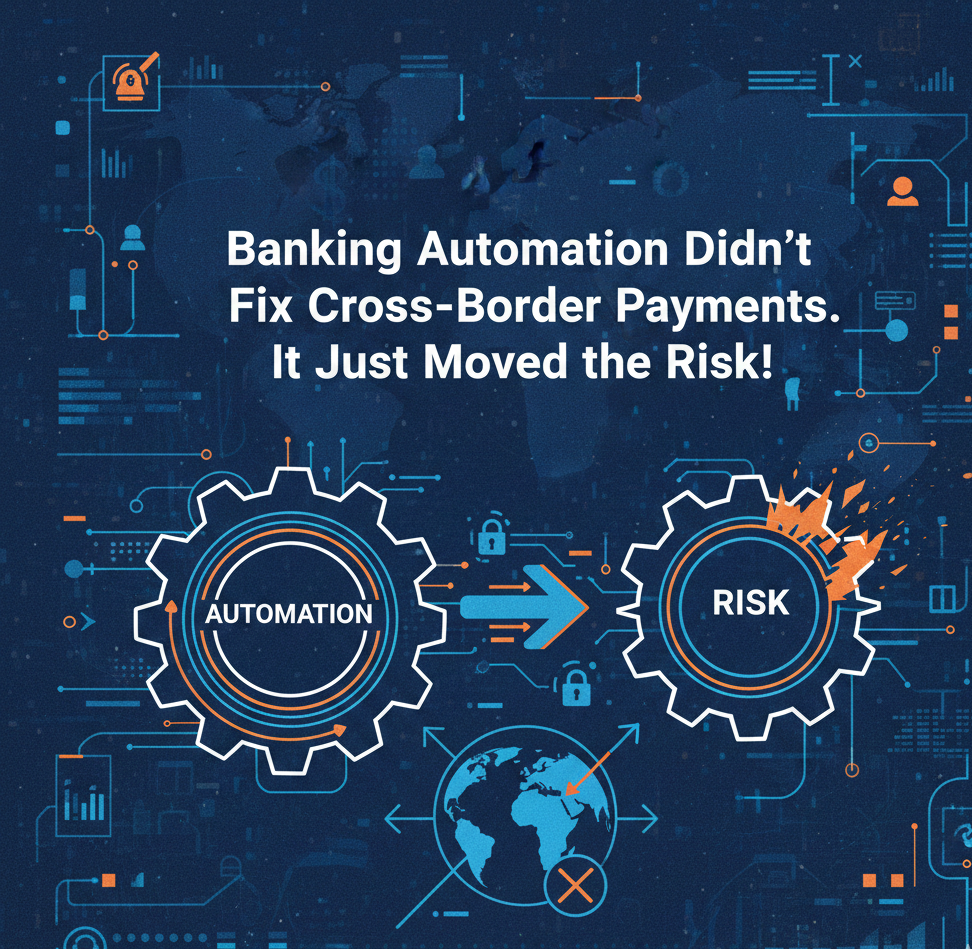
Banking Automation in Transition for Global Payments

Banking Automation Futuristic digital globe illustrating global payment networks with interconnected nodes, glowing data streams, and abstract financial connections on a dark blue background. Centered bold white text reads: 'Banking Automation in Transition for Global Payments

Executive Summary

Banking automation in global payments has crossed a structural tipping point. What was once a back-office efficiency initiative is now a decisive power shift that determines who controls customer relationships, data, and margins.

Standardization through ISO 20022 and real-time payment rails reduces friction—but it also commoditizes differentiation. Banks that treat automation as compliance plumbing will meet regulatory deadlines and still lose pricing power. Those that treat it as a data and intelligence foundation can reclaim margin through orchestration, risk ownership, and value-added services.

Real-time payments and AI-driven automation fundamentally change risk dynamics. Speed without end-to-end automation amplifies fraud, liquidity stress, and operational failure. Partial automation is worse than none. AI accelerates both value creation and error propagation; without clean data and clear commercial ownership, it becomes a regulatory and revenue liability.

The core leadership trade-offs are unavoidable:

  • Control vs. convenience in build-versus-partner decisions
  • Speed vs. risk containment in real-time rails
  • Compliance vs. monetization in ISO 20022 adoption

Over the next 12–36 months, banks will diverge sharply. Some will modernize on paper—compliant, connected, and operationally busy—yet continue to cede margin and customer ownership. Others will internalize complexity, invest in data-first automation, and use intelligence—not rails—to defend relevance.

Automation is no longer about efficiency. It is the battleground for control in global payments.

Read more

Stablecoin-as-a-Service: How Coinbase Is Building the Future of Global Payments

Chart showing stablecoin market capitalization growth to over $310 billion in December 2025, highlighting USDC and global adoption trends

Executive Summary

  • Stablecoin-as-a-service is moving payments from experimentation to production.
  • Coinbase is productizing USDC payments for merchants and enterprises at scale.
  • Distribution, regulation, and reserve economics form Coinbase’s first-mover moat.
  • Revenue is driven by volume, on-platform balances, and reserve yield sharing.
  • Execution risks remain: liquidity shocks, banking exposure, and regulation.
  • Success would position Coinbase as core payments infrastructure, not a crypto exchange.

Read more

FX Rails Bottlenecks in SEA: Strategies for Smoother Enterprise Integrations

Map of Southeast Asia (SEA) showing fragmented FX rails and cross-border payment corridors in countries like Singapore, Indonesia, Thailand, and Vietnam, illustrating FX rails bottlenecks SEA

Executive Summary

FX rails bottlenecks SEA persist as a major hurdle for enterprises. Southeast Asia’s FX rails remain fragmented and slow, creating operational bottlenecks that impact cross-border payments, liquidity management, and enterprise P&L. Multi-leg conversions, legacy banking infrastructure, and divergent regulatory frameworks make enterprise integration complex and costly.

Key strategies for smoother FX operations:

  • API-led payment orchestration – unify multiple FX rails under a single integration layer.
  • Centralized liquidity management – optimize cash positioning and reduce settlement delays.
  • Modular compliance frameworks – adapt dynamically to market-specific FX regulations.
  • Tiered Tier-1 bank partnerships – prioritize high-volume corridors while optimizing cost and risk.
  • Predictive FX analytics – minimize slippage, mitigate volatility, and improve reconciliation.

Enterprises that implement these strategies will accelerate settlement, reduce FX costs, and enhance ARR growth, while positioning themselves to leverage upcoming developments like ISO 20022 standardization, RTGS expansion, and CBDCs.

Bottom line: FX rails bottlenecks in SEA are a strategic revenue challenge, not just a technical issue. Proactive integration and orchestration are essential for enterprise-scale growth.

Read more

The Purple Squirrel in Leadership and Strategy: Why the Pursuit of the Perfect Leader Can Undermine Strategic Momentum

An illustrative banner titled "The Purple Squirrel in Leadership and Strategy." It features a stylized purple squirrel standing on a futuristic city platform labeled "Strategy" and "Leadership." The squirrel holds a compass and points toward a glowing "Goal" at the top of an ascending arrow. The background includes a lighthouse, a digital network bridge, and icons for "Visionary," "Adaptive," and "Strategic."

The Purple Squirrel in leadership and strategy represents one of the most subtle yet consequential challenges in modern organizational decision-making. Most leadership searches begin with a reasonable objective: identify the best possible leader for the next phase of growth. Yet as job specifications evolve, expectations accumulate. Requirements expand across multiple dimensions, experience, technical expertise, industry … Read more

Enterprise Cross-Border Payments 2026: CEO & SVP Playbook for $240 Trillion Market

Digital world map representing global enterprise payment rails, cross-border revenue strategy, and financial technology networks.

The Enterprise Cross-Border Payments 2026 landscape is undergoing a structural transformation. The fragmented network of correspondent banks—once slow, opaque, and costly—is giving way to a unified, data-rich, and autonomous financial fabric. For CEOs and SVPs of Sales, the next 12 months are shaping up as a “Liquidity War,” where competitive advantage comes not from simply moving money, but from optimizing the intelligence and data surrounding every transaction.

Executive Summary

The Enterprise Cross-Border Payments 2026 landscape is undergoing a structural transformation. Key takeaways for CEOs and SVPs:

  • Liquidity War: Optimize data and intelligence, not just money movement.
  • ISO 20022: Unlock semantic data for AI-driven treasury and risk management.
  • Instant Rails: Connect domestic real-time systems (UPI, Pix, FedNow) into multilateral corridors.
  • Stablecoins 2.0: Emerging as regulated B2B settlement rails with cost reduction potential.
  • Agentic AI: Deploy AI agents for FX optimization, compliance, and Smart Acceptance.
  • Regulatory Readiness: Embrace digital identity and Unified Trade Intelligence.
  • Strategic Action: Weaponize data, integrate stablecoins, govern AI, align sales to payment strategy.

Read more

Sustainable Fintech: Embedding ESG into Cross-Border Payments and Banking Automation – Outlook 2025–2030

ESG framework applied to sustainable fintech cross-border payment systems

Sustainable fintech is no longer a marketing footnote. In 2025, ESG is no longer a compliance checkbox—it’s a strategic lever for profitability, risk mitigation, and global expansion. Global cross-border payments messaging and flows approach ~$1 quadrillion annually (including wholesale/FX per IMF 2025), while retail/commercial markets hit ~$220-250B in value with flows projected to $290T by 2030. Stablecoin on-chain volumes reached ~$27-30T in 2024 (largely trading + payments, including bot activity). Fintechs and banks embedding ESG at the infrastructure layer—leveraging AI for real-time reporting, blockchain/stablecoins for traceable low-friction flows, and ISO 20022 for rich data—are unlocking profit pools in sustainable trade finance, green remittances, and carbon-conscious lending. Laggards face penalties, divestment, and obsolescence in a decarbonizing economy.

Executive Summary

  • ESG integration turns cross-border payments from cost centers into revenue drivers via green products/efficiency.
  • Stablecoins/blockchain enable low-cost, instant settlements with indirect carbon reductions (fewer intermediaries).
  • AI automation streamlines ESG reporting/compliance, delivering 30-40% efficiency gains in workflows.
  • ISO 20022 migration (completed Nov 2025) enables structured data for transparency and potential ESG tagging.
  • Climate fintech funding surges; sustainable startups outperform broader sector in VC.
  • First movers build moats, tapping multi-trillion sustainable finance opportunities by 2030.

Read more

The Growth and Future of Multirail Payment Ecosystems: Why “One Rail to Rule Them All” Is Dead”

Multirail payment ecosystems

Multirail payment ecosystems are becoming the new operating system of global fintech as CXOs move beyond single-rail dependencies. Bold as many legacy-treasurers and CFOs may be, the era of a single dominant payment rail is over — and the real battleground will be defined by orchestration, not dominance. Real-time account-to-account (A2A) systems, diverse rails (cards, open-banking APIs, digital wallets, RTP networks) and AI-powered orchestration layers are converging. Boards that assume “cards + SWIFT = safe” are dangerously wrong. Here’s why most boards are getting this dangerously wrong — and what the top 1% are doing instead.

Executive Summary

Understanding Multirail Payment Ecosystems
  • Multirail convergence: A2A, real-time, cards, wallets — payment flows are fragmenting; orchestration is becoming the strategic asset.
  • A2A explosion: Real-time A2A is growing globally — >70 countries now support RTP; volumes to double by 2028.
  • Cost & speed advantage: A2A/instant rails threaten 15–25% of future card-transaction growth globally.
  • Interoperability as growth lever: True value lies in cross-rail and cross-border interoperability; fragmentation is the principal bottleneck.
  • AI-driven orchestration rising: AI routing and orchestration significantly reduce payment failures and improve efficiency.
  • Compliance & risk as strategic constraints: Regulatory, liquidity, FX, and fraud-management complexity demand re-architecting.

Read more

Enterprise Fintech Infrastructure: The Strategic Bet to Win by 2030

Fintech Infrastructure

Fintech infrastructure is the true competitive lever for the next decade. Most executives mistakenly focus on user counts, global expansion, or flashy features, but these are tactical. The companies that own and standardize modular, API-first financial rails — embedding payments, credit, wallets, and compliance into ecosystems — will capture network effects, enforce regulatory moats, and generate scalable, high-margin revenue streams, leaving legacy banks struggling. Boards often misread this strategic inflection, but the top 1% of fintech leaders are already monetizing infrastructure at scale. Here’s why this bet is non-negotiable and how executive teams can act now..

Executive Summary

  • Embedded rails = largest moat; volume alone won’t win.
  • Legacy banks lag; regulatory and tech debt hinder agility.
  • Modular, API-first fintech stacks scale globally, reducing costs.
  • AI-driven compliance and risk create speed + cost advantage.
  • Capital allocation: stack > marketing; platform-first investment wins.
  • Talent strategy: platform-centric engineers > product-centric teams.

Read more

APAC Revenue Moats in 2026 — Why Asia‑Pacific Could Win the Global Payments Game

APAC revenue moats 2026

APAC revenue moats are being misunderstood in 2026 — many global payments leaders still mistake slowing per-transaction yields for structural decline. In reality, APAC’s shifting payments architecture, volume scale, regulatory tailwinds, and embedded trade flows are forging some of the deepest and most durable moats in global payments. The companies that recognize and build around these structural edges — rather than chasing Western-style credit-card economics — will dominate cross-border and digital payments into the next decade.

Here’s why most boards are getting this dangerously wrong — and what the top 1% are doing instead.

Executive Summary

  • Volume scale trumps yield compression. APAC cross‑border flows are on track to nearly double by 2032.
  • Structural shift to real‑time accounts & wallets. Real‑time (A2A) payment volumes in APAC are forecast to double over 2022–2027.
  • Revenue mix is re‑balancing — favoring transaction fees over interest income. As net‑interest income slows, transaction‑based revenues remain resilient globally.
  • Cross‑border demand is backed by remittances + trade corridors. APAC handles over US$700 billion in remittance flows yearly.
  • Innovation & interoperability (stablecoins, digital wallets, CBDCs) give first‑mover advantage. APAC leads in stablecoin adoption for trade settlements and remittances.
  • Regulation and geopolitical fragmentation raise barriers to entry — but deepen moats for incumbents. As global payment rails fragment, local/regional scale becomes a competitive advantage.

Read more