Executive Summary
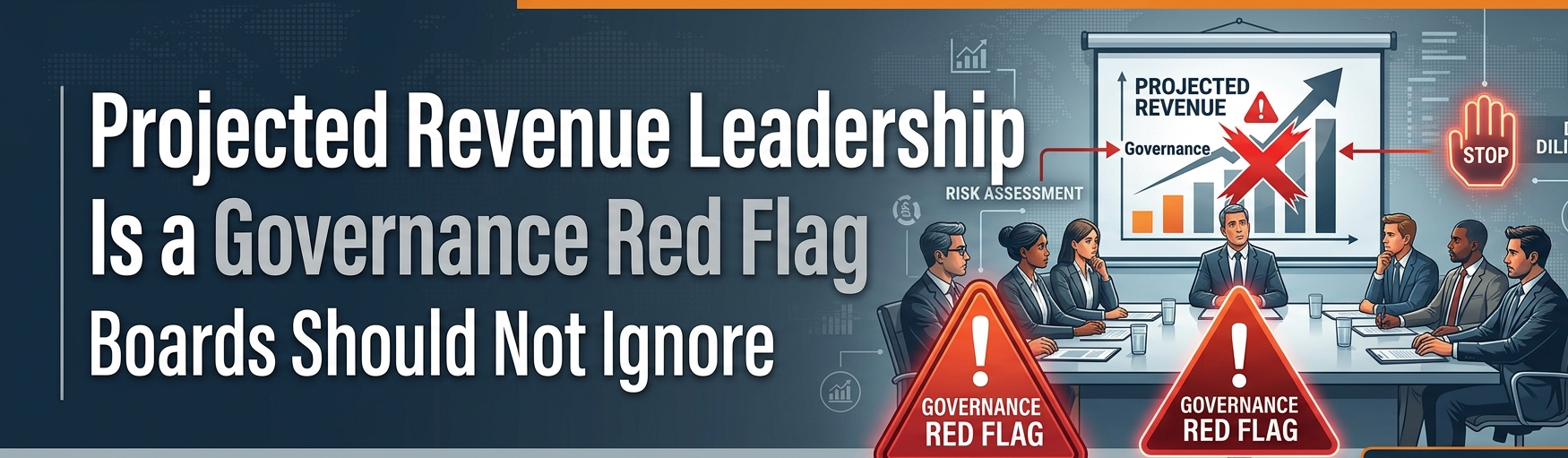
Projected Revenue Leadership is becoming one of the most significant governance vulnerabilities in modern enterprises when projections consistently outpace realized operational outcomes. Forecasting, strategic modeling, and future-oriented planning remain essential components of executive leadership. Markets reward future potential, investors evaluate long-range growth assumptions, and boards must assess strategic expansion opportunities. The governance problem emerges when projected revenue narratives begin substituting for measurable operational realization. Organizations gradually start emphasizing:
- pipeline expansion over conversion quality
- strategic positioning over execution consistency
- transformational language over operational outcomes
- future opportunity over present delivery discipline
At first, this often appears sophisticated. Executive communications become more polished, growth projections more ambitious, and market narratives more expansive. Yet beneath the strategic presentation layer, operational stress frequently begins accumulating:
- widening forecast variances
- delayed implementations
- declining conversion efficiency
- deteriorating escalation transparency
- increasing dependence on narrative framing
Boards that fail to distinguish between projected capability and realized capability eventually inherit accumulated operational fragility hidden beneath optimistic strategic signaling. The issue is not ambition. The issue is whether leadership maintains a repeatable realization engine capable of converting strategic claims into sustainable operational outcomes. Projection without realization discipline is rarely just a communication style. It is often an early governance indicator of deeper structural weakness.
Table of Contents
Introduction
Projected Revenue Leadership cultures often appear strategically sophisticated while concealing deep operational fragility beneath narrative momentum and future-oriented growth signaling. In modern executive environments, leadership teams are increasingly rewarded for communicating confidence, scale, market opportunity, and transformational ambition with narrative fluency. Those capabilities matter. But governance risk begins when organizations become more effective at explaining future success than operationally delivering present results. In many enterprises, leadership discussions gradually become dominated by:
- projected pipelines
- forward revenue assumptions
- market expansion narratives
- transformation roadmaps
- future positioning strategies
Meanwhile, realization metrics often receive materially less scrutiny:
- actual conversion rates
- implementation completion
- forecast accuracy
- profitability quality
- customer retention durability
- operational stability
This imbalance creates momentum internally and externally. Investors remain optimistic, employees remain aligned around growth narratives, and boards continue supporting strategic expansion. However, when future narratives repeatedly outpace realized execution, organizations can drift into operational unreal environments where protecting narrative continuity becomes institutionally easier than confronting execution variance. This transition rarely emerges through deliberate deception. More commonly, it develops incrementally through:
- optimistic forecasting assumptions
- capital market pressure
- incentive structures tied to growth signaling
- delayed escalation of operational problems
- selective metric framing
- leadership cultures that reward confidence more than transparency
The governance challenge is not forecasting itself. The governance challenge is whether projections remain anchored to measurable realization discipline. That distinction determines whether ambition evolves into sustainable growth or institutional distortion.
Projection Is Necessary, But Projection Cannot Replace Realization
No serious enterprise can operate without projections. Boards require forecasting to evaluate:
- capital allocation
- hiring plans
- market expansion
- infrastructure investment
- acquisition strategy
- product development priorities
Forecasting is not optional. But healthy organizations maintain disciplined separation between:
- projected value
- expected value
- realized value
Weak organizations gradually blur those distinctions. This matters because projected revenue possesses disproportionate psychological influence inside organizations.
| Projected growth | Realized growth |
| – Supports valuation narratives – Sustains investor patience – Reinforces executive credibility – Encourages expansion decisions – Influences hiring velocity | – Produces cash durability – Validates execution quality – Strengthens operational confidence – Improves strategic resilience – Confirms delivery capability |
One influences perception. The other determines institutional durability. Mature governance structures ensure projections support planning not substitute for evidence.
How Narrative-Centric Leadership Cultures Develop
Modern executive ecosystems increasingly reward narrative capability.
Leaders are expected to:
- inspire confidence
- communicate strategic ambition
- sustain market optimism
- articulate transformational vision
- defend future growth assumptions
These are legitimate leadership responsibilities. However, organizations become vulnerable when narrative capability evolves faster than operational capability. This creates what may be described as a narrative-centric leadership culture.
In such environments:
- presentation quality begins outweighing execution clarity
- strategic language becomes more sophisticated while delivery discipline weakens
- unfavorable operational realities surface later and later
- leadership teams prioritize preserving confidence over exposing friction
The shift is subtle at first.
Quarterly misses become:
- “timing related”
- “temporary execution friction”
- “market-adjusted”
- “part of long-term transformation sequencing”
Repeatedly re-framing operational underperformance through narrative language creates institutional normalization of unrealized outcomes. Over time, the organization begins protecting the projection rather than confronting the variance. That is where governance risk accelerates.
The Incentive Structures Behind Projection Dependency
Projection heavy leadership cultures rarely emerge randomly. They are often reinforced structurally through incentives. For example:
1. Capital Market Pressure – Public companies operate under continuous expectation pressure. Leadership teams may feel compelled to sustain aggressive growth narratives to:
- preserve valuation multiples
- support market confidence
- avoid negative analyst sentiment
- maintain acquisition leverage
Under those conditions, optimistic forecasting gradually becomes institutionally rewarded.
2. Executive Compensation Design – In some organizations, executive compensation becomes disproportionately linked to: expansion signaling, pipeline growth, market share narratives, strategic announcements, and rather than realization quality, operational durability, forecast accuracy, and delivery consistency.
When incentives reward future storytelling more than realized outcomes, projection inflation becomes structurally predictable.
3. Internal Political Dynamics – Inside large enterprises, upward communication often becomes filtered. Middle management may avoid escalating operational problems early because:
- optimism is culturally rewarded
- negative escalation carries political risk
- leadership narratives appear institutionally protected
As a result: bad news arrives late, operational variance compounds quietly, and reporting integrity weakens gradually.
Boards frequently see the polished version long before they see the operational reality.
The Realization Deficit Boards Must Monitor
One of the most important governance responsibilities is monitoring the gap between: strategic claims, forecast assumptions, operational delivery, and realized outcomes. This can be described as the realization deficit. The larger and more persistent the realization deficit becomes, the greater the probability of underlying structural weakness. Several indicators typically emerge early.
1. Persistent Pipeline Inflation
Leadership repeatedly emphasizes: strong future demand, robust opportunities, expanding pipeline coverage, yet realized conversion remains inconsistent. This often indicates weak qualification discipline, inflated probability assumptions, unrealistic sales expectations, and poor operational readiness. Pipeline volume alone has limited governance value unless conversion quality remains measurable and historically validated.
2. KPI Substitution
Organizations gradually shift attention away from hard operational metrics toward softer proxy indicators. Instead of emphasizing on realized revenue, customer retention, margin stability, implementation completion, and operational uptime leadership discussions increasingly prioritize on engagement, strategic alignment, ecosystem participation, transformation readiness, future enablement. Remember proxy indicators can provide useful context. But when they systematically displace realization metrics, boards should intensify scrutiny.
3. Endless Transformation Narratives
Transformation becomes continuous but rarely conclusive. Organizations repeatedly describe themselves as modernizing, repositioning, evolving, digitizing, and restructuring without demonstrating measurable operational stabilization. Healthy transformation produces increasing execution clarity over time. Weak transformation cultures produce permanent transition states. At that point, transformation language becomes institutional postponement rather than operational progress.
4. Forecasting Without Variance Accountability
Strong organizations examine forecast accuracy rigorously. Weak organizations continuously produce new forecasts without deeply analyzing prior forecasting failures. Boards should routinely ask:
- What percentage of prior projections materialized?
- Which assumptions failed repeatedly?
- Which operational dependencies were underestimated?
- Why did forecast variance recur?
Without variance accountability, forecasting gradually shifts from planning discipline to narrative maintenance.
The Internal Damage Begins Earlier Than Boards Realize
Projection heavy environments often create internal deterioration long before financial distress becomes externally visible. High performing operational teams usually detect narrative execution gaps early. When employees repeatedly observe:
- ambitious promises without delivery closure
- unrealistic timelines
- selective reporting
- recurring forecast misses
Organizational trust begins weakening. The consequences are cumulative:
- escalation honesty declines
- execution energy deteriorates
- internal cynicism rises
- talent retention weakens
- cross-functional coordination suffers
The most dangerous outcome is not immediate underperformance. It is institutional disbelief. Once teams stop believing leadership narratives internally, execution quality begins degrading structurally.
Organizations can recover from operational setbacks. Recovering from systemic credibility erosion is far more difficult.
Questions Boards Should Ask More Aggressively
Boards do not require operational omniscience to identify realization risk. But they do require disciplined inquiry. Critical questions include:
| Forecast Integrity | 1. How accurate have historical forecasts been? 2. What percentage of projected revenue materialized? 3. Which assumptions repeatedly failed? |
| Execution Discipline | 1. Which strategic initiatives delivered measurable outcomes? 2. Which programs remain perpetually “in progress”? 3. Where do realization delays consistently occur? |
| Reporting Transparency | 1. Are unfavorable variances surfaced early? 2. Is operational friction discussed openly? 3. Are metrics selectively framed? |
| Incentive Alignment | 1. Does executive compensation reward realization quality? 2. Are leaders incentivized for sustainable delivery or narrative expansion? 3. Can operational teams challenge projections safely? |
| Organizational Trust | 1. Do frontline teams trust executive forecasts? 2. Is escalation culturally safe? 3. Are uncomfortable operational truths politically acceptable internally? |
Boards that fail to ask realization-oriented questions often encounter realization-oriented crises later.
Vision Versus Institutional Delusion
Every successful organization requires vision. But vision without realization discipline eventually becomes institutional distortion. The distinction is operationally observable.
| Visionary Leadership | Delusional Leadership |
| Acknowledges execution constraints | Minimizes operational friction |
| Examines forecasting errors honestly | Recycles optimistic assumptions |
| Encourages truth escalation | Protects narrative continuity |
| Measures realization rigorously | Prioritizes expectation management |
| Balances ambition with delivery | Confuses aspiration with capability |
The issue is not optimism. The issue is optimism disconnected from measurable operational conversion. Eventually markets detect the gap, employees experience the gap, customers absorb the consequences, and boards confront accumulated variance. The only uncertainty is timing.
Reflection
Organizations rarely fail because they lacked projections. Many fail because leadership became increasingly dependent on projections while realization discipline weakened beneath the surface. Boards exist not merely to endorse strategic ambition, but to protect institutional integrity from accumulated operational unreality.
When leadership communicates more fluently about future revenue than realized execution, governance attention should intensify immediately. Because sustained projection dependency is often symptomatic of:
- weak execution infrastructure
- distorted incentive systems
- fragile reporting cultures
- delayed operational escalation
- strategic over extension
- leadership avoidance of uncomfortable variance
Operational truth eventually arrives in every enterprise. The strategic difference lies in whether organizations confront reality early through disciplined governance or encounter it later through financial, operational, or reputational crisis.
Disclaimer: This article provides strategic, operational, and governance-oriented analysis intended solely for educational and leadership discussion purposes. It does not constitute legal, financial, accounting, investment, fiduciary, regulatory, or organizational advisory guidance. Enterprise conditions vary materially across industries, ownership structures, regulatory environments, and market cycles. Readers should apply independent judgment and consult appropriately qualified professionals before making governance, financial, operational, or investment decisions.