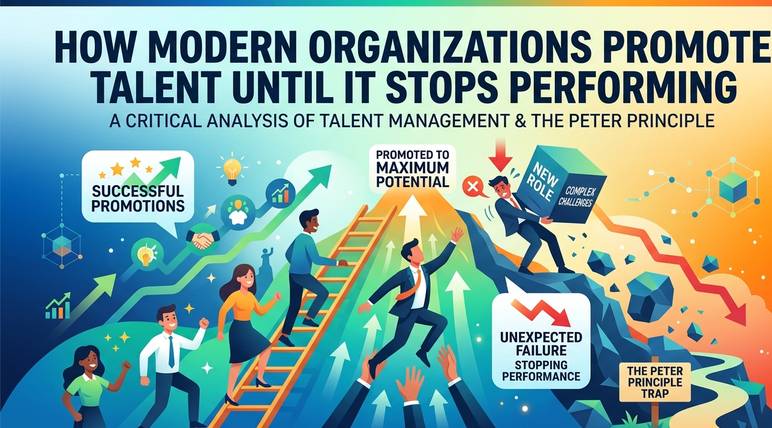
The Peter Principle describes a deceptively simple phenomenon: individuals in a hierarchy tend to rise to their level of incompetence. In isolation, this sounds like an observational insight. In reality, it is a systemic design flaw embedded in how most organizations evaluate, reward, and promote talent.
In high-growth sectors such as global payments and fintech, where execution speed and innovation cycles are compressed, this flaw becomes amplified. Organizations often equate delivery excellence in a current role with readiness for the next level of leadership. This assumption is not just flawed, it is operationally dangerous. Because leadership is not a continuation of execution. It is a fundamentally different discipline. And when organizations fail to recognize this distinction, they begin to accumulate a specific type of risk: Leadership capability debt.
Read more: The Peter Principle Trap: How Modern Organizations Promote Talent Until It Stops Performing
Table of Contents
Executive Summary
The Peter Principle is not a theoretical anomaly, it is a structural inevitability in modern organizations that lack disciplined leadership validation systems. As enterprises scale across global payments, fintech, and banking automation, promotion frameworks continue to reward past performance rather than future capability. This creates a silent but compounding risk: individuals are elevated into roles where their competence no longer matches the complexity of execution required.
The result is not immediate failure, it is gradual organizational drag. Decision latency increases, strategic clarity erodes, execution quality declines, and high-performing teams lose alignment. The most dangerous aspect is that these failures are often misdiagnosed as market conditions, talent shortages, or operational complexity.
This article dissects why high performers frequently fail in leadership roles, how promotion systems unintentionally institutionalize inefficiency, and why capability validation, not tenure or performance history, must become the cornerstone of sustainable leadership pipelines.
It ultimately re-frames a critical leadership question:
Are the right people actually leading the organization or simply the most recently successful ones?
Promotion Systems Are Designed for Fairness – Not Accuracy
Most promotion frameworks are built around three primary signals:
- Historical performance
- Tenure and consistency
- Stakeholder visibility
These signals create a perception of fairness and objectivity. However, they fail to answer the only question that truly matters: Can this individual operate effectively at the next level of complexity?
The gap emerges because: Performance is retrospective and Leadership capability is predictive
This mismatch leads to a structural distortion:
- High performers are promoted based on what they have done
- Leadership roles require capability in what they have never done before
In global payments organizations, for example, a top-performing sales leader may excel in closing enterprise deals. But when promoted to a regional leadership role, the expectation shifts to: Pipeline architecture design, Multi-market strategy alignment, Cross-functional orchestration, and Talent development and coaching. These are not incremental extensions of prior skills, they are entirely different competencies. Without explicit validation of these capabilities, promotion becomes a gamble disguised as meritocracy.
The High Performer Fallacy
One of the most persistent myths in organizational design is this: “Our best individual contributors will become our best leaders.” This assumption fails because it ignores the fundamental shift in value creation between roles.
| Individual Contributor Value Model | Leadership Value Model |
| Output-driven Skill-specific Measurable in isolation Direct control over outcomes | Outcome-driven through others System-level thinking Dependent on influence, not control Measured through indirect impact |
When high performers are promoted without recalibration, three failure patterns typically emerge:
1. Execution Substitution: Leaders continue to operate as individual contributors, stepping into deals, solving problems directly, and bypassing team capability development.
Short-term impact: performance stability
Long-term impact: team dependency and scalability failure
2. Decision Paralysis: New leaders lack frameworks for ambiguity and begin to delay decisions or over-rely on consensus.
Short-term impact: perceived thoroughness
Long-term impact: organizational slowdown
3. Control Inflation: Leaders compensate for uncertainty by increasing oversight, creating unnecessary reporting layers and approval processes.
Short-term impact: perceived governance
Long-term impact: innovation suppression and morale decline
These are not personality issues. They are capability mismatches created by flawed promotion logic.
The Hidden Cost – Organizational Drag
The Peter Principle does not create immediate failure. It creates gradual inefficiency that compounds over time. This is why it often goes undetected.
Key Indicators of Peter Principle Impact: Increasing decision cycles despite stable team size, High performer attrition under specific leaders, Rework loops and misaligned execution, Over-reliance on a few “anchor performers”, and Leadership meetings focused on operational detail instead of strategy.
In fintech environments where margins are pressured and competition is intense, these inefficiencies translate directly into: Slower product launches, Missed market opportunities, Reduced revenue velocity, and Increased operational cost. What appears externally as “market pressure” is often internally driven by misaligned leadership capability.
Why Organizations Continue to Fall Into the Trap?
Despite its predictability, the Peter Principle persists because it is reinforced by organizational incentives.
1. Promotion as a Retention Tool: Organizations promote high performers to prevent attrition, even when leadership readiness is unproven. Result: Retention of individuals, degradation of leadership quality
2. Lack of Alternative Growth Paths: Without strong individual contributor career tracks, promotion becomes the only visible path to progression. Result: Leadership roles filled by default, not design.
3. Absence of Capability Frameworks: Most organizations lack clearly defined leadership competency models tied to role complexity. Result: Subjective promotion decisions
4. Cultural Bias Toward Upward Mobility: There is an implicit belief that career success equals hierarchical progression. Result: Misalignment between aspiration and capability.
These factors create a reinforcing loop where: Promotion decisions are made under pressure, Capability gaps are normalized, and Organizational inefficiency becomes systemic.
Capability Validation – The Missing Discipline
To break the Peter Principle cycle, organizations must shift from promotion by performance to promotion by validated capability. This requires a structural redesign of leadership pipelines.
1. Define Leadership as a Distinct Skill Set: Leadership roles must be treated as new professions, not extensions of existing roles. This includes explicit evaluation of:
- Strategic thinking
- Decision-making under ambiguity
- Talent development capability
- Cross-functional influence
2. Introduce Pre-Promotion Simulation Models: Before formal promotion, individuals should operate in controlled environments that simulate next-level complexity. Examples: Acting leadership roles, Cross-functional project ownership, and Market expansion initiatives. This shifts promotion from assumption to evidence-based validation.
3. Separate Recognition from Promotion: High performance should be rewarded independently of leadership progression. Mechanisms include: Compensation acceleration, Specialist career tracks, and Enterprise-level recognition frameworks. This prevents forced promotions driven by retention concerns.
4. Implement Post-Promotion Stabilization Windows: The first 6-12 months post-promotion should be treated as a validation phase, not a confirmation of success. Key components: Structured coaching, Defined performance metrics aligned to leadership outcomes, and Early intervention mechanisms.
Leadership Pipelines as Revenue Infrastructure
In global payments and fintech, leadership quality is not a cultural variable, it is a revenue determinant. Strong leadership pipelines enable: Faster go-to-market execution, Better cross-regional coordination, Higher team productivity, and Lower attrition of critical talent.
Conversely, weak pipelines introduce: Execution friction, Strategic misalignment, and Revenue leakage. This re-frames leadership development from HR function to core business infrastructure. Organizations that fail to operationalize this distinction will continue to experience: growth volatility despite strong market positioning
The Strategic Leadership Question
At its core, the Peter Principle forces a fundamental reassessment of organizational design.
Not: Are we hiring the best talent? Are we rewarding performance effectively?
But: Are we placing individuals in roles where they can consistently succeed at the required level of complexity?
Because misalignment at leadership levels does not remain isolated. It cascades: Into team performance, Into operational efficiency, Into customer outcomes, and Into revenue predictability.
Structural Integrity Determines Organizational Outcomes
The Peter Principle is not a critique of individuals. It is a critique of systems. High performers do not fail because they lack capability. They fail because they are placed in roles that demand different capabilities without preparation or validation. Organizations that continue to rely on traditional promotion models will face an unavoidable trajectory: Increasing leadership inconsistency, Compounding inefficiency, and Erosion of execution excellence.
Those that evolve will recognize a critical truth: Leadership is not the reward for performance, it is the responsibility of capability. And capability must be proven, not assumed.
Disclaimer: This content reflects strategic perspectives on leadership and organizational design, not universal prescriptions. Outcomes will vary based on organizational context, execution maturity, and market conditions.